German adjective endings are one of the most confusing topics for learners. Unlike English adjectives, German adjectives change their endings depending on:
This system allows German adjectives to provide important grammatical information about the nouns they describe.
The good news is that German adjective endings follow predictable patterns. Once you understand the three main situations, strong, weak, and mixed endings, the system becomes much easier to master.
This guide explains German adjective endings step by step, with clear tables and examples for every situation.
What Are German Adjective Endings?
German adjectives usually appear before a noun and take an ending that matches the grammatical structure of the sentence.
Example:
Der große Hund läuft schnell.
The big dog runs fast.
Here:
- groß = adjective root
- große = adjective + ending
The ending -e reflects the grammatical role of the noun.
When Do Adjective Endings Change?
Adjective endings appear when the adjective comes before a noun.
Adjective after a verb (no ending)
Der Hund ist groß.
The dog is big.
Das Haus ist alt.
The house is old.
The good news? No adjective ending is added.
Adjective before a noun (ending required)
Der große Hund
The big dog
Das alte Haus
The old house
Here, the adjective must change its ending.
What Affects German Adjective Endings?
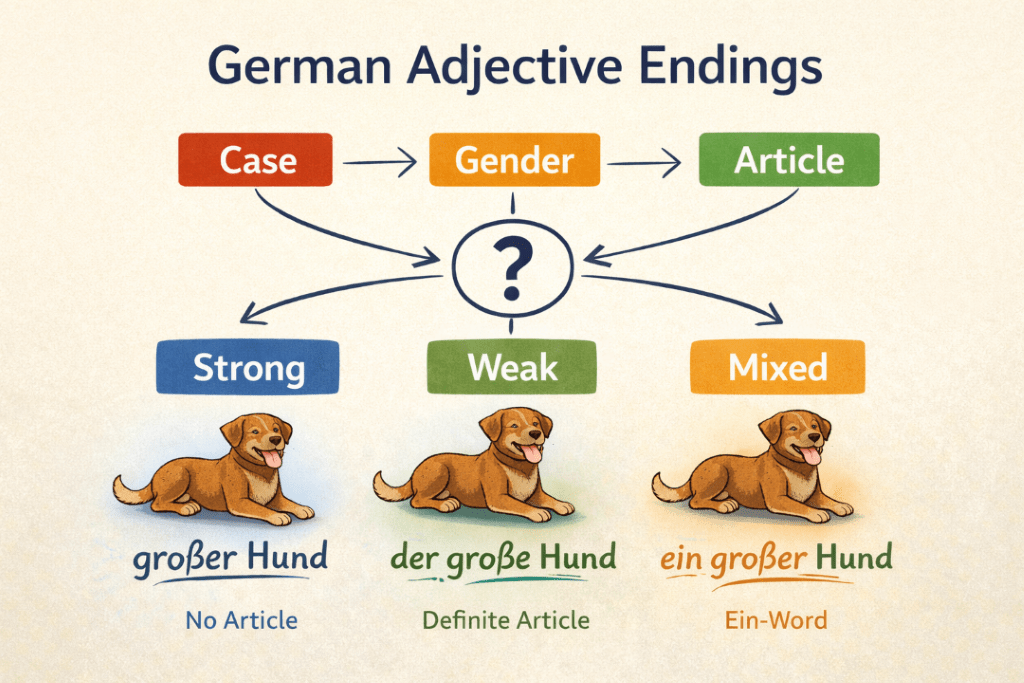
German adjective endings change based on case, gender, and article. That means the ending can shift depending on whether the noun is in the nominative, accusative, or dative case, whether it is masculine, feminine, or neuter, and whether it follows der, die, das, ein, eine, or no article at all.
1. The case
The noun’s role in the sentence changes the adjective ending. The most important cases for beginners are:
- Nominative — the subject of the sentence
- Accusative — the direct object
- Dative — the indirect object or the object after certain prepositions
Example:
Der große Hund schläft.
The big dog is sleeping.
→ nominative
Ich sehe den großen Hund.
I see the big dog.
→ accusative
Ich spiele mit dem großen Hund.
I play with the big dog.
→ dative
2. The gender
German nouns can be:
- masculine
- feminine
- neuter
The gender of the noun affects both the article and the adjective ending.
3. The article
The type of article in front of the adjective also matters.
- definite article: der, die, das
- indefinite article: ein, eine
- no article at all
Because of this, the same adjective can take different endings depending on the sentence.
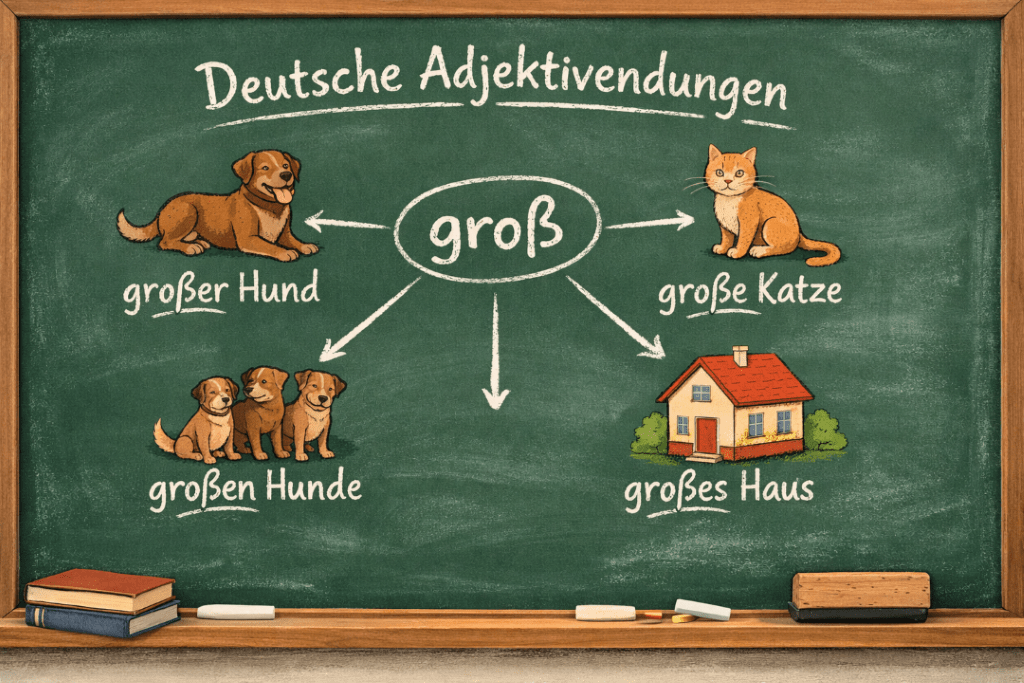
For example, the adjective groß changes like this:
- der große Hund
- den großen Hund
- großem Hund
The Three Types of German Adjective Endings
German adjective endings fall into three categories.
| Type | When It Is Used |
| Strong endings | When no article appears before the adjective |
| Weak endings | When a definite article (der, die, das) appears |
| Mixed endings | When an indefinite article (ein, eine) appears |
Each system follows its own pattern.
Strong Adjective Endings
Strong endings occur when the adjective appears without an article.
Example:
Großer Hund
big dog
In this case, the adjective carries the full grammatical information.
Strong Endings Table
| Case | Masculine | Feminine | Neuter | Plural |
| Nominative | -er | -e | -es | -e |
| Accusative | -en | -e | -es | -e |
| Dative | -em | -er | -em | -en |
| Genitive | -en | -er | -en | -er |
Weak Adjective Endings
Weak endings occur when the adjective follows a definite article.
Definite articles already contain grammatical information, so the adjective endings become simpler.
Articles include:
- der
- die
- das
- den
- dem
- des
Weak Endings Table
| Case | Masculine | Feminine | Neuter | Plural |
| Nominative | -e | -e | -e | -en |
| Accusative | -en | -e | -e | -en |
| Dative | -en | -en | -en | -en |
| Genitive | -en | -en | -en | -en |
Examples
Der große Hund
The big dog
Die schöne Stadt
The beautiful city
Das kleine Haus
The small house
Die großen Autos
The big cars
Mixed Adjective Endings
Mixed endings occur with indefinite articles such as:
- ein
- eine
- einen
- einem
- einer
These articles provide some grammatical information, but not all.
The adjective therefore combines elements of strong and weak endings.
Mixed Endings Table
| Case | Masculine | Feminine | Neuter | Plural |
| Nominative | -er | -e | -es | -en |
| Accusative | -en | -e | -es | -en |
| Dative | -en | -en | -en | -en |
| Genitive | -en | -en | -en | -en |
Examples
Ein großer Hund
A big dog
Eine schöne Stadt
A beautiful city
Ein kleines Haus
A small house
Keine großen Probleme
No big problems
Comparing German Adjective Endings
The following chart compares strong, weak, and mixed adjective endings across the three most common German cases.
This allows you to see how endings change depending on:
- case
- gender
- article type
Nominative Case
| Gender | No Article (Strong) | Definite Article (Weak) | Indefinite Article (Mixed) |
| Masculine | großer Hund | der große Hund | ein großer Hund |
| Feminine | große Katze | die große Katze | eine große Katze |
| Neuter | großes Haus | das große Haus | ein großes Haus |
| Plural | große Häuser | die großen Häuser | keine großen Häuser |
Example:
der große Hund
the big dog
ein großer Hund
a big dog
großer Hund
big dog
Accusative Case
| Gender | No Article (Strong) | Definite Article (Weak) | Indefinite Article (Mixed) |
| Masculine | großen Hund | den großen Hund | einen großen Hund |
| Feminine | große Katze | die große Katze | eine große Katze |
| Neuter | großes Haus | das große Haus | ein großes Haus |
| Plural | große Häuser | die großen Häuser | keine großen Häuser |
Example:
Ich sehe den großen Hund.
I see the big dog.
Dative Case
| Gender | No Article (Strong) | Definite Article (Weak) | Indefinite Article (Mixed) |
| Masculine | großem Hund | dem großen Hund | einem großen Hund |
| Feminine | großer Katze | der großen Katze | einer großen Katze |
| Neuter | großem Haus | dem großen Haus | einem großen Haus |
| Plural | großen Häusern | den großen Häusern | keinen großen Häusern |
Example:
Ich spiele mit dem großen Hund.
I play with the big dog.
Genitive Case
| Gender | No Article (Strong) | Definite Article (Weak) | Indefinite Article (Mixed) |
| Masculine | großen Hundes | des großen Hundes | eines großen Hundes |
| Feminine | großer Katze | der großen Katze | einer großen Katze |
| Neuter | großen Hauses | des großen Hauses | eines großen Hauses |
| Plural | großer Häuser | der großen Häuser | keiner großen Häuser |
Example:
Die Farbe des großen Hauses
The color of the big house
The Pattern You Should Notice
Several patterns appear throughout the system:
1. Weak endings are the simplest
After der, die, das, adjectives usually end in:
-e or -en
Examples:
- der große Hund
- die schöne Stadt
- das kleine Haus
2. Strong endings resemble article endings
When no article appears, the adjective must carry the grammatical information.
Examples:
- großer Hund
- großes Haus
- großer Mann
3. Mixed endings combine both systems
With ein / eine, the adjective sometimes carries grammatical information.
Examples:
- ein großer Hund
- eine schöne Stadt
- ein kleines Haus
German Adjective Endings Master Table
| Case | Ending Type | Masculine | Feminine | Neuter | Plural |
| Nominative | Strong | -er | -e | -es | -e |
| Weak | -e | -e | -e | -en | |
| Mixed | -er | -e | -es | -en | |
| Accusative | Strong | -en | -e | -es | -e |
| Weak | -en | -e | -e | -en | |
| Mixed | -en | -e | -es | -en | |
| Dative | Strong | -em | -er | -em | -en |
| Weak | -en | -en | -en | -en | |
| Mixed | -en | -en | -en | -en | |
| Genitive | Strong | -en | -er | -en | -er |
| Weak | -en | -en | -en | -en | |
| Mixed | -en | -en | -en | -en |
Why German Uses Adjective Endings
German developed this system because word order is flexible. Adjective endings help identify the grammatical role of nouns even when sentence structure changes.
Example:
Der große Hund beißt den Mann.
Den Mann beißt der große Hund.
The big dog bites the man.
Because of the endings, German speakers can still identify the subject and object clearly.
Summary: German Adjective Endings Explained
German adjective endings change depending on three factors:
- case (nominative, accusative, dative, or genitive)
- gender (masculine, feminine, neuter, or plural)
- article type (definite article, indefinite article, or no article)
Because of this, German uses three adjective ending systems:
Strong endings appear when no article is present. The adjective carries the grammatical information itself.
Weak endings appear after definite articles like der, die, and das. Since the article already shows gender and case, the adjective usually takes simple endings like -e or -en.
Mixed endings appear after indefinite articles such as ein, eine, kein, or mein. In these cases, the adjective sometimes provides additional grammatical information that the article does not.
Although the system may seem complex at first, it follows predictable patterns. Once you understand how case, gender, and article type work together, German adjective endings become much easier to recognize and use correctly.
With practice, these patterns will start to feel natural, allowing you to describe people, objects, and situations more precisely in German.