German Travel Vocabulary: Ultimate Guide for Public Transport
Travel in Germany can be smooth and stress‑free if you know German travel vocabulary. From buying tickets at the machine to asking for platform information, this guide covers everything you need for a confident journey on trains, buses and at airports. You will find essential vocabulary, useful phrases and sample dialogues that help you navigate Germany’s renowned transit system.

TIP: Use the audio to listen to a German speak the words and phrases aloud.
Who doesn’t love to travel! Talking about German travel vocabulary is so much fun and will prepare you for your first trip in a Germany!
A passion for everything travel may be what makes it one of the best places to start learning German vocabulary. That’s why I’ve assembled a Basic German Travel Vocabulary PDF for you to download for free.
Learn all the German names of travel and transportation to navigate your way around the world. Get 13 pages of flashcards with German travel vocabulary by downloading the printable pdf below.
Why German Travel Vocabulary Matters
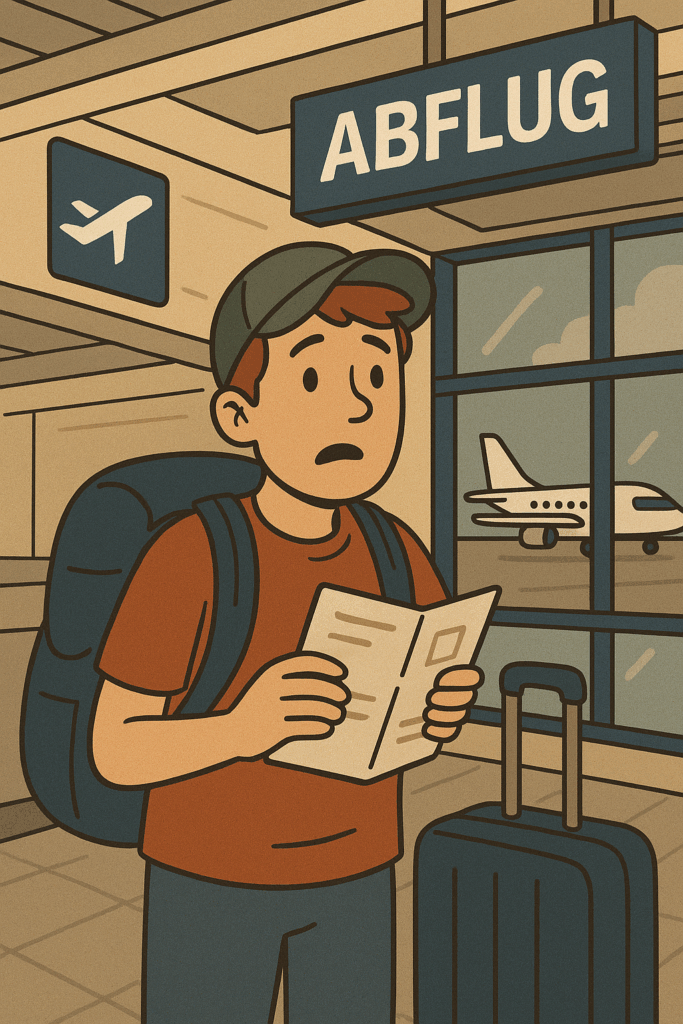
Germany’s network of trains, trams and buses is extensive, but it can be confusing without the right terminology. At the train station you might see announcements about an “Abfahrt” or need to find the correct “Gleis” for your ICE train. If you arrive at an airport, you will need to understand signs for “Sicherheitskontrolle” and “Gepäckausgabe.” Learning these words before you travel saves time, prevents misunderstandings and ensures you can ask for help when something goes wrong.
Basic Must-Know German Travel Vocabulary
Whether planning, traveling, or exploring, these words and phrases are essential for all stages of your trip—from departure to return.
Travel & Documents
German differentiates between der Ausweis which means ID card, and der Reisepass which means passport. Know what else is interesting? Germany was the first country in the world to introduce biometric passports back in 1986. That’s why the German term der Reisepass is so central.
| German | English |
| Reise | journey, trip |
| reisen (verb) | to travel |
| Urlaub | vacation |
| Reisender/Reisende | traveler (male/female) |
| Reiseziel | travel destination |
| Reisepass | passport |
| Visum | visa |
| Koffer | suitcase |
| Rucksack | backpack |
| Gepäck | luggage |
Common phrases:
- “Hier ist mein Reisepass.” – Here is my passport.
- “Brauche ich ein Visum für die Einreise?” – Do I need a visa to enter?
- “Der Zweck meiner Reise ist Urlaub / Studium / Arbeit.” – The purpose of my trip is vacation / study / work.
- “Wie lange darf ich in Deutschland bleiben?” – How long may I stay in Germany?
- “Ich habe nichts zu verzollen.” – I have nothing to declare.
- “Ich möchte meine Adresse anmelden.” – I would like to register my address.
- “Haben Sie meinen Ausweis dabei?” – Do you have my ID with you?
- “Hier ist meine Meldebescheinigung.” – Here is my registration certificate.
- “Wo finde ich das Bürgeramt?” – Where can I find the registration office?
- “Brauche ich eine beglaubigte Kopie?” – Do I need a certified copy?
- “Ich hätte gerne eine Fahrkarte nach Berlin.” – I would like a ticket to Berlin.
- “Ist das ein gültiges Ticket?” – Is this a valid ticket?
- “Muss ich das Ticket entwerten?” – Do I need to validate the ticket?
- “Wo kann ich eine BahnCard kaufen?” – Where can I buy a BahnCard?
- “Fahrscheine, bitte.” – Tickets, please. (what conductors say)
Accommodation
Hotels (Hotels) are common, but many Germans prefer smaller guesthouses (die Pension) or holiday apartments (die Ferienwohnung). Budget travellers often stay in Jugendherbergen (youth hostels), which require a Jugendherbergsausweis (hostel membership card).
| German | English |
| Hotel | hotel |
| Jugendherberge | youth hostel |
| Ferienwohnung | vacation apartment |
| Zimmer | room |
| Einzelzimmer | single room |
| Doppelzimmer | double room |
| Reservierung | reservation |
| Buchung | booking |
| Check‑in | check-in (noun) |
| Check‑out | check-out (noun) |
| Rezeption | reception desk |
Common phrases:
- “Ich möchte ein Zimmer reservieren.” – I would like to reserve a room.
- “Haben Sie ein Einzelzimmer / Doppelzimmer frei?” – Do you have a single / double room available?
- “Ist das Frühstück inbegriffen?” – Is breakfast included?
- “Wie viel kostet eine Nacht?” – How much is one night?
- “Gibt es WLAN im Zimmer?” – Is there Wi-Fi in the room?
- “Könnten Sie bitte das Zimmer sauber machen?” – Could you please clean the room?
- “Das Handtuch ist schmutzig. Könnte ich ein neues bekommen?” – The towel is dirty. Could I get a new one?
- “Gibt es eine Klimaanlage / Heizung im Zimmer?” – Is there air conditioning / heating in the room?
- “Die Dusche funktioniert nicht.” – The shower isn’t working.
- “Könnte ich bitte ein zusätzliches Kissen haben?” – Could I have an extra pillow, please?
- “Ich möchte auschecken.” – I would like to check out.
- “Könnte ich bitte die Rechnung bekommen?” – Could I please get the bill?
- “Akzeptieren Sie Kreditkarten?” – Do you accept credit cards?
- “Könnte ich mein Gepäck hier lassen?” – Could I leave my luggage here?
- “Vielen Dank für den Aufenthalt!” – Thank you for the stay!
Sightseeing & Directions
In German, sightseeing literally translates to Besichtigungen or Sehenswürdigkeiten anschauen. Many cities offer Stadtführungen (city tours) or Audioguides. Museums are often closed on Mondays in Germany. Popular spots charge Eintritt (admission fee), but churches and parks are free.
| German | English |
| Sehenswürdigkeit | attraction, sight |
| Stadtzentrum | city centre |
| Touristeninformation | tourist information |
| Weg | way, route |
| links / rechts / geradeaus | left/right/straight ahead |
| Entschuldigung, wo ist…? | Excuse me, where is…? |
| Ich habe mich verlaufen. | I am lost. |
| Wie komme ich zu…? | How do I get to…? |
| Wann fährt der nächste…? | When does the next… depart? |
Common phrases for sightseeing
- “Welche Sehenswürdigkeiten empfehlen Sie?” – Which sights do you recommend?
- “Wo ist die Altstadt?” – Where is the old town?
- “Gibt es hier ein berühmtes Schloss?” – Is there a famous castle here?
- “Kann man den Dom besichtigen?” – Can you visit the cathedral?
- “Wie viel kostet der Eintritt?” – How much is the entrance fee?
- “Gibt es eine Stadtführung?” – Is there a city tour?
- “Haben Sie einen Audioguide?” – Do you have an audio guide?
- “Wann sind die Öffnungszeiten?” – What are the opening hours?
- “Darf man hier fotografieren?” – Are you allowed to take photos here?
- “Wo ist das nächste Museum?” – Where is the nearest museum?
Common German phrases for giving and receiving directions
- “Entschuldigung, wie komme ich zum Bahnhof?” – Excuse me, how do I get to the train station?
- “Ist es weit von hier?” – Is it far from here?
- “Können Sie mir das auf der Karte zeigen?” – Can you show me on the map?
- “Geht man besser zu Fuß oder mit der U-Bahn?” – Is it better to walk or take the subway?
- “Welcher Bus fährt zum Flughafen?” – Which bus goes to the airport?
- “Gehen Sie geradeaus.” – Go straight ahead.
- “Biegen Sie links ab.” – Turn left.
- “Biegen Sie rechts ab.” – Turn right.
- “An der Ampel links.” – At the traffic light, turn left.
- “Die zweite Straße rechts.” – The second street on the right.
- “Es ist in der Nähe der Kirche.” – It’s near the church.
- “Es dauert etwa zehn Minuten zu Fuß.” – It takes about ten minutes on foot.
- “Fahren Sie mit der U-Bahn bis zum Alexanderplatz.” – Take the subway to Alexanderplatz.
Emergencies & Help
Germans take safety seriously: you’ll always find Notausgänge (emergency exits) and Feuerlöscher (fire extinguishers) clearly marked. The emergency number in Germany is 112 (for ambulance and fire) and 110 (for police).
| German | English |
| der Unfall | the accident |
| der Notarzt | the emergency doctor |
| das Krankenhaus | the hospital |
| die Polizei | the police |
| die Notaufnahme | the emergency room |
| die Feuerwehr | the fire department |
Common phrases:
- Hilfe, bitte! – Help, please!
- “Ich brauche einen Arzt.” – I need a doctor.
- “Rufen Sie die Polizei!” – Call the police!
- “Es ist ein Notfall.” – It’s an emergency.
German Travel Vocabulary: Modes of Transportation
In Germany, public transport is highly developed, and knowing the right words makes travel much easier. The main modes of transportation you’ll encounter are:
| German | English |
| der Zug | train |
| die S‑Bahn | suburban train |
| die U‑Bahn | subway |
| der Bus | bus |
| die Straßenbahn | tram |
| das Taxi | taxi |
| das Flugzeug | airplane |
| der Bahnhof | train station |
| der Flughafen | airport |
| das Fahrrad | bicycle |
Tip: ICE stands for InterCityExpress—Germany’s fastest long‑distance train.
German Transportation Phrases
- “Wo ist der nächste Bahnhof?” – Where is the nearest train station?
- “Ich brauche eine Fahrkarte nach München.” – I need a ticket to Munich.
- “Fährt dieser Zug direkt?” – Does this train go directly?
- “Muss ich umsteigen?” – Do I need to change trains?
- “Der Zug hat Verspätung.” – The train is delayed.
- “Wo ist die nächste Haltestelle?” – Where is the nearest stop?
- “Hält dieser Bus am Marktplatz?” – Does this bus stop at the marketplace?
- “Wann fährt die nächste Straßenbahn?” – When does the next tram leave?
- “Wie viele Stationen sind es bis zum Zentrum?” – How many stops is it to the city center?
- “Könnten Sie mich bitte zum Flughafen fahren?” – Could you please drive me to the airport?
- “Wie viel kostet die Fahrt?” – How much does the ride cost?
- “Können Sie bitte hier anhalten?” – Could you stop here, please?
- “Wo kann ich ein Auto mieten?” – Where can I rent a car?
- “Kann ich hier ein Fahrrad ausleihen?” – Can I rent a bicycle here?
- “Gibt es einen Radweg bis zum Schloss?” – Is there a bike path to the castle?
- “Wo kann ich mein Fahrrad abstellen?” – Where can I park my bike?
German Train Station Vocabulary
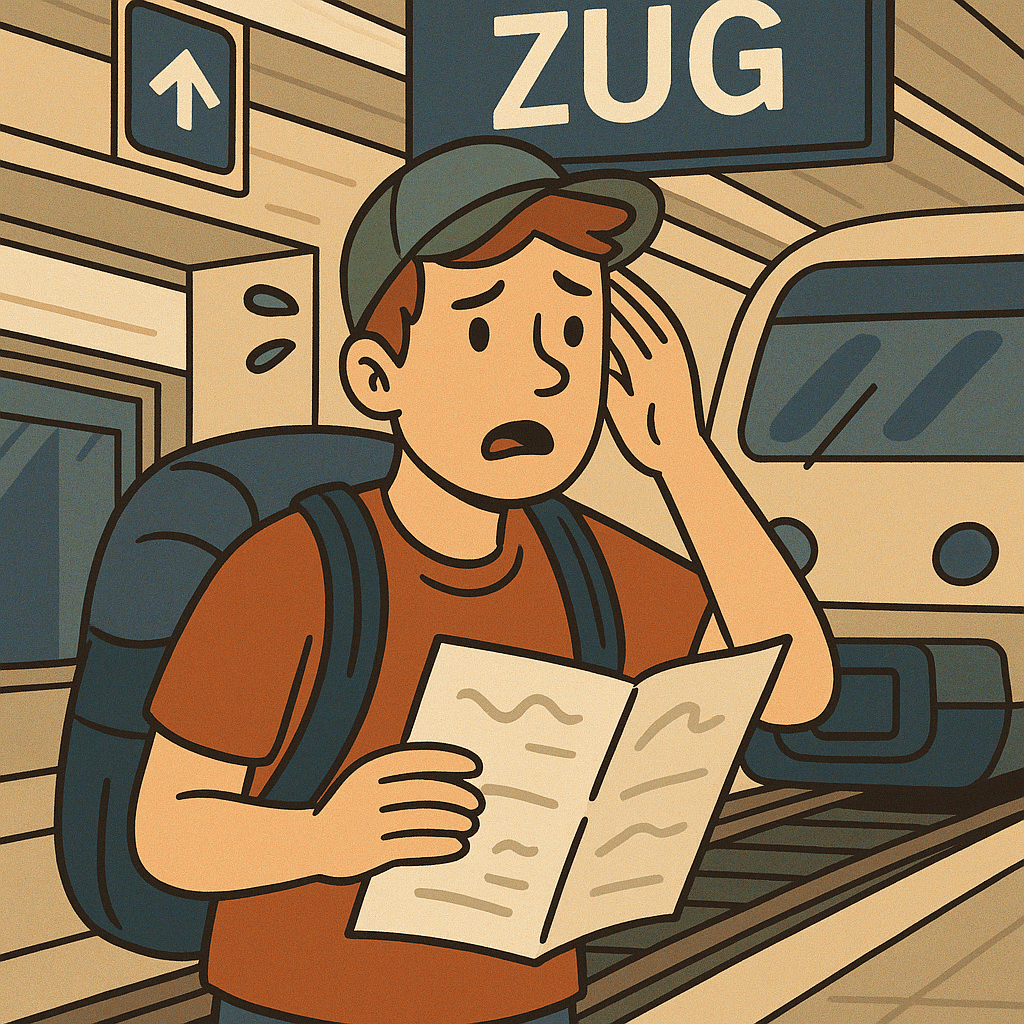
Major stations (Hauptbahnhöfe) aren’t just for trains. Inside you’ll find supermarkets, bakeries, pharmacies, bookstores, fast food, even clothing shops. Germans have a reputation for punctuality, but Deutsche Bahn trains are often late. A 5–15 minute delay is very common. That said, local S-Bahn and U-Bahn trains within cities tend to run more reliably.
| German | English |
| der Bahnhof | train station |
| das Gleis (Bahnsteig) | platform |
| die Abfahrt/Ankunft | departure / arrival |
| der Fahrplan | timetable display |
| der Fahrkartenautomat | ticket vending machine |
| der Schalter | ticket counter |
| der Informationsschalter | info desk |
| die Gepäckaufbewahrung | luggage storage |
| der Ausgang | exit |
| der Eingang | entrance |
| die Umsteigemöglichkeit | transfer option |
Platforms (Gleis) are usually marked by number, and the signs clearly show where each train car will stop (sections A, B, C, etc.). Long-distance trains (ICE, IC) have specific car numbers — if you have a seat reservation, you’ll need to stand in the right section of the platform.
Unlike in the U.S., there are no ticket barriers. You just walk onto the platform. But inspectors (Kontrolleure) do random checks on board. Traveling without a ticket (Schwarzfahren) is a criminal offense and comes with a hefty fine (~€60+).
Station Infrastructure & Layout
Stations are busy public spaces, especially in cities like Berlin, Frankfurt, or Cologne. Pickpocketing can be an issue — keep valuables secure. However, stations are well-lit, patrolled, and generally safe even late at night compared to many U.S. stations.
| German | English | Notes |
| Hauptbahnhof (Hbf) | main central station | E.g., Berlin Hbf, Hamburg Hbf – major transit hubs |
| Haltepunkt (Hp) | halt/stop (small station) | No switches or sidings |
| Bahnsteig | platform (where passengers wait) | Can serve multiple tracks on both sides |
| Abfahrtstafel / Ankunftstafel | departure board / arrival board | Displays live train schedules |
| Anzeigetafel | display board | General display of service info |
| Wartesaal | waiting room / lounge | May have seating and shops |
| Kofferkuli | luggage trolley | Enables easy luggage transport |
| Informationsschalter | information desk | Great for help and details |
| Bahnhofsvorsteher | station master | Rarely seen, but part of staff |
Be prepared: if there’s a delay, announcements may only be in German, and spoken very quickly. Screens (Anzeigetafeln) are often clearer.
German Train Types & Their Uses
Germany’s train system is layered, with different types of trains serving different distances and purposes. At the top are the long-distance trains, known as Fernverkehr. The fastest and most famous is the ICE (InterCity Express), which can reach speeds of up to 300 km/h (about 186 mph). These trains connect major German cities such as Berlin, Frankfurt, Munich, and Hamburg, and travel internationally to Paris, Brussels, and Amsterdam.
ICE trains are comfortable, with Wi-Fi, power outlets, and restaurant cars. Slightly slower but still convenient are the IC (InterCity) and EC (EuroCity) trains. These run both within Germany and across borders to nearby countries, usually at a lower price than ICE, but with longer travel times.
- ICE: high-speed trains between major cities
- IC/EC: long-distance but slower than ICE
- RE: regional express for medium distances
- RB: local trains, frequent stops
- Nahverkehrszug: local/regional train
- Hochgeschwindigkeitszug: high-speed train
- Schlafwagen: sleeper carriage
- Speisewagen: dining car
- Großraumwagen: open‑plan carriage
- Abteil: compartment
The RE (Regional-Express) is the faster option, connecting medium-sized cities and towns while skipping some smaller stops. The RB (RegionalBahn), by contrast, is the slowest option, stopping at nearly every station along its route.
The S-Bahn system bridges the gap between local and regional travel. Within the cities, you’ll find the U-Bahn and Straßenbahn. Buses fill in the gaps where no train or tram routes exist, and they are well-integrated with train schedules.
Common Passenger Verbs
- einsteigen – to get on
- aussteigen – to get off
- umsteigen – to transfer/change trains
- abfahren – to depart
- ankommen – to arrive
- buchen – to book
- reservieren – to reserve
- entwerten – to validate (ticket)
- kontrollieren – to check (tickets)
- warten – to wait
Examples:
- „Ich steige jetzt in den Zug ein.“ (I’m getting on the train now.)
- „Wir steigen in Berlin Hauptbahnhof aus.“ (We’re getting off at Berlin Central Station.)
- „In Frankfurt müssen wir in einen Regionalzug umsteigen.“ (In Frankfurt we have to transfer to a regional train.)
- „Der Zug fährt um 10:15 Uhr ab.“ (The train departs at 10:15 a.m.)
- „Wann kommt der Zug in München an?“ (When does the train arrive in Munich?)
- „Ich habe die Fahrkarte online gebucht.“ (I booked the ticket online.)
- „Möchten Sie einen Sitzplatz reservieren?“ (Would you like to reserve a seat?)
- „Vergessen Sie nicht, Ihr Ticket zu entwerten.“ (Don’t forget to validate your ticket.)
- „Der Schaffner kontrolliert die Fahrkarten.“ (The conductor is checking the tickets.)
- „Wir warten am Gleis 9.“ (We’re waiting at platform nine.)
Phrases & Questions at the German Train Station
- Wie komme ich zum Gleis 7? (How do I get to platform 7?)
- Ist dieser Zug pünktlich? (Is this train on time?)
- Welcher Zug fährt nach Hamburg? (Which train goes to Hamburg?)
- Wo kann ich die Fahrkarte entwerten? (Where can I validate the ticket?)
- Kann ich hier umsteigen? (Can I change here?)
- Wo ist der Informationsschalter? (Where is the information desk?)
- Gibt es WLAN am Bahnhof? (Is there Wi‑Fi at the station?)
- Wie viel kostet eine Sitzplatzreservierung? (How much is a seat reservation?)
German Airport Vocabulary
Whether flying in, out, or connecting at a German airport, these words and phrases will help you understand signs, talk to staff, and handle any situation, from check-in to baggage claim.
Common phrases
- „Gibt es einen Duty-Free-Shop?“ – Is there a duty-free shop?
- „Wo ist der Informationsschalter?“ – Where is the information desk?
- „Ich brauche Hilfe.“ – I need help.
- „Gibt es einen Notausgang hier?“ – Is there an emergency exit here?
Check-in & Ticketing
Airport employees rarely use small talk. Asking “Sprechen Sie Englisch?” is always helpful. Large airports like Frankfurt can require 45+ minutes to get from security to your next gate, so tight connections are riskier than in most U.S. airports.
| German | English |
| Check‑in‑Schalter | check‑in counter |
| Gepäckabgabe / Gepäckaufgabe | baggage drop-off |
| Bordkarte | boarding pass |
| Reiseziel | destination |
| Flugticket / Flugschein | plane ticket |
| Buchungsnummer | booking number |
| Direktflug | direct flight |
| Anschlussflug | connecting flight |
Common phrases:
- „Ich möchte einchecken.“ – I would like to check in.
- „Hier ist mein Reisepass und mein Ticket.“ – Here is my passport and ticket.
- „Haben Sie Gepäck aufzugeben?“ – Do you have luggage to check in?
- „Wie viel Gepäck darf ich mitnehmen?“ – How much luggage can I bring?
- „Kann ich einen Fensterplatz bekommen?“ – Can I get a window seat?
Security & Passport Control
Common phrases
- „Muss ich die Flüssigkeiten auspacken?“ – Do I have to take the liquids out?
- „Hier ist mein Ausweis / Reisepass.“ – Here is my ID / passport.
- „Wie lange darf ich bleiben?“ – How long am I allowed to stay?
- „Wo ist die Sicherheitskontrolle?“ – Where is the security check?
Boarding & Flight Information
| German | English |
| Gate / Flugsteig | boarding gate |
| Abflugzeit | departure time |
| Ankunftszeit | arrival time |
| Boarding / Einsteigen | boarding |
| Verspätet / verspäteter Flug | delayed / delayed flight |
| Gestrichen / annuliert | canceled |
| Letzter Aufruf | final call |
| Fluggast | passenger |
| Flugbegleiter/in | flight attendant |
| Pilot/in | pilot |
Common phrases
- „Wo ist das Gate für Flug 123?“ – Where is the gate for flight 123?
- „Wann beginnt das Boarding?“ – When does boarding begin?
- „Mein Flug ist verspätet.“ – My flight is delayed.
- „Kann ich meinen Sitzplatz wechseln?“ – Can I change my seat?
Baggage Claim and Loss
| German | English |
| Gepäckausgabe | baggage claim |
| Gepäckband | baggage carousel |
| Gepäckwagen | luggage trolley |
| Verlorenes Gepäck | lost luggage |
| Gepäckverlust | luggage loss |
| Sperrgepäck | oversized baggage |
Common phrases
- „Wo ist die Gepäckausgabe?“ – Where is the baggage claim?
- „Mein Koffer ist verloren gegangen.“ – My suitcase is lost.
- „Wo kann ich einen Koffer nachmelden?“ – Where can I report a lost suitcase?
Airport Services & Amenities
| German | English |
| Lounge | lounge |
| VIP‑Terminal | VIP Terminal |
| Besucherpark | visitor park / observation deck |
| Parkhaus | multi‑storey car park |
| Mietwagenzentrum | car hire centre |
| Busse / Taxi | buses / taxis |
| Haltepunkt | shuttle stop |
| Rolltreppe | escalator |
| Fahrstuhl / Aufzug | elevator |
German Bus Vocabulary
Infrastructure & Signage
| German | English | Notes and Usage |
| Bushaltestelle | bus stop | Common sign: green H inside yellow circle |
| Busbahnhof | bus station (hub) | For long-distance or connecting buses |
| Linie | route / line number | Appears on timetable/sign “Linie 5 – Richtung Stadtmitte” |
| Fahrplan | timetable/schedule | Shows weekday, Saturday, and Sunday times |
| Linienplan | route map | Displays full bus route and stops |
| Fahrkartenautomat | ticket machine | You’ll find these both at stations and some bus stops |
| Entwerter | ticket validator | Often needed to validate paper tickets on board or at stops |
| Bussteig | platform | Seen at major bus hubs like “Bussteig 3” |
| Bordsteinkante | curb edge | Roadside edge where the bus stops |
Boarding & Ticketing Tips
- Board through the front door in small towns so the driver can check your ticket. In larger cities, any door if your ticket is already valid.
- Raise your arm slightly or stand clearly visible at the stop so the bus driver knows you’re waiting
- Validate paper tickets using onboard Entwerter or before boarding to avoid fines
Common Ticket Types in Germany
| German | English |
| Fahrkarte | ticket |
| Einzelfahrschein | single-journey ticket |
| Tageskarte | day pass |
| Wochenkarte | weekly pass |
| Monatskarte | monthly pass |
| Rückfahrkarte | return ticket |
Phrases at the Bus Stop or on Board
- Wann kommt der nächste Bus Linie 10? – When does the next Bus 10 come?
- Fährt dieser Bus ins Stadtzentrum? – Does this bus go to the city center?
- Ist dieser Platz noch frei? – Is this seat free?
- Drücken Sie bitte die Haltewunschtaste. – Please press the stop request button.
- Kann ich hier mit Karte zahlen? – Can I pay by card here?
- Muss ich ein neues Ticket für den nächsten Bus kaufen? – Do I need a new ticket for the next bus?
- Haben Sie Vergünstigungen mit dem Monatsabo? – Do you have discounts with a monthly pass?
German Bus Etiquette & Rules
- Let others exit before boarding: “Erst aussteigen lassen”
- Offer seats to elderly, disabled, or pregnant passengers
- Remove backpacks or place them on your lap in crowded vehicles
- Keep voices down and avoid playing loud music
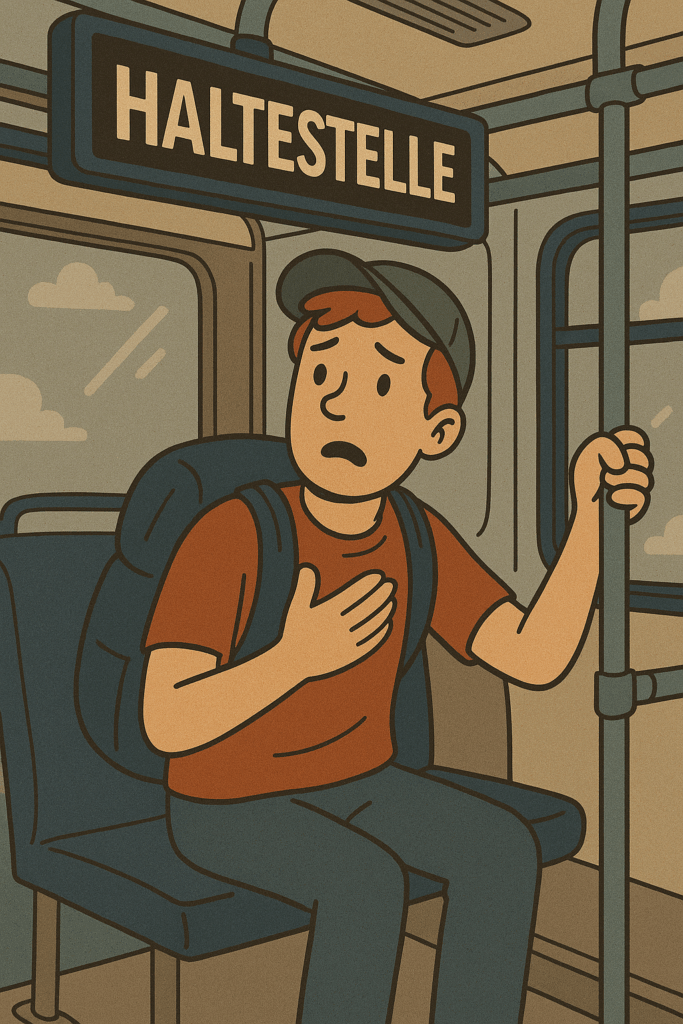
- Press the Haltewunschtaste before your stop—buses won’t always stop automatically
- Eating and drinking are usually discouraged; follow the pictograms onboard
German Taxi Vocabulary
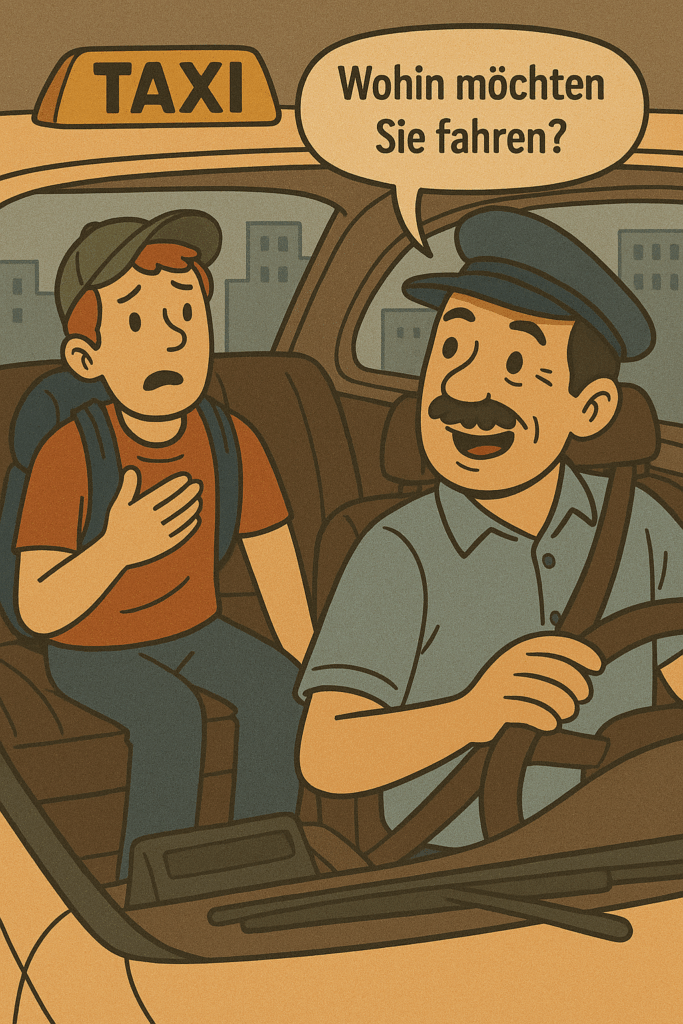
From flagging one down, to asking the fare and paying tips, these are the essential words and phrases you’ll need when using taxis in Germany.
Signs & Infrastructure
| German | English |
| das Taxi | taxi |
| der Taxistand | taxi stand |
| Taxameter | taximeter (meter in taxi) |
| einsteigen | to get in |
| aussteigen | to get out |
| Fahrer | driver (general) |
| Taxifahrer | taxi driver |
| Fahrgast | passenger |
| Das Fahrzeug | vehicle |
Booking & Calling a Taxi
Useful phrases when booking a taxi.
- “Können Sie mich bitte zum Flughafen bringen”
“Can you please take me to the airport?” - “Wo ist der nächste Taxistand”
“Where is the nearest taxi stand?” - “Können Sie ein Taxi telefonisch bestellen”
“Can I order a taxi by phone?” - “Ist das Taxi frei”
“Is the taxi free?”
Giving Directions
- “Fahren Sie bitte geradeaus.” — Drive straight ahead, please.
- “Bitte hier rechts/links abbiegen.” — Please turn right/left here.
- “Fahren Sie mich zu [Adresse/Hotel/Herrenstraße 10].” — Drive me to [address/hotel/Street name].
- “Könnten Sie das Ziel bitte in das Navigationsgerät eingeben?”
“Please enter the destination into the GPS.”
Fare & Payment Questions
- “Wie viel kostet es bis zum [Ort]?” — How much does it cost to [place]?
- “Wie viel kostet eine Taxifahrt ins Stadtzentrum?” — How much does a taxi ride to the city centre cost?
- “Kann ich mit Karte zahlen?” — Can I pay by card?
- “Gibt es einen Zuschlag für Gepäck?” — Is there an extra fee for luggage?
- “Bitte geben Sie mir eine Quittung / Kann ich eine Quittung bekommen?”
“Please give me a receipt / Can I have a receipt?”
Timing & Speed
- “Wie lange dauert es, bis das Taxi hier ist?”
“How long will it take for the taxi to arrive?” - “Ich habe es eilig. Können wir schneller fahren?”
“I’m in a hurry. Can we drive faster?” - “Es sollte nicht länger als 15 Minuten dauern.”
“It shouldn’t take longer than 15 minutes.”
Stopping & Saying Thanks
- “Hier ist gut, Sie können anhalten, bitte.” — This is fine; you can stop here.
- “Bitte halten Sie am nächsten Zebrastreifen.” — Please stop at the next crosswalk.
- “Vielen Dank für die Fahrt.” — Thank you for the ride.
- “Das war eine angenehme Fahrt.” — That was a pleasant drive.
Tip & Receipt
- “Wie viel Trinkgeld gibt man dem Taxifahrer? – “How much tip should you give the taxi driver?”
- “Ich habe kein Kleingeld.” — I have no small change.
- “Es stimmt so, der Rest ist für Sie.” — That’s fine; keep the change.
German “Mitfahrgelegenheit” (Ride-Sharing) Vocabulary
Mitfahrgelegenheiten—often referred to as ride-sharing in Germany—offer cost-effective, eco-friendly, and sociable travel options. Whether you’re planning a one-off trip or a regular commute, knowing the right terms is crucial. Here’s everything you should know.
Key Terms & Definitions
| German Term | English Translation |
| die Mitfahrgelegenheit (f) | ride, lift, carpool opportunity |
| mitfahren (verb) | to ride along / join a ride |
| jemandem eine Mitfahrgelegenheit bieten | to give someone a ride |
| Fahrtangebot | ride offer |
| Mitfahrer / Mitfahrerin | passenger |
| Kostenbeteiligung | cost-sharing contribution |
| Mitfahrzentralen | ride-sharing platforms |
| Mitfahrbank / Mitfahrbänkli | ride-sharing bench (hitchhiking bench) |
| Abholort | pickup location |
| Zielort | destination |
| Fahrerprofil | driver profile |
Typical German Rideshare Phrases
- Ich suche eine Mitfahrgelegenheit nach München.
I’m looking for a ride to Munich. - Ich biete eine Mitfahrgelegenheit (von Hamburg nach Berlin) an.
I’m offering a ride from Hamburg to Berlin. - Ich fahre am Freitagabend – passt das?
I’m driving Friday evening—is that okay? - Ich habe zwei freie Plätze.
I have two free seats. - Kostenbeteiligung pro Person: 15 Euro.
Cost per person (fuel share): 15 EUR.
Booking & Communication Phrases
- Können Sie mich am Bahnhof abholen?
Can you pick me up at the station? - Welcher Ort ist der Abholpunkt?
What’s the pickup location? - Wie lange dauert die Fahrt?
How long is the drive? - Ist ein Platz für Gepäck frei?
Is there room for luggage? - Ist WLAN oder USB-Ladeanschluss verfügbar?
Is there Wi-Fi or a USB charger?
Some drivers mention such amenities in their Fahrerprofil.
Meeting & During the Ride
- Hallo, ich bin [Name]—du musst Benjamin sein.
Hello, I’m [name]—you must be Benjamin. - Danke, dass ich mitfahren darf.
Thanks for letting me ride along. - Darf ich dir etwas mitbringen?
May I bring you something? - Wir können hier kurz halten, bitte?
Can we stop briefly here, please? - Ich helfe beim Navigieren, wenn Sie möchten.
I can help with navigation, if you like.
Post-Ride Etiquette
- Danke für die Mitfahrgelegenheit!
Thank you for the ride! - Ich schreibe eine Bewertung.
I’ll leave a review. - Bis zum nächsten Mal!
See you next time! - Ich habe dir das Geld per App überwiesen.
I transferred the cost via app.
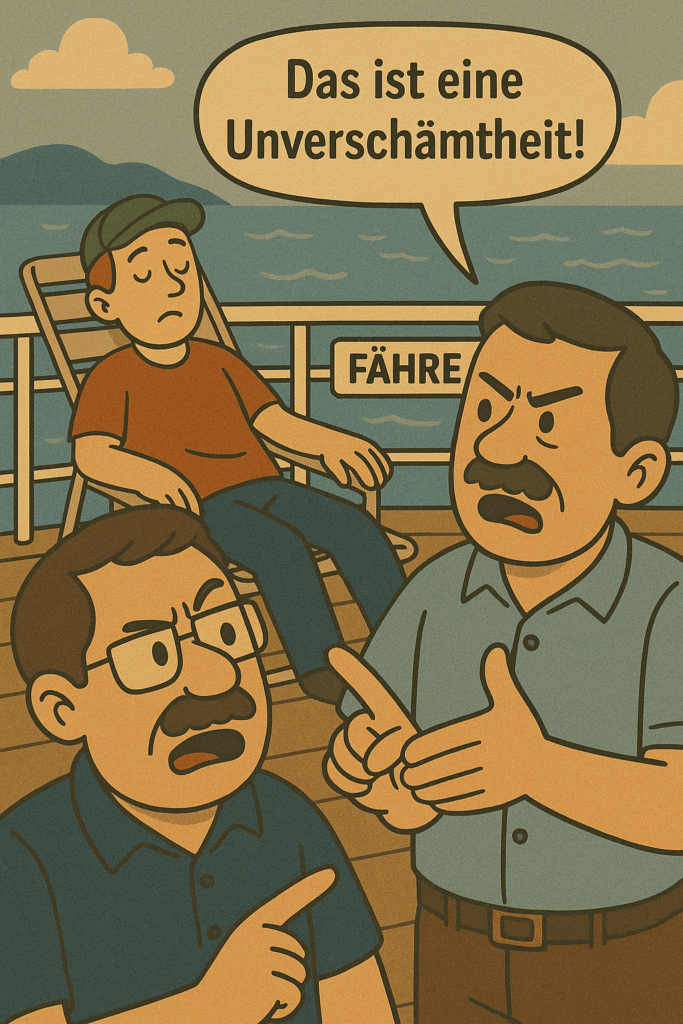
German Boat & Ferry Travel Vocabulary
Planning a river cruise, taking a ferry across a lake, or hopping on a boat tour in Germany? These essential German travel vocabulary and phrases will help you navigate the docks, buy tickets, and enjoy the ride.
Useful Nouns
die Fähre – ferry
das Boot – boat
das Schiff – ship
das Kreuzfahrtschiff – cruise ship
der Hafen – harbor / port
der Anleger / die Anlegestelle – pier / docking point
die Überfahrt – crossing
die Rundfahrt – round trip / sightseeing cruise
das Deck – deck
die Kabine – cabin
die Rettungsweste – life jacket
das Ruder – oar
der Kapitän – captain
die Mannschaft – crew
die Seekarte – nautical map
die Reederei – shipping company
die Strömung – current
die Welle – wave
Phrases for Taking a Ferry or Boat Tour
Wann fährt die nächste Fähre? – When does the next ferry leave?
Wie lange dauert die Überfahrt? – How long is the crossing?
Wo kann ich ein Ticket kaufen? – Where can I buy a ticket?
Ist das eine Rundfahrt oder nur eine einfache Fahrt? – Is this a round trip or just one way?
Fährt dieses Boot auch bei schlechtem Wetter? – Does this boat run in bad weather?
Kann man Fahrräder mitnehmen? – Can you take bikes on board?
Gibt es Toiletten an Bord? – Are there toilets on board?
Wie viel kostet die Überfahrt? – How much is the crossing?
Ist das eine geführte Tour? – Is this a guided tour?
Wo ist der Einstieg? – Where is the boarding area?
Muss ich die Rettungsweste tragen? – Do I have to wear a life jacket?
Kann ich draußen auf dem Deck sitzen? – Can I sit outside on the deck?
Your German Journey Starts Here
You’ve just unlocked the most essential German travel vocabulary for public transport—trains, buses, taxis, ride-sharing, and taxis. Now you have everything you need to navigate German transit like a local. Practice these words, repeat the sample dialogues, and keep the cheat sheet and audio offering a quick review anytime you travel. Check out these posts next!