German Nursing Vocabulary: 150+ Words and Phrases for Nurses
German Nursing Vocabulary: 150+ Essential Words and Phrases for Nurses
Whether you are a nurse, a nursing student, a healthcare worker moving to a German-speaking country, or a German learner with an interest in medicine, you need more than textbook vocabulary. You need the German nursing vocabulary that real people actually use in hospitals, clinics, and care settings.
This guide covers the most important German words and phrases for nurses, from staff roles and hospital rooms to patient care, symptoms, equipment, documentation, and shift handovers. You will also learn polite patient-friendly phrases in formal German, because in healthcare, sounding respectful is not optional.
And yes, there is a difference between the German you learn in a classroom and the German you may hear during a chaotic morning shift.
The Most Important German Nursing Vocabulary at a Glance
Here are some of the most useful terms to learn first:
| German | English |
| die Pflegekraft | nurse/care worker |
| die Pflegefachkraft | qualified nursing professional |
| der Patient / die Patientin | patient |
| das Krankenhaus | hospital |
| die Station | ward |
| das Zimmer | room |
| die Notaufnahme | emergency room / ER |
| die Intensivstation | intensive care unit |
| der Blutdruck | blood pressure |
| die Temperatur | temperature |
| der Puls | pulse |
| die Atmung | breathing |
| die Schmerzen | pain |
| die Wunde | wound |
| der Verband | bandage/dressing |
| die Infusion | IV/infusion |
| die Spritze | syringe/injection |
| das Medikament | medication |
| die Tablette | tablet/pill |
| die Pflege | care |
| die Untersuchung | examination |
| die Behandlung | treatment |
| die Aufnahme | admission |
| die Entlassung | discharge |
| die Schicht | shift |
These are the words that keep showing up again and again, so they are a smart place to start.
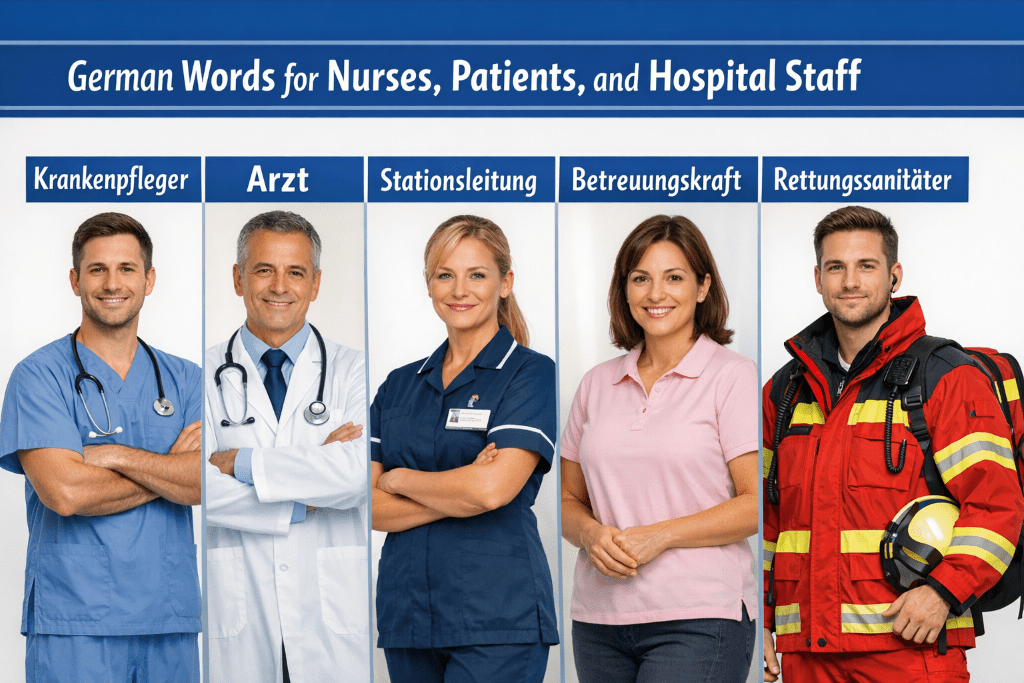
German Words for Nurses, Patients, and Hospital Staff
One of the first things learners notice is that there are several ways to say “nurse” in German.
| German | English |
| die Pflegekraft | nurse/care worker |
| die Pflegefachkraft | licensed or trained nursing professional |
| der Krankenpfleger | male nurse |
| die Krankenschwester | nurse, traditionally a female term |
| der Pfleger / die Pflegerin | caregiver/nurse in some contexts |
| der Arzt / die Ärztin | doctor |
| die Assistenzärztin / der Assistenzarzt | resident doctor |
| die Kollegin / der Kollege | colleague |
| die Stationsleitung | ward manager/head nurse |
| das Pflegepersonal | nursing staff |
| der Patient / die Patientin | patient |
| der Angehörige / die Angehörige | family member / relative |
| die Betreuungskraft | support caregiver |
| der Rettungssanitäter / die Rettungssanitäterin | paramedic |
A useful note about nurse terminology
Krankenschwester is still widely understood and still commonly heard, but it sounds older and more traditional. In many modern contexts, Pflegekraft or Pflegefachkraft is the better choice. It sounds more current and more professional. That is one of those small language details that instantly makes you sound more natural.
Visit the German pronunciation guide to learn how to speak German.
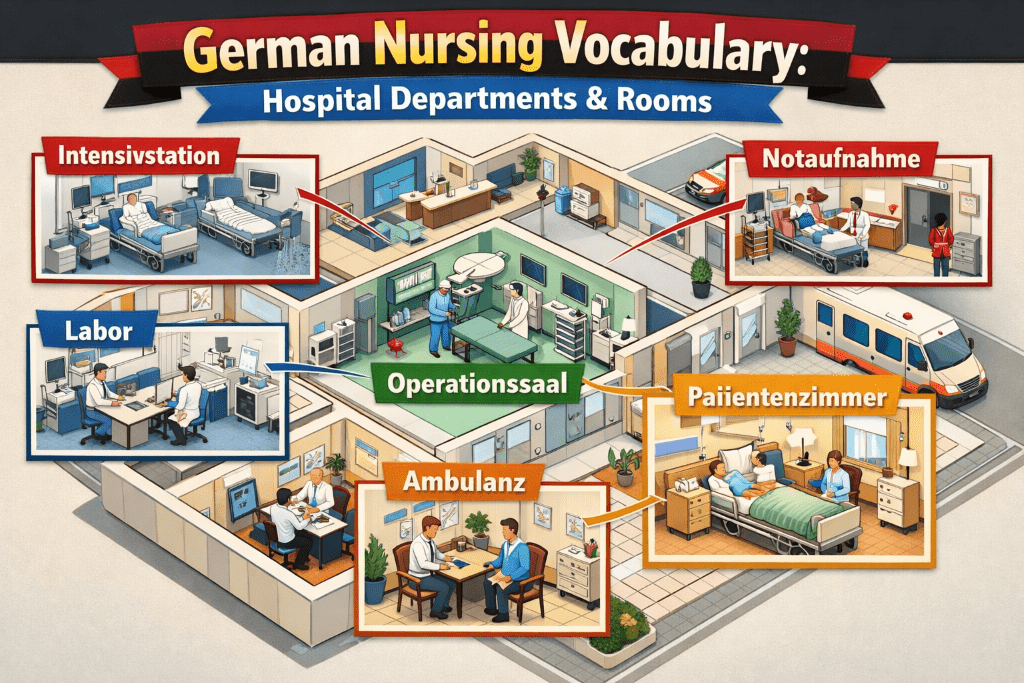
German Nursing Vocabulary for Hospital Departments and Rooms
Nurses need to talk about where patients are, where they are going, and where something happened.
| German | English |
| das Krankenhaus | hospital |
| die Klinik | clinic/hospital |
| die Station | ward |
| die Intensivstation | ICU |
| die Notaufnahme | ER / emergency department |
| der Operationssaal | operating room |
| das Patientenzimmer | patient room |
| das Einzelzimmer | single room |
| das Doppelzimmer | shared room |
| das Untersuchungszimmer | exam room |
| das Labor | lab |
| die Ambulanz | outpatient department |
| der Flur | hallway |
| das Schwesternzimmer | nurses’ station |
| die Reha-Abteilung | rehabilitation department |
| die Chirurgie | surgery department |
| die Innere Medizin | internal medicine |
| die Geriatrie | geriatrics |
| die Pädiatrie | pediatrics |
Example sentences
- Der Patient liegt auf der Intensivstation.
The patient is in the ICU. - Bitte bringen Sie die Patientin ins Untersuchungszimmer.
Please bring the patient to the exam room. - Die Angehörigen warten auf dem Flur.
The family members are waiting in the hallway.
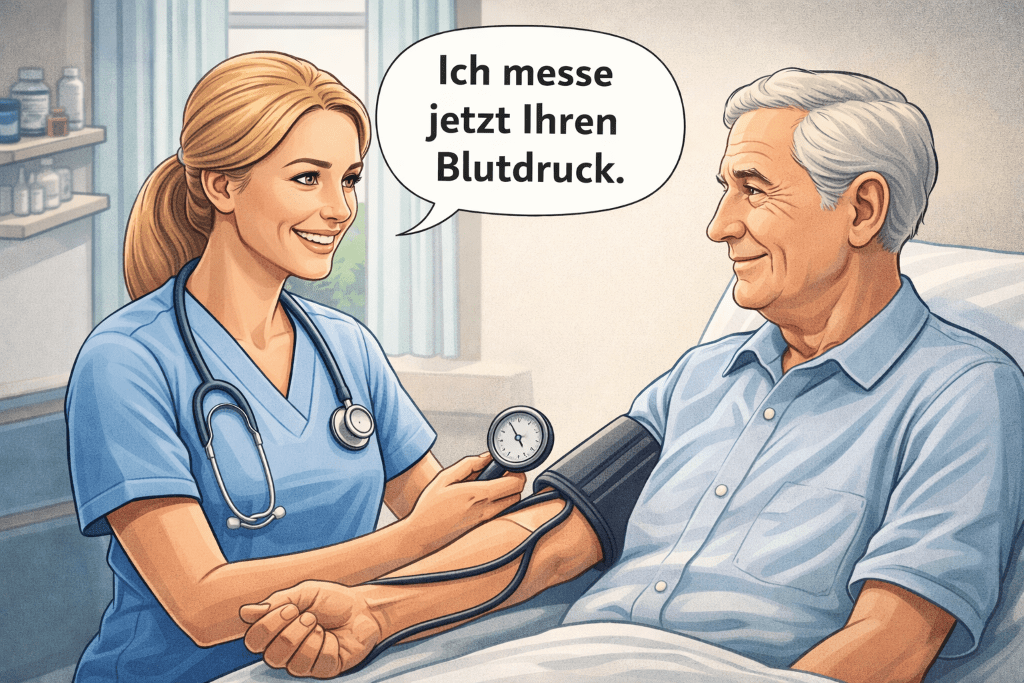
German Nursing Vocabulary for Daily Patient Care
This is the kind of vocabulary nurses use constantly. These verbs matter because nursing is not just about labels. It is about actions.
| German | English |
| pflegen | to care for |
| helfen | to help |
| waschen | to wash |
| lagern | to position |
| mobilisieren | to mobilize |
| messen | to measure |
| untersuchen | to examine |
| behandeln | to treat |
| dokumentieren | to document |
| beobachten | to observe |
| versorgen | to care for / dress |
| den Verband wechseln | to change the dressing |
| Blut abnehmen | to draw blood |
| eine Infusion anlegen | to start an IV |
| Medikamente geben | to administer medication |
| Tabletten verteilen | to hand out pills |
| die Temperatur messen | to take the temperature |
| den Blutdruck messen | to take blood pressure |
| den Puls kontrollieren | to check pulse |
| beim Aufstehen helfen | to help someone stand up |
Example sentences
- Ich messe jetzt Ihren Blutdruck.
I’m going to take your blood pressure now. - Wir helfen Ihnen beim Aufstehen.
We will help you get up. - Ich wechsle jetzt den Verband.
I’m changing the dressing now. - Die Patientin muss regelmäßig mobilisiert werden.
The patient needs to be mobilized regularly.
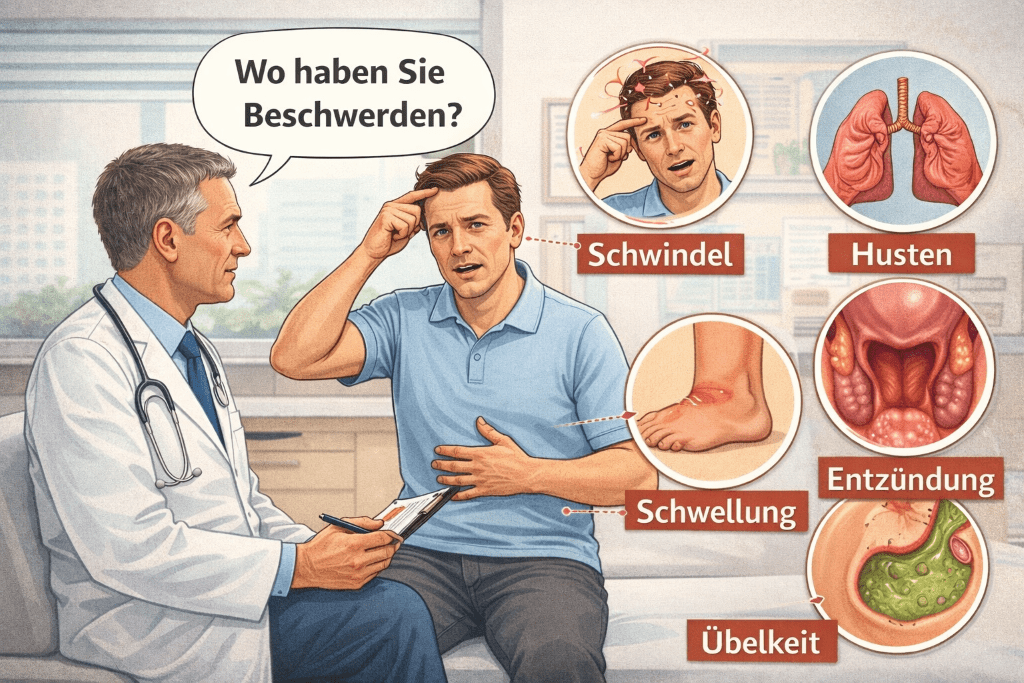
German Body Parts, Symptoms, and Common Complaints
This is where medical German starts to feel very real very fast.
Body parts in German
| German | English |
| der Kopf | head |
| der Hals | neck/throat |
| die Schulter | shoulder |
| der Arm | arm |
| die Hand | hand |
| die Brust | chest |
| der Rücken | back |
| der Bauch | stomach/abdomen |
| das Bein | leg |
| der Fuß | foot |
| das Herz | heart |
| die Lunge | lung |
| die Haut | skin |
| die Wunde | wound |
Symptoms and Complaints in German
| German | English |
| die Schmerzen | pain |
| das Fieber | fever |
| der Husten | cough |
| die Übelkeit | nausea |
| das Erbrechen | vomiting |
| der Schwindel | dizziness |
| die Atemnot | shortness of breath |
| die Schwäche | weakness |
| die Schwellung | swelling |
| die Entzündung | inflammation |
| die Blutung | bleeding |
| die Allergie | allergy |
| die Verstopfung | constipation |
| der Durchfall | diarrhea |
| die Müdigkeit | fatigue |
Useful symptom questions
- Haben Sie Schmerzen?
Are you in pain? - Wo tut es Ihnen weh?
Where does it hurt? - Seit wann haben Sie diese Beschwerden?
How long have you had these symptoms? - Haben Sie Fieber oder Schüttelfrost?
Do you have a fever or chills? - Ist Ihnen übel?
Do you feel nauseous?
Notice the formal Ihnen and Sie forms. In a healthcare setting, these are usually the safest default.
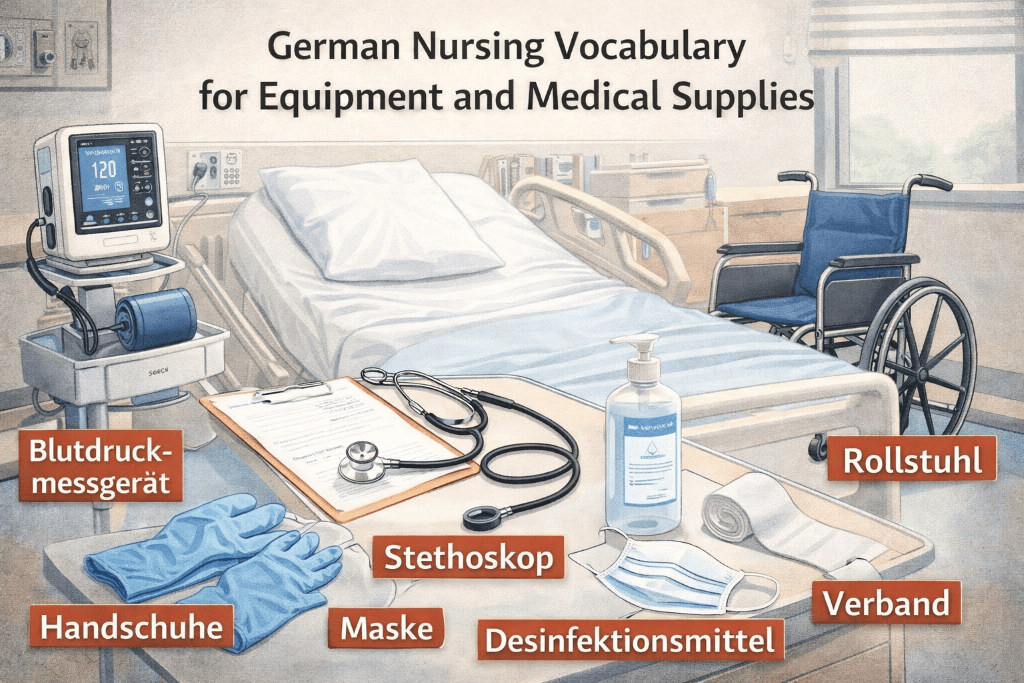
German Nursing Vocabulary for Equipment and Medical Supplies
If you work in healthcare, you cannot avoid equipment vocabulary. It shows up in charting, handovers, patient instructions, and those moments when everyone suddenly needs the same thing at once.
| German | English |
| das Stethoskop | stethoscope |
| das Thermometer | thermometer |
| das Blutdruckmessgerät | blood pressure monitor |
| die Spritze | syringe |
| die Nadel | needle |
| die Kanüle | cannula |
| die Infusion | infusion / IV |
| der Tropf | drip |
| der Katheter | catheter |
| der Rollstuhl | wheelchair |
| das Pflegebett | hospital bed |
| die Decke | blanket |
| die Handschuhe | gloves |
| die Maske | mask |
| das Desinfektionsmittel | disinfectant |
| der Verband | bandage/dressing |
| das Pflaster | plaster/bandage |
| die Kompresse | compress / gauze pad |
| das Messgerät | monitor/measuring device |
| die Sauerstoffmaske | oxygen mask |
Example sentences
- Die Infusion läuft noch.
The IV is still running. - Bitte holen Sie einen Rollstuhl.
Please get a wheelchair. - Wir brauchen sterile Handschuhe.
We need sterile gloves.
Nursing Phrases in German for Speaking With Patients
This is one of the most important parts of German for nurses. Vocabulary lists are helpful, but patients do not usually hand you a flashcard and politely wait while you translate.
You need clear, calm, respectful phrases.
Basic Patient Communication
| German | English |
| Guten Morgen, ich bin Ihre Pflegekraft heute. | Good morning, I’m your nurse today. |
| Ich kümmere mich heute um Sie. | I’ll be taking care of you today. |
| Wie geht es Ihnen? | How are you? |
| Haben Sie gut geschlafen? | Did you sleep well? |
| Haben Sie Schmerzen? | Are you in pain? |
| Können Sie mir sagen, wo es weh tut? | Can you tell me where it hurts? |
| Ich messe jetzt Ihre Temperatur. | I’m going to take your temperature now. |
| Ich messe jetzt Ihren Blutdruck. | I’m going to take your blood pressure now. |
| Bitte atmen Sie tief ein. | Please take a deep breath. |
| Bitte drehen Sie sich auf die Seite. | Please turn onto your side. |
| Bitte bleiben Sie kurz sitzen. | Please stay seated for a moment. |
| Ich bin gleich wieder da. | I’ll be right back. |
| Es dauert nur einen Moment. | It will only take a moment. |
| Versuchen Sie, sich zu entspannen. | Try to relax. |
| Ich helfe Ihnen. | I’ll help you. |
Medication and Treatment Phrases
| German | English |
| Haben Sie Ihre Medikamente schon genommen? | Have you taken your medication already? |
| Jetzt bekommen Sie Ihre Medikamente. | You are getting your medication now. |
| Diese Tablette nehmen Sie bitte nach dem Essen. | Please take this tablet after eating. |
| Ich lege Ihnen jetzt eine Infusion an. | I’m going to start an IV now. |
| Ich wechsle jetzt den Verband. | I’m changing the dressing now. |
| Bitte sagen Sie mir sofort Bescheid, wenn es schlimmer wird. | Please tell me immediately if it gets worse. |
| Haben Sie Allergien gegen Medikamente? | Do you have any medication allergies? |
Reassuring phrases
| German | English |
| Keine Sorge, wir sind da. | Don’t worry, we’re here. |
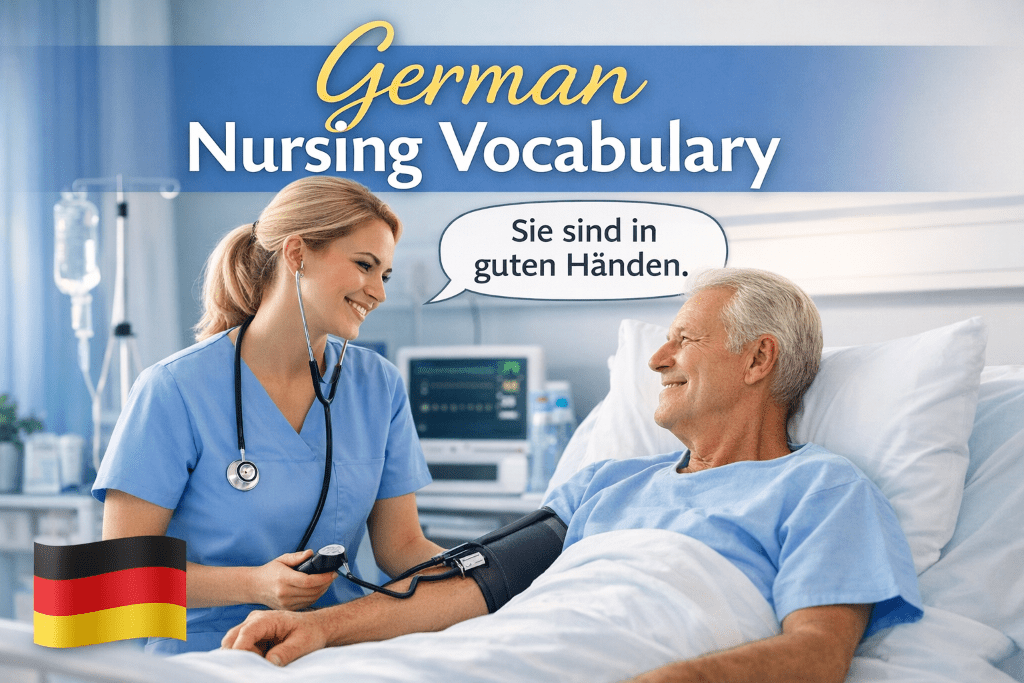
| Sie sind in guten Händen. | You’re in good hands. |
| Wir passen gut auf Sie auf. | We’ll take good care of you. |
| Ich erkläre Ihnen alles Schritt für Schritt. | I’ll explain everything step by step. |
That last one is especially useful because patients are often scared, confused, or tired. Sometimes they are all three at once, which is honestly not their best language-learning moment.
German Phrases Nurses Use With Coworkers and During Handover
Patient communication matters, but nursing German also includes fast workplace German. Handovers tend to be brief, direct, and packed with information.
Common Handover Vocabulary
| German | English |
| die Übergabe | handover |
| stabil | stable |
| kritisch | critical |
| ansprechbar | responsive |
| orientiert | oriented |
| verwirrt | confused |
| nüchtern | fasting |
| mobil | mobile |
| bettlägerig | bedridden |
| die Vitalzeichen | vital signs |
| unauffällig | unremarkable/normal |
| auffällig | abnormal/notable |
| die Medikation | medication |
| die Dosis | dose |
| die Drainage | drain |
| die Ausscheidung | output/elimination |
Handover Phrases
- Die Patientin ist seit heute Morgen stabil.
The patient has been stable since this morning. - Der Blutdruck war in der Nacht erhöht.
Blood pressure was elevated during the night. - Die Vitalzeichen sind unauffällig.
The vital signs are normal. - Er klagt über starke Schmerzen im Rücken.
He is complaining of severe back pain. - Die Wunde sieht gut aus.
The wound looks good. - Bitte die Temperatur weiter kontrollieren.
Please continue monitoring the temperature. - Die Patientin ist heute noch nüchtern.
The patient is still fasting today. - Die Infusion muss um 14 Uhr gewechselt werden.
The IV needs to be changed at 2 p.m.
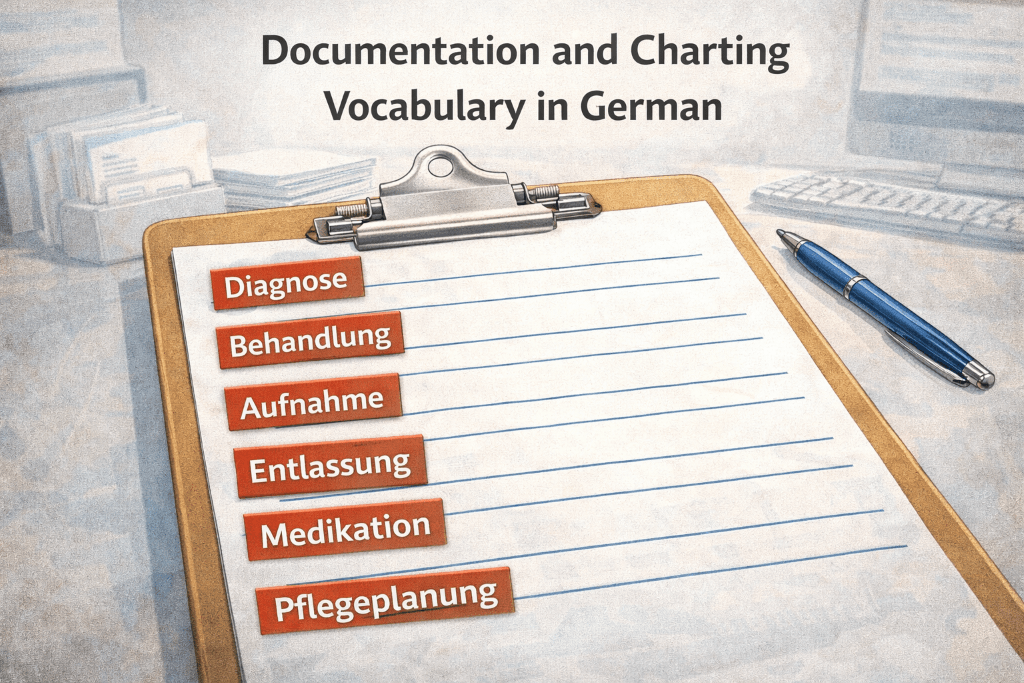
Documentation and Charting Vocabulary in German
Charting vocabulary is not glamorous, but it matters. A lot.
| German | English |
| die Dokumentation | documentation |
| der Befund | findings |
| die Diagnose | diagnosis |
| die Behandlung | treatment |
| die Aufnahme | admission |
| die Entlassung | discharge |
| die Verordnung | medical order/prescription |
| die Medikation | medication |
| die Dosis | dosage |
| die Einnahme | intake/administration |
| die Beobachtung | observation |
| der Verlauf | progress/course |
| der Zustand | condition |
| die Pflegeplanung | care plan |
| die Wundversorgung | wound care |
| die Flüssigkeitsbilanz | fluid balance |
| die Ausscheidung | output |
| die Stuhlprobe | stool sample |
| die Urinprobe | urine sample |
| die Blutprobe | blood sample |
Example Charting Phrases
- Die Patientin klagt über Schmerzen im rechten Bein.
The patient complains of pain in the right leg. - Temperatur, Puls und Blutdruck wurden kontrolliert.
Temperature, pulse, and blood pressure were checked. - Die Wunde wurde gereinigt und neu verbunden.
The wound was cleaned and re-dressed. - Der Patient wurde mobilisiert und tolerierte dies gut.
The patient was mobilized and tolerated it well.
That last one is a good example of professional written language. Spoken German in the room may be simpler. Written German in documentation is often more compact and formal.
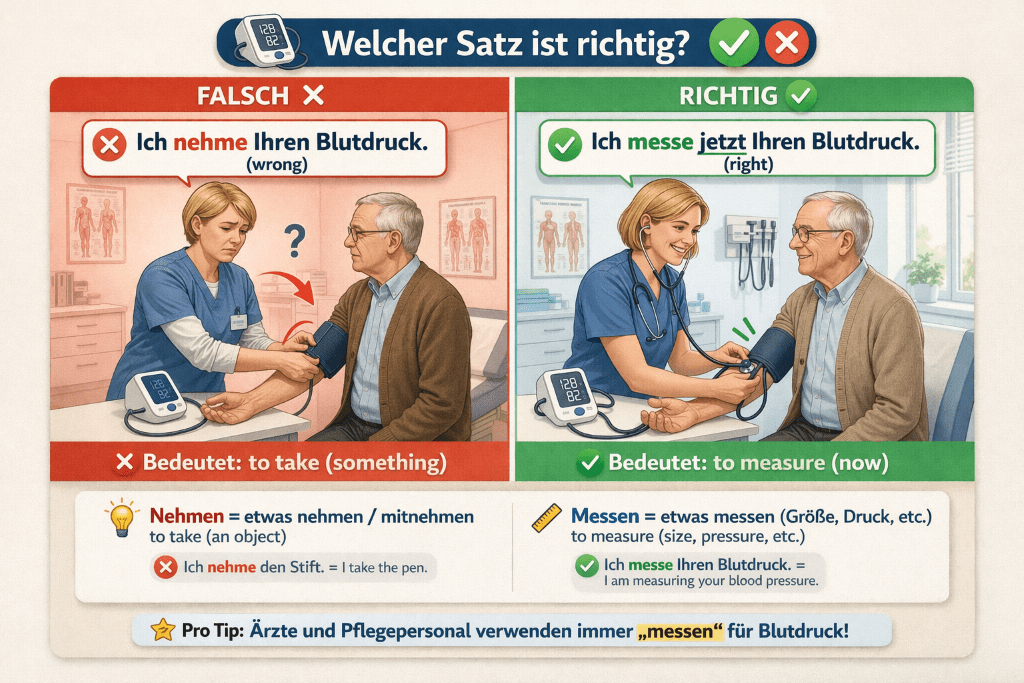
Common Mistakes English Speakers Make With German Nursing Vocabulary
1. Using the wrong word for “nurse.”
Krankenschwester is familiar, but it is not always the best modern default. Pflegekraft or Pflegefachkraft is often more neutral and current.
2. Forgetting the formal form
In healthcare, du can sound too informal unless there is a special context. Sie is safer.
- Können Sie aufstehen?
Can you stand up?
Not:
- Kannst du aufstehen?
unless the setting clearly calls for informal speech.
3. Translating too literally
English speakers often try to build German sentences word-for-word. German usually punishes that kind of optimism.
For example:
- Ich nehme Ihren Blutdruck.
sounds odd.
Better:
- Ich messe jetzt Ihren Blutdruck.
4. Mixing up medical verbs
A few verbs come up constantly:
- messen = measure
- geben = give / administer
- wechseln = change
- beobachten = observe
- dokumentieren = document
Learn these well, and you can build dozens of useful sentences.
5. Ignoring articles and gender
German articles matter. In medical vocabulary, they are not decorative little accessories. Learn the noun with the article.
- die Wunde
- der Verband
- das Medikament
That saves time later and makes your German more accurate.
Mini Dialogues Using German Nursing Vocabulary for Real-Life Practice
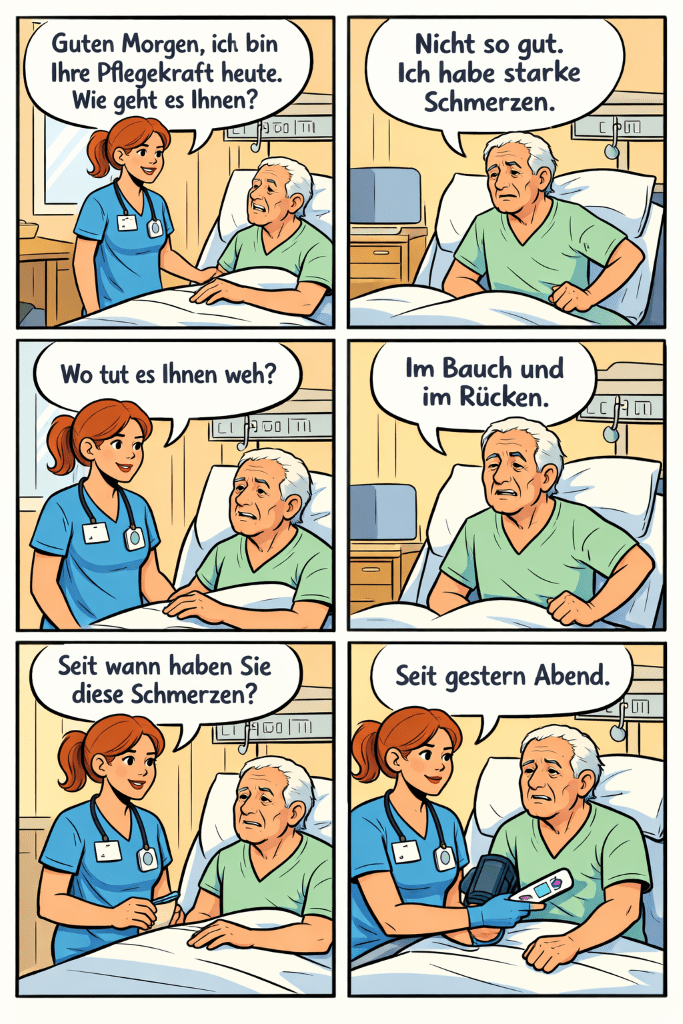
Dialogue 1: Nurse and patient
Pflegekraft: Guten Morgen, ich bin Ihre Pflegekraft heute. Wie geht es Ihnen?
Patient: Nicht so gut. Ich habe starke Schmerzen.
Pflegekraft: Wo tut es Ihnen weh?
Patient: Im Bauch und im Rücken.
Pflegekraft: Seit wann haben Sie diese Schmerzen?
Patient: Seit gestern Abend.
Pflegekraft: Ich messe jetzt zuerst Ihren Blutdruck und Ihre Temperatur.
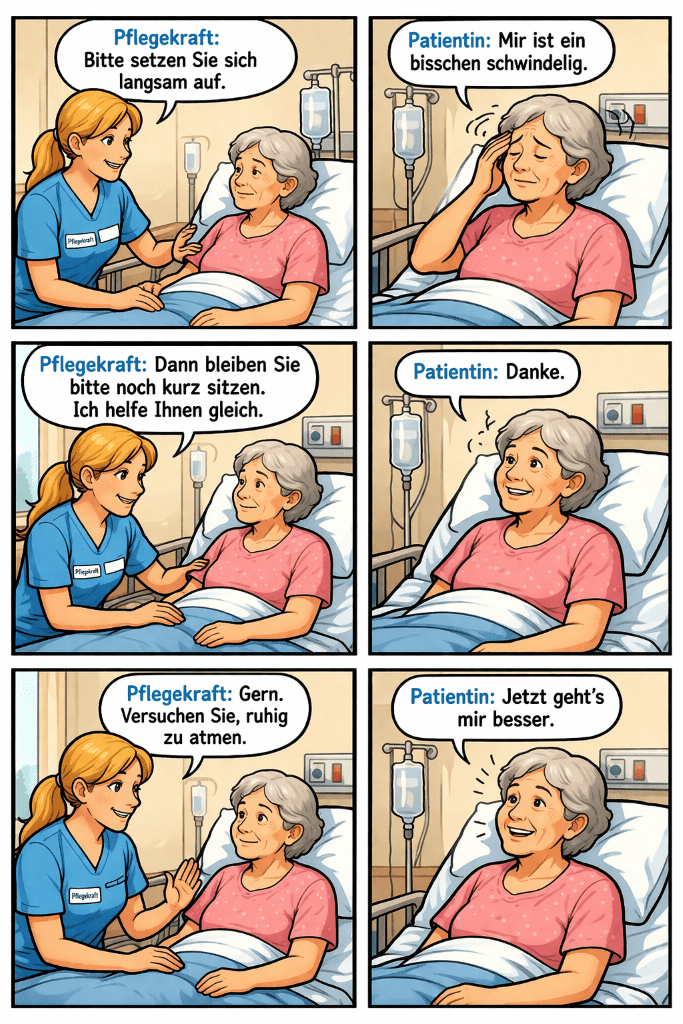
Dialogue 2: Nurse giving instructions
Pflegekraft: Bitte setzen Sie sich langsam auf.
Patientin: Mir ist ein bisschen schwindelig.
Pflegekraft: Dann bleiben Sie bitte noch kurz sitzen. Ich helfe Ihnen gleich.
Patientin: Danke.
Pflegekraft: Gern. Versuchen Sie, ruhig zu atmen.
Patientin: Jetzt geht’s mir besser.
Dialogue 3: Shift handover
Pflegekraft 1: Zimmer 12 ist stabil. Die Vitalzeichen sind unauffällig.
Pflegekraft 2: Hat der Patient noch Fieber?
1: Nein, aber er klagt noch über Schmerzen in der Schulter.
2: Gibt es neue Medikamente?
1: Ja, Antibiotika alle acht Stunden.
Learn German doctor phrases in this post.
FAQ About German Nursing Vocabulary
What is the German word for nurse?
There is more than one option. Pflegekraft is a common modern term for a nurse or care worker. Pflegefachkraft is often used for a trained nursing professional. You may also hear Krankenschwester or Krankenpfleger, but those can sound more traditional.
What are the most important German phrases for nurses?
Some of the most useful phrases are Haben Sie Schmerzen?, Ich messe jetzt Ihren Blutdruck, Bitte atmen Sie tief ein, and Ich helfe Ihnen. These are practical, high-frequency phrases you can use in daily patient care.
Why do nurses use the formal “Sie” in German?
In hospitals and clinics, Sie is usually the respectful default when speaking to patients. It sounds professional and polite. In some settings, informal language may be used, but formal speech is the safest place to start.
Is medical German different from everyday German?
Yes. Medical German includes specialized vocabulary, more formal phrasing, and a lot of precise documentation language. At the same time, nurses still need simple, clear everyday German for patient communication, especially when patients are stressed or unwell.
What is the difference between German hospital vocabulary and German nursing vocabulary?
German hospital vocabulary is broader. It covers departments, staff, equipment, and general medical terms. German nursing vocabulary is more focused on patient care, daily tasks, treatment phrases, charting, and handovers.
How can I learn German nursing vocabulary faster?
Start with the most common patient-care verbs and phrases, then learn vocabulary by theme: staff, symptoms, equipment, and documentation. It also helps to practice short dialogues instead of memorizing isolated nouns forever, like a person preparing for a very weird spelling bee.
Final Thoughts on German Nursing Vocabulary
Learning German nursing vocabulary is not just about memorizing medical words. It is about communicating clearly, treating patients respectfully, and feeling more confident in real healthcare situations.
Start with the words and phrases you will use every day. Learn how to ask about pain, explain basic procedures, take vital signs, and talk to coworkers during handover. Once those basics feel natural, the rest of your medical German becomes much easier to build.
For broader medical terms, hospital phrases, and pronunciation help, this post works best as part of a larger German-learning system. Nursing German is a specialized skill, but it becomes much less intimidating when you break it into useful chunks and learn the language people actually say.