German Question Words: How to Ask Questions in German
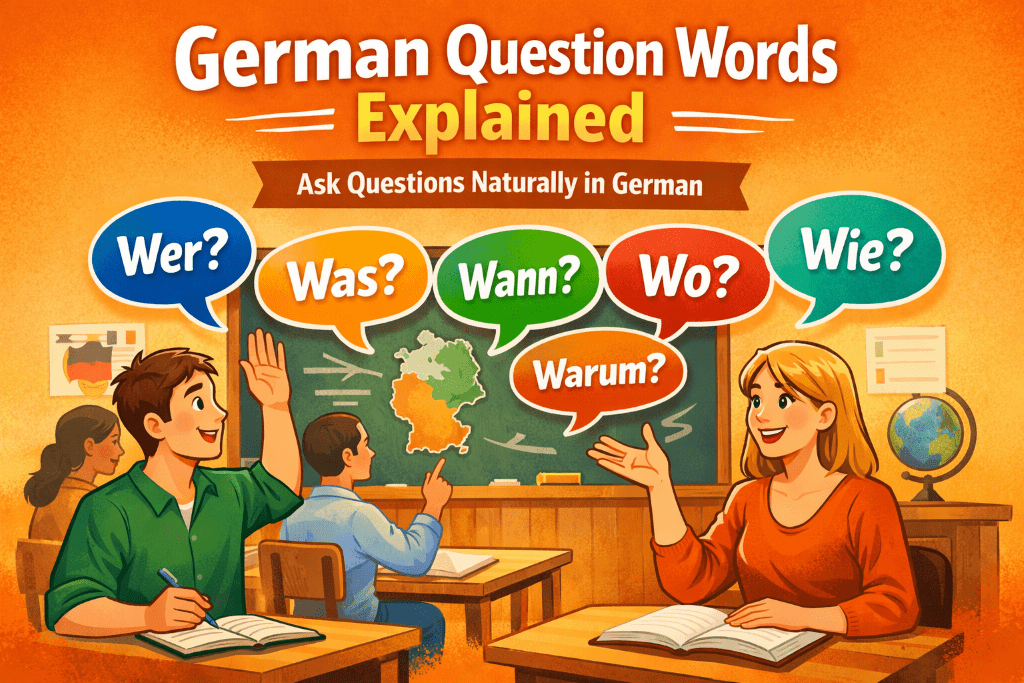
German question words are the words you use to ask for information, not just a yes or no answer. If you want to know who, what, when, where, why, or how, you need German W-Fragen. The good news is that once you understand the basic pattern, how to ask questions in German becomes much more predictable.
In most German information questions, the question word comes first, the conjugated verb comes second, and the subject comes after that. That’s the basic rule behind German question formation, and it will carry you through a lot of everyday conversations.
In this guide, you’ll learn the most important German question words, how German question word order works, the difference between tricky pairs like wo, wohin, and woher, and how to avoid the most common mistakes beginners make.
If you need a bigger overview of sentence structure first, read my guide on German word order. It will make everything in this post feel much less random.
What Are German Question Words?
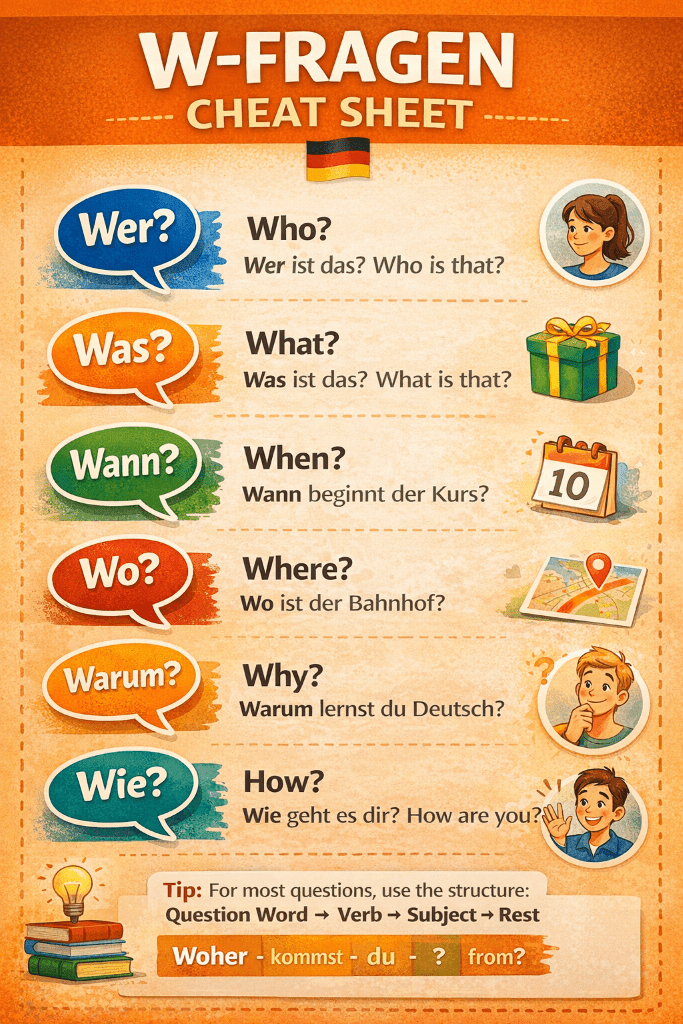
German question words are usually called W-Fragen because many of them begin with w, just like English question words often begin with wh.
These are the words you use when you want real information:
- wer = who
- was = what
- wann = when
- wo = where
- warum = why
- wie = how
These are different from yes/no questions, where the verb comes first, and the answer can usually be answered with ja or nein.
Compare:
- Wo wohnst du? = Where do you live?
- Wohnst du in Berlin? = Do you live in Berlin?
That distinction matters because German word order changes depending on the type of question.
The Basic Rule for German Question Word Order
Here is the core pattern for most German W-questions:
Question word + conjugated verb + subject + rest of sentence
Examples:
- Wo wohnst du?
Where do you live? - Warum lernst du Deutsch?
Why are you learning German? - Wann kommt der Zug?
When does the train arrive? - Wie heißt du?
What is your name?
This is one reason learners struggle at first. In English, the structure feels familiar but not identical. In German, the verb is very stubborn. It wants its spot early in the sentence, and it usually gets it.
The Most Common German Question Words
Here is a quick overview of the question words you’ll use most often.
| German | English | Example | Translation |
| wer | who | Wer ist das? | Who is that? |
| was | what | Was machst du? | What are you doing? |
| wann | when | Wann kommst du? | When are you coming? |
| wo | where | Wo ist mein Handy? | Where is my phone? |
| warum | why | Warum lachst du? | Why are you laughing? |
| wie | how | Wie geht es dir? | How are you? |
| welche / welcher / welches | which | Welches Buch liest du? | Which book are you reading? |
| wie viel | how much | Wie viel kostet das? | How much does that cost? |
| wie viele | how many | Wie viele Geschwister hast du? | How many siblings do you have? |
| woher | where from | Woher kommst du? | Where are you from? |
| wohin | where to | Wohin gehst du? | Where are you going? |
You’ll notice that some of these are single words and some are phrases. Either way, they all function as German question words.
Wer, Wen, Wem, and Wessen Explained Simply
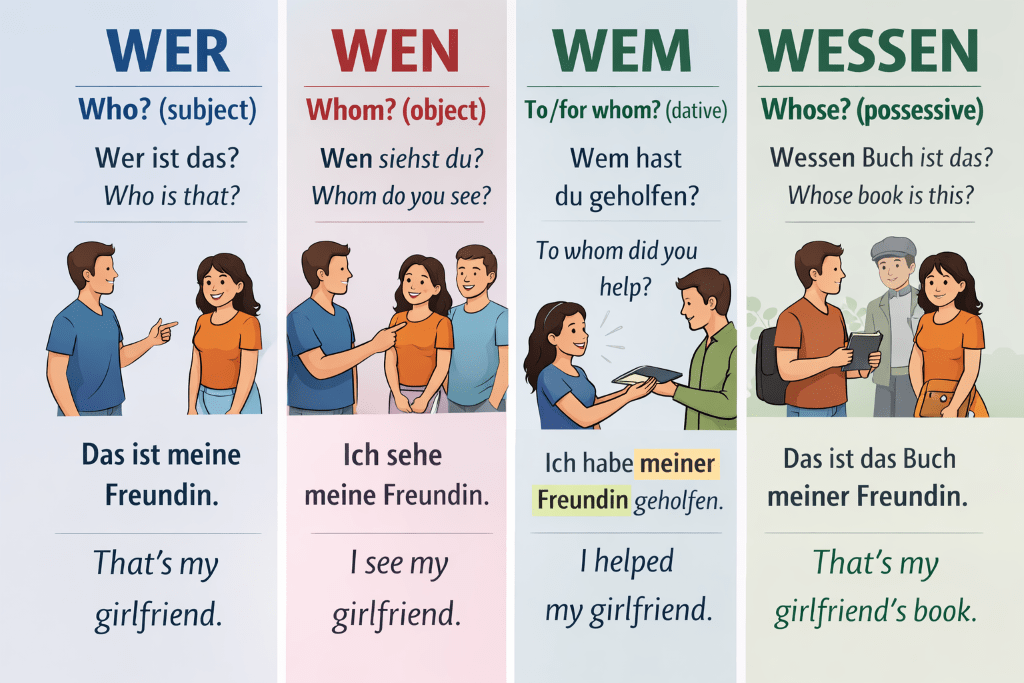
German has cases, so the word for “who” changes depending on its role in the sentence. If you need a full foundation first, read The German Cases Beginner’s Guide.
Here’s the simple version:
- wer = who (nominative)
- wen = whom / who (accusative)
- wem = to whom (dative)
- wessen = whose (genitive)
Wer
Use wer when the question word is the subject of the sentence.
- Wer kommt heute?
Who is coming today? - Wer hat das gesagt?
Who said that?
Wen
Use wen when the person is the direct object.
- Wen siehst du?
Who do you see? - Wen kennst du hier?
Who do you know here?
Wem
Use wem when the person is the indirect object.
- Wem gibst du das Buch?
Who are you giving the book to? - Wem hast du geschrieben?
Who did you write to?
Wessen
Use wessen to ask “whose.”
- Wessen Tasche ist das?
Whose bag is that? - Wessen Auto steht vor dem Haus?
Whose car is parked in front of the house?
This is one of the most important German question word patterns to learn because it ties directly into cases, pronouns, and sentence roles. If you need a refresher on pronouns, you can also read German Pronouns: Quick and Simple.
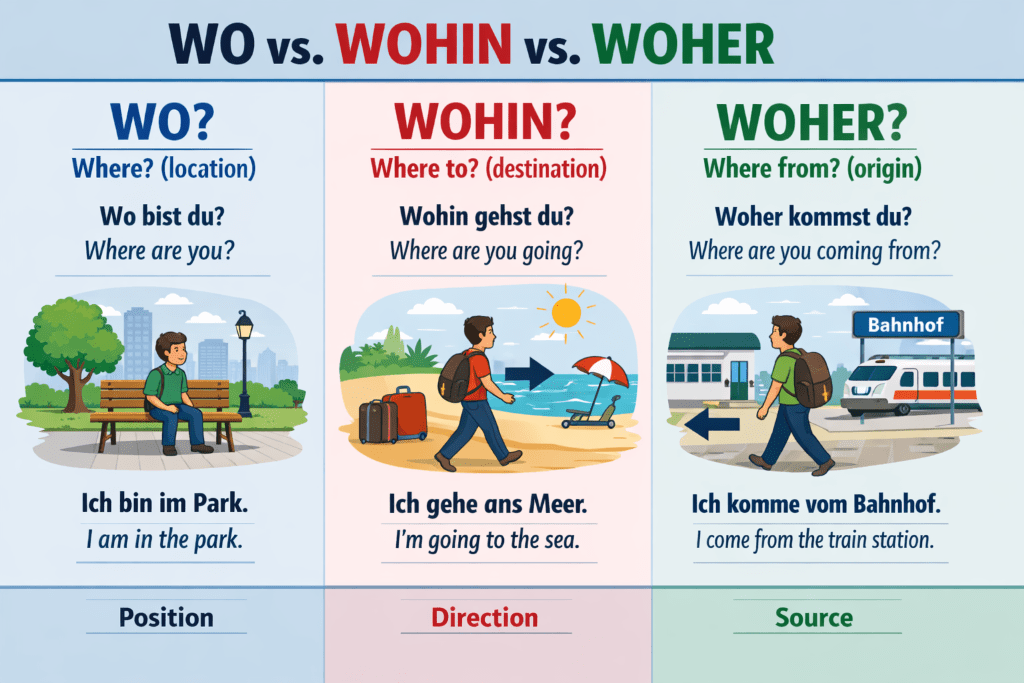
Wo vs. Wohin vs. Woher
This is one of the most common beginner mistakes, and honestly, it makes sense. English uses “where” for a lot of things. German is less vague.
Wo = where (location)
Use wo when something is located somewhere.
- Wo wohnst du?
Where do you live? - Wo ist der Bahnhof?
Where is the train station?
Wohin = where to (destination)
Use wohin when someone is going somewhere.
- Wohin gehst du?
Where are you going? - Wohin fahren wir morgen?
Where are we driving tomorrow?
Woher = where from (origin)
Use woher when something or someone comes from somewhere.
- Woher kommst du?
Where are you from? - Woher hast du das?
Where did you get that from?
Here’s the difference at a glance:
| German | Meaning | Use |
| wo | where | location |
| wohin | where to | direction/destination |
| woher | where from | origin |
If you mix these up, Germans will still usually understand you from context. But it sounds off, and this is exactly the kind of detail that helps you sound more natural.
Warum vs. Wieso vs. Weshalb
All three of these question words mean why.
- warum
- wieso
- weshalb
In everyday speech, warum is the most common and the safest choice for beginners.
Examples:
- Warum lernst du Deutsch?
Why are you learning German? - Wieso bist du zu spät?
Why are you late? - Weshalb ist das wichtig?
Why is that important?
There can be tiny differences in tone depending on region or context, but at the beginner level, you do not need to overcomplicate this. Use warum first. Master the basics before trying to sound like a philosopher in a black turtleneck.
How to Form Questions in German
Now let’s look at the two main types of questions.
1. W-Questions
These use a German question word and ask for specific information.
Pattern:
Question word + verb + subject + rest
Examples:
- Wie heißt du?
- Wo arbeitest du?
- Wann beginnt der Film?
- Warum ist das teuer?
2. German Yes/No Questions
These do not use a question word. Instead, the verb comes first.
Pattern:
Verb + subject + rest
Examples:
- Kommst du morgen?
Are you coming tomorrow? - Hast du Zeit?
Do you have time? - Ist das dein Buch?
Is that your book? - Sprichst du Deutsch?
Do you speak German?
This is a key part of how to ask questions in German. If you want information, use a question word. If you want a yes or no answer, put the verb first.
German Question Formation with Modal Verbs
If you’ve studied German modal verbs, you already know that the conjugated modal verb takes the early position, and the second verb goes to the end.
Examples:
- Was kannst du heute machen?
What can you do today? - Wo willst du wohnen?
Where do you want to live? - Warum musst du gehen?
Why do you have to leave?
The same principle applies to questions. The conjugated verb still takes the key position.
German Question Word Order with Separable Verbs
Questions with separable verbs follow the same basic rules, but the prefix still splits off in main clauses.
Examples:
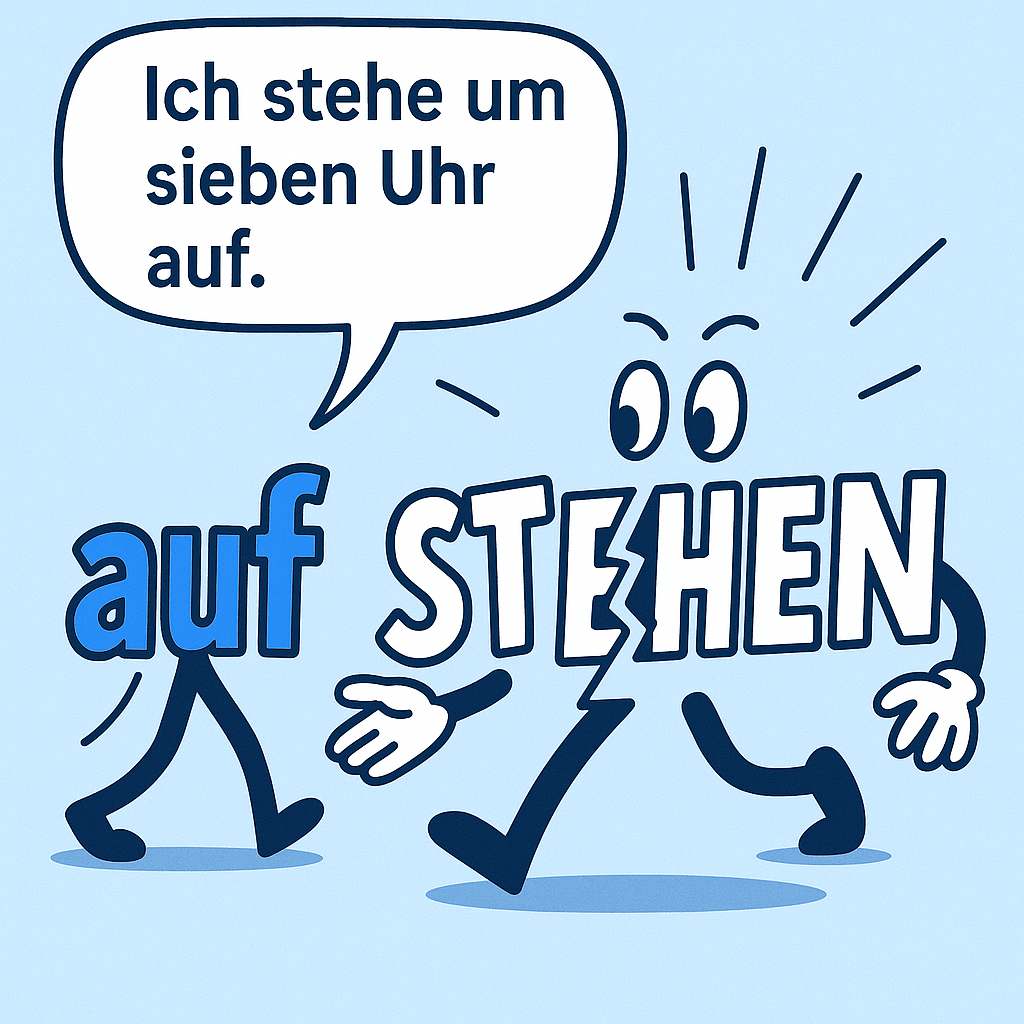
- Wann stehst du auf?
When do you get up? - Wo kaufst du ein?
Where do you shop? - Warum rufst du mich an?
Why are you calling me?
If separable verbs still feel messy, read German Separable Verbs Made Simple.
Question Words in Different Tenses
You can use German question words in any tense. The word order pattern stays familiar, but the verb structure changes.
Present tense
- Wo arbeitest du?
Where do you work?
Perfect tense
- Was hast du gemacht?
What did you do?
Future tense
- Wann wirst du ankommen?
When will you arrive? - Wo wirst du wohnen?
Where will you live?
For more on future forms, see German Future Tense (Futur I).
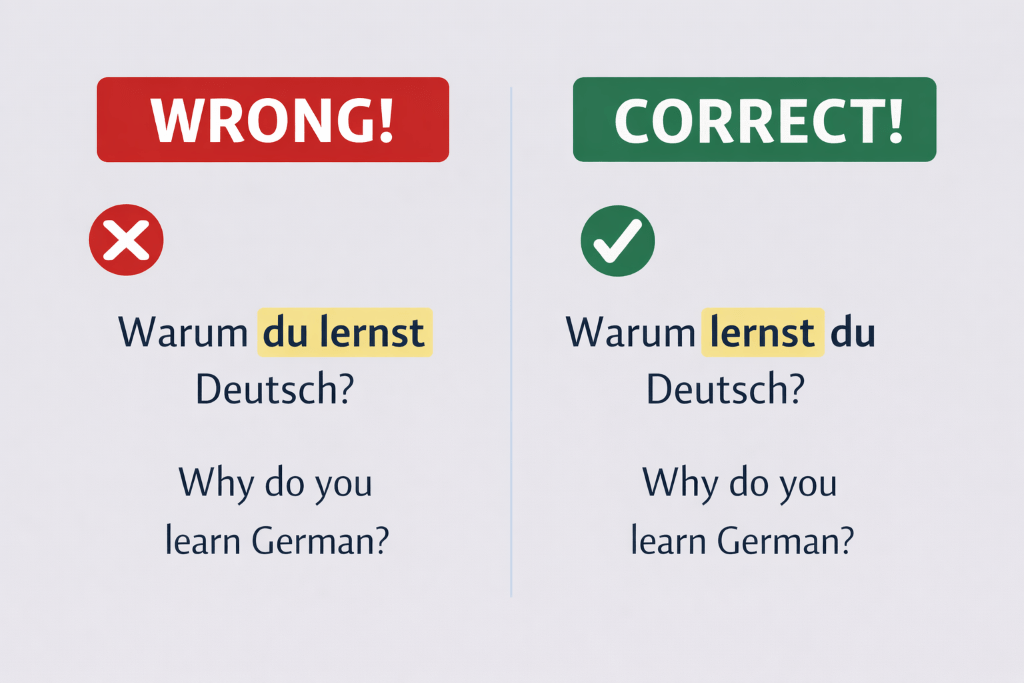
Common Mistakes English Speakers Make
These are the most common errors I see with German question formation.
Mistake 1: Keeping English word order
Wrong: Warum du lernst Deutsch?
Correct: Warum lernst du Deutsch?
In German, the verb needs to come early. English habits will try to sabotage you here.
Mistake 2: Using wo for everything
Wrong: Wo gehst du?
Better: Wohin gehst du?
If movement is involved, you usually need wohin.
Mistake 3: Mixing up wer, wen, and wem
Wrong: Wem siehst du?
Correct: Wen siehst du?
If the person is the direct object, use wen.
Mistake 4: Forgetting the case with prepositions
- Mit wem sprichst du?
Who are you speaking with?
This is where German cases sneak back into the conversation, because apparently they enjoy making surprise appearances.
Real-Life German Question Examples
Here are some useful everyday questions you can start using right away.
Introductions
- Wie heißt du?
What is your name? - Woher kommst du?
Where are you from? - Was machst du beruflich?
What do you do for work?
Travel
- Wo ist das Hotel?
Where is the hotel? - Wohin fährt dieser Bus?
Where does this bus go? - Wann kommt der Zug an?
When does the train arrive?
Restaurant
- Was empfehlen Sie?
What do you recommend? - Wie viel kostet das?
How much does that cost? - Kann ich mit Karte zahlen?
Can I pay by card?
Everyday Conversation
- Wie geht es dir?
How are you? - Warum bist du müde?
Why are you tired? - Was machst du heute Abend?
What are you doing this evening?
If you want more useful expressions to combine with these, browse my German phrases page.
Indirect Questions in German
Once you get comfortable with direct questions, the next step is indirect questions.
Examples:
- Ich weiß nicht, wo er wohnt.
I don’t know where he lives. - Kannst du mir sagen, wann der Film beginnt?
Can you tell me when the movie starts? - Sie fragt, warum du müde bist.
She asks why you are tired.
This matters because German question words can also introduce subordinate clauses. In those clauses, the conjugated verb usually moves to the end. That’s one reason question words connect so closely to the overall German sentence structure.
Dartmouth’s German grammar guide gives a more technical explanation of questions and dependent clauses if you want to dig deeper, and the Leibniz Institute for the German Language has a reference entry on Interrogativ-Pronomen.
Quick Tip Box: The Easiest Way to Build a German Question
When in doubt, use this formula:
Question word + verb + subject + rest
For example:
- Wann kommst du nach Hause?
- Warum ist das wichtig?
- Wie heißt dein Lehrer?
If it’s a yes/no question, just move the verb to the front:
- Kommst du nach Hause?
- Ist das wichtig?
- Heißt dein Lehrer Martin?
That simple shift will already take you very far.
Practice Exercises: Put the Words in the Right Order
Try to put these into the correct German question order.
1. du / wo / wohnst
2. hat / wer / das / gesagt
3. gehen / wohin / wir / morgen
4. du / warum / lachst
5. Zeit / hast / du
6. das / wem / gibst / du / Buch
7. das / wie viel / kostet
8. ihr / woher / kommt
9. liest / welches / du / Buch
10. du / kannst / was / heute / machen
Answer Key:
- Wo wohnst du?
- Wer hat das gesagt?
- Wohin gehen wir morgen?
- Warum lachst du?
- Hast du Zeit?
- Wem gibst du das Buch?
- Wie viel kostet das?
- Woher kommt ihr?
- Welches Buch liest du?
- Was kannst du heute machen?
FAQ: German Question Words
What are German question words?
German question words are words like wer, was, wann, wo, warum, and wie that you use to ask for specific information. They are often called W-Fragen and usually come at the beginning of the sentence.
How do you ask questions in German?
To ask a W-question, use this pattern: question word + verb + subject + rest. To ask a yes/no question, put the conjugated verb first.
What is the difference between wo, wohin, and woher?
Wo asks about location, wohin asks about destination, and woher asks about origin.
What is the difference between wer, wen, wem, and wessen?
These all mean forms of “who,” but they change by case. Wer is nominative, wen is accusative, wem is dative, and wessen is genitive.
Are all German question words W-words?
Yes, all German question words start with a “w,” which is why they are called W-Fragen.
How do yes/no questions work in German?
In German yes/no questions, the conjugated verb usually comes first, followed by the subject. Example: Hast du Hunger?
Final Thoughts
German question words are one of the fastest ways to become more conversational because they let you actually interact instead of just memorizing isolated phrases.
Start with the most common W-Fragen, practice the difference between wo, wohin, and woher, and pay attention to German question word order.