Talking About Yourself in German for Beginners
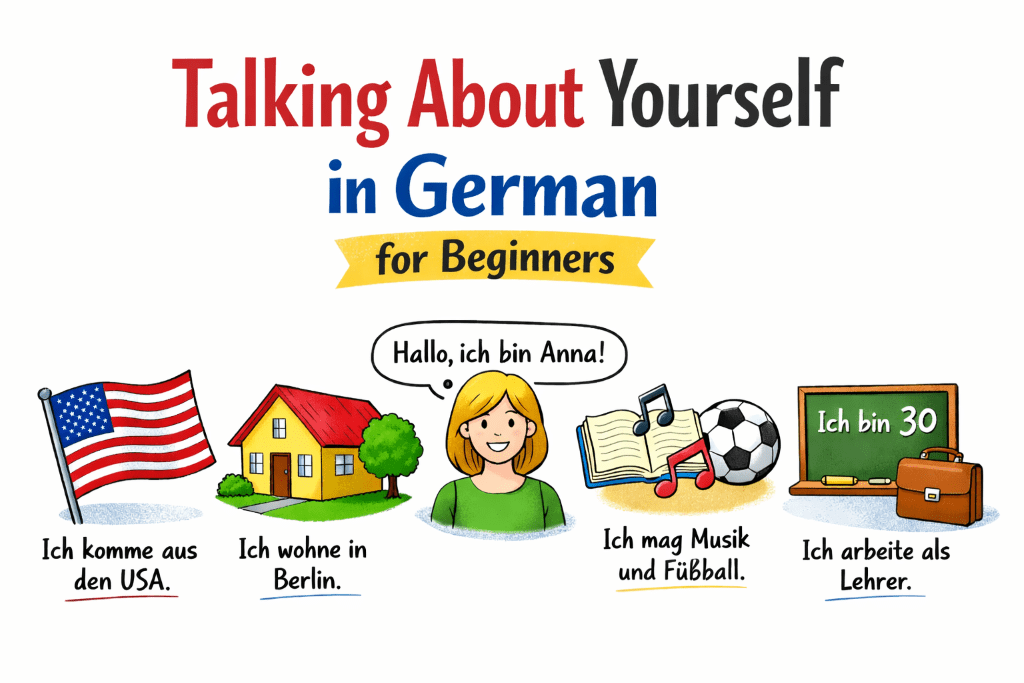
Learning how to start talking about yourself in German is one of the most useful early speaking skills. At the A1 and A2 levels, you do not need long stories or complicated sentences. You need short, practical phrases to share basic information about yourself.
These beginner German phrases are useful in class, in language exchanges, while traveling, and in everyday conversation. They help you say where you are from, where you live, what languages you speak, what you do, and what you like.
In this guide, you will learn simple German phrases for talking about yourself with English translations, beginner-friendly formulas, and easy examples you can start using right away.
Basic German Phrases for Talking About Yourself
These are some of the most useful A1 and A2 phrases for talking about yourself in German.
- Ich komme aus den USA. = I come from the USA.
- Ich wohne in Texas. = I live in Texas.
- Ich spreche Englisch. = I speak English.
- Ich lerne Deutsch. = I am learning German.
- Ich bin Anfänger. = I am a beginner.
- Ich bin 30 Jahre alt. = I am 30 years old.
- Ich arbeite als Lehrer. = I work as a teacher.
- Ich studiere Deutsch. = I study German.
- Ich mag Musik. = I like music.
- In meiner Freizeit lese ich gern. = In my free time, I like to read.
These A1 German phrases are perfect for introductions, classroom conversations, and early speaking practice.
Where You Are From
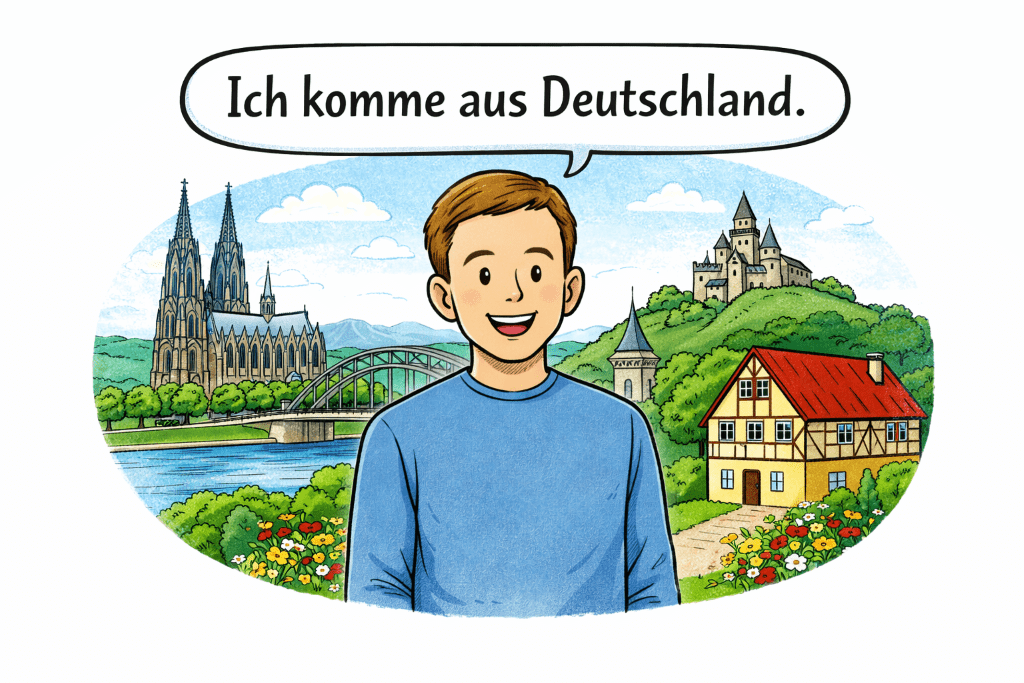
One of the most common ways to talk about yourself is to say where you come from.
Formula:
Ich komme aus + country/place
Examples:
- Ich komme aus den USA. = I come from the USA.
- Ich komme aus Deutschland. = I come from Germany.
- Ich komme aus Spanien. = I come from Spain.
- Ich komme aus England. = I come from England.
This is a very useful beginner structure because you can keep the sentence the same and only change the country.
Where You Live
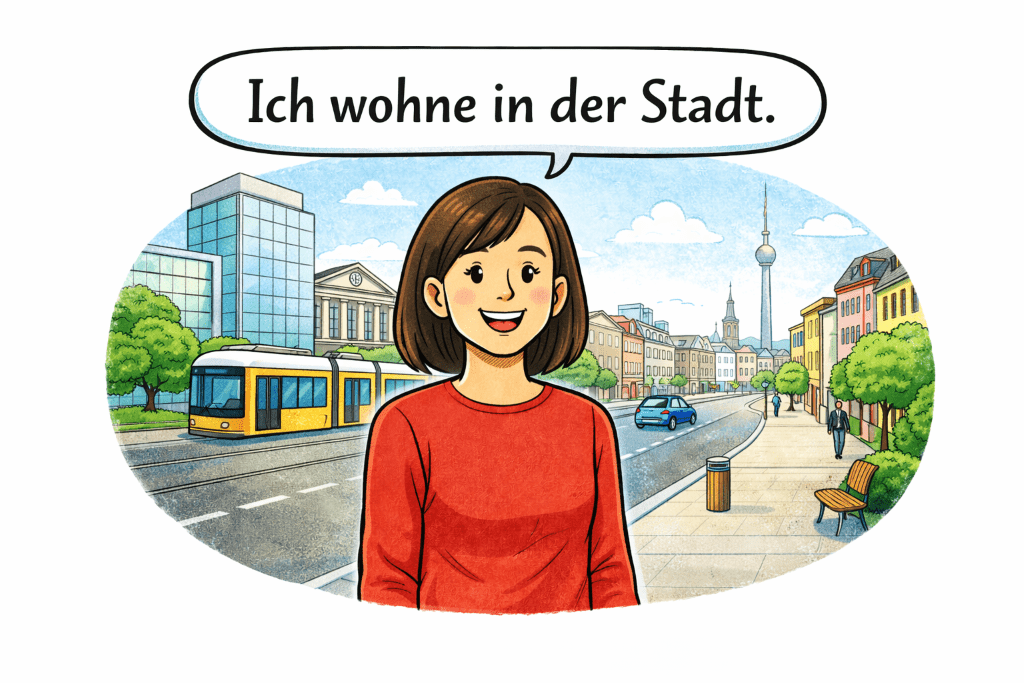
Another important beginner topic is saying where you live.
Formula:
Ich wohne in + city/place
Examples:
- Ich wohne in Berlin. = I live in Berlin.
- Ich wohne in der Stadt. = I live in the city.
- Ich wohne in den USA. = I live in the USA.
These phrases are simple and practical for talking about your daily life naturally.
What Language You Speak
Languages are a common topic in beginner German, especially in school or language-learning settings.
Formula:
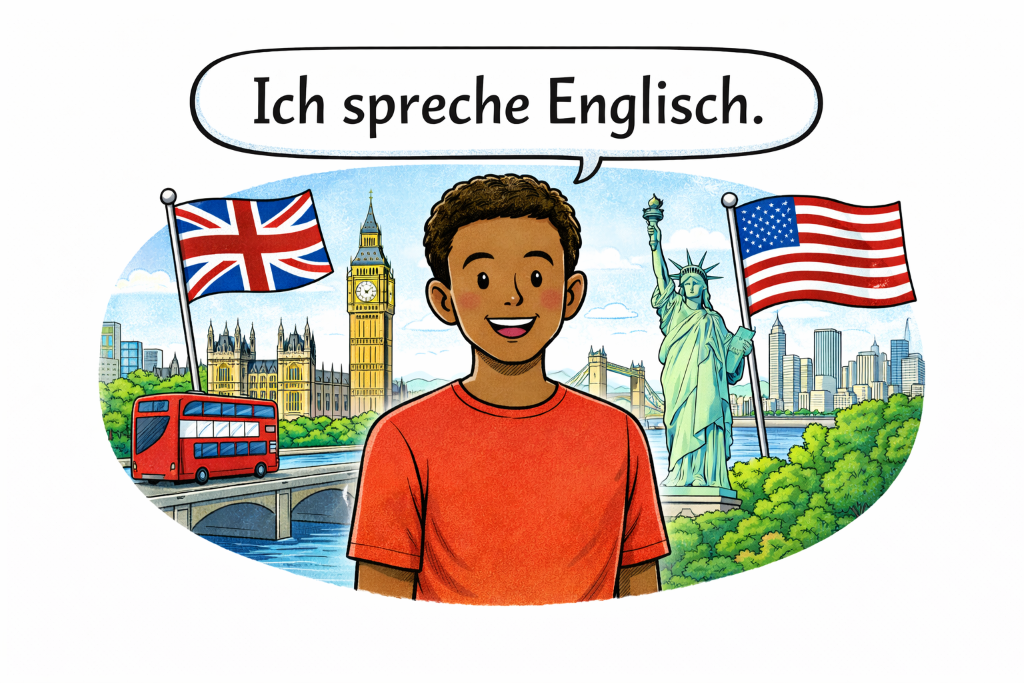
Ich spreche + language
Examples:
- Ich spreche Englisch. = I speak English.
- Ich spreche Deutsch. = I speak German.
- Ich spreche Englisch und Deutsch. = I speak English and German.
- Ich spreche ein bisschen Deutsch. = I speak a little German.
These phrases come up often when meeting new people.
Your Age in German
Here’s how to talk about age in German.
Formula:
Ich bin + number + Jahre alt
Examples:
- Ich bin 30 Jahre alt. = I am 30 years old.
- Ich bin 18 Jahre alt. = I am 18 years old.
- Ich bin 25 Jahre alt. = I am 25 years old.
If you want to build your own version of this sentence more easily, it helps to review German numbers and practice saying ages out loud.
What You Do
Beginners also need simple phrases to say whether they work or study.
Formula 1:
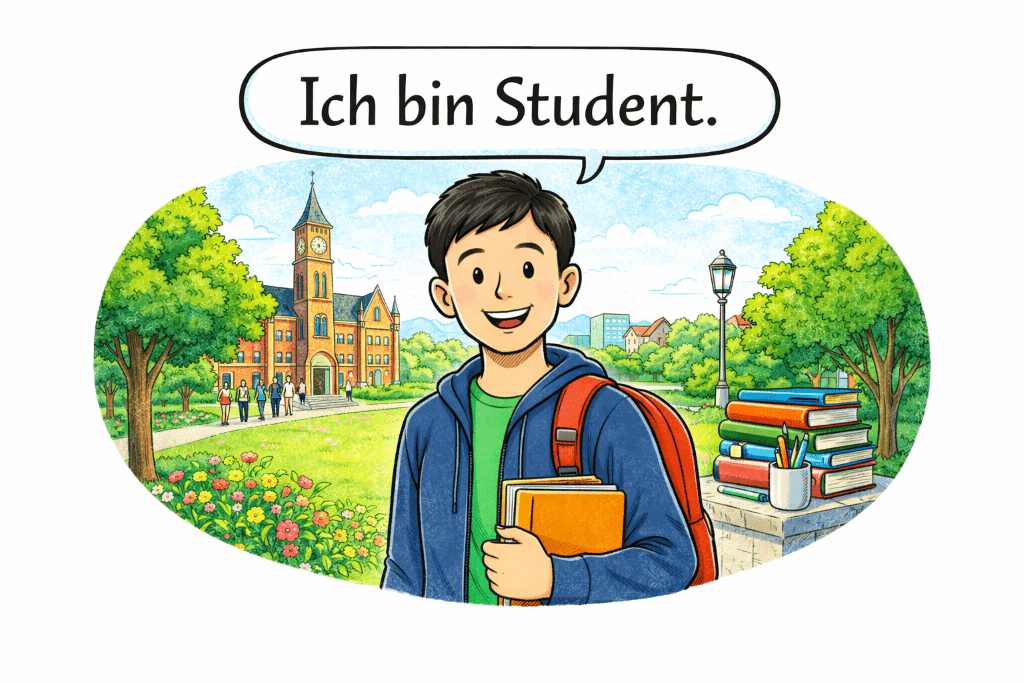
Ich bin + job
Examples:
- Ich bin Lehrer/in. = I’m a teacher. (male/female)
- Ich bin Student/in. = I’m a student.(male/female)
Formula 2:
Ich arbeite als + job
- Ich arbeite als Lehrer/in. = I work as a teacher.
- Ich arbeite als Ingenieur/in. = I work as an engineer.
Formula 3:
Ich studiere + subject
Examples:
- Ich studiere Deutsch. = I study German.
- Ich studiere Mathematik. = I study mathematics.
These phrases are useful in many beginner conversations.
What You Like
Once you know how to say where you are from, where you live, and what you do, the next step is talking about what you like. This makes your German sound more personal and more natural. At the beginner level, there are two very useful ways to do this.
You can talk about what you like with:
- ich mag + noun
- ich + verb + gern
Both patterns are common, but they are used in slightly different ways.
Formula: ich mag + noun
Use this pattern when you want to say that you like a thing.
Formula:
Ich mag + noun
Examples:
Ich mag
- Musik. = I like music.
- Kaffee. = I like coffee.
- Filme. = I like movies.
- Hunde. = I like dogs.
- Pizza. = I like pizza.
This pattern is simple and useful because you only need to change the noun.
Formula: ich + verb + gern
Use this pattern when you want to say that you like doing an activity.
Formula:
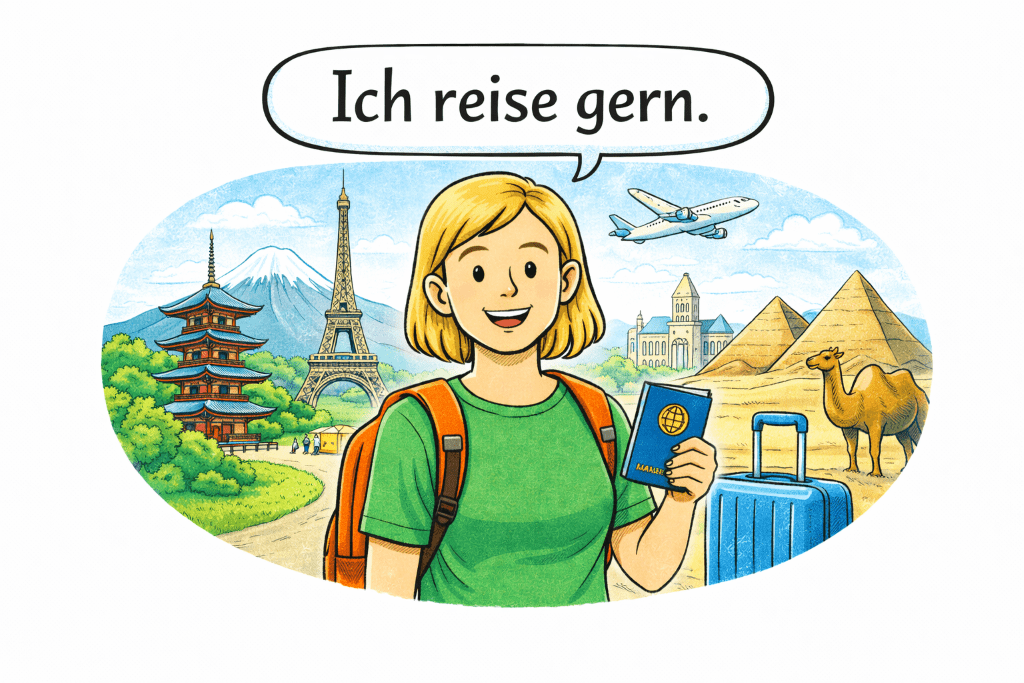
Ich + verb + gern
Examples:
- Ich lese gern. = I like reading.
- Ich höre gern Musik. = I like listening to music.
- Ich koche gern. = I like cooking.
- Ich reise gern. = I like traveling.
- Ich lerne gern Deutsch. = I like learning German.
This pattern is very common in German. Instead of saying “I like” plus an activity noun, German often uses gern with the verb.
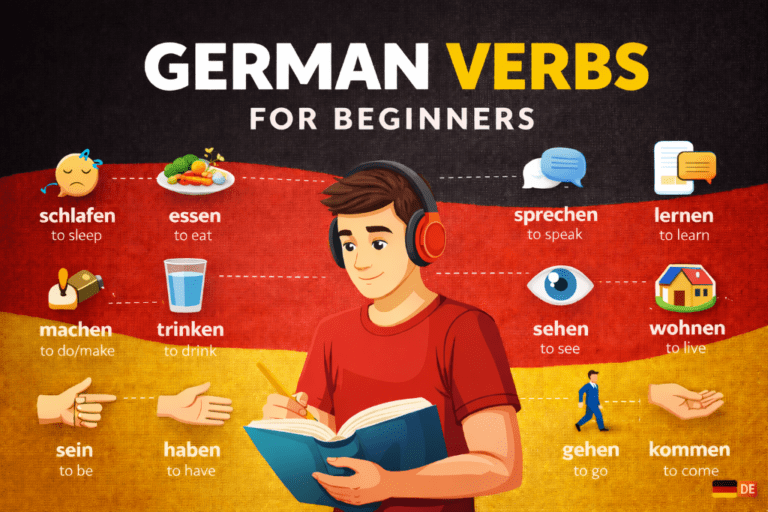
Tip: Learn the Most Common German Verbs for Beginners to start forming sentences with basic vocabulary.
What is the difference?
The difference is simple:
- Ich mag Musik. = I like music.
- Ich höre gern Musik. = I like listening to music.
The first sentence focuses on the thing.
The second sentence focuses on the activity.
Another example:
- Ich mag Bücher. = I like books.
- Ich lese gern. = I like reading.
Both are correct, but they do not say exactly the same thing.
How to Practice Talking About Yourself in German
The best way to learn these phrases is to turn them into your own short self-introduction.
Start by answering simple questions like:
- Where are you from?
- Where do you live?
- What language do you speak?
- How old are you?
- What do you do?
- What do you like?
- What do you do in your free time?
Then build 5 to 8 simple sentences about yourself.
Easy Practice Exercises
Complete these sentences with your own information.
- Ich komme aus _____.
- Ich wohne in _____.
- Ich spreche _____.
- Ich bin _____ Jahre alt.
- Ich mag _____.
Use 5 simple German sentences to talk about yourself.
Example structure:
- Ich komme aus _____.
- Ich wohne in _____.
- Ich spreche _____.
- Ich arbeite als _____.
- In meiner Freizeit _____.
Read your sentences out loud
After writing your sentences, read them out loud two or three times. This helps with memory, speaking confidence, and pronunciation. If you want extra speaking practice, use this German pronunciation guide while you say your sentences aloud.
Building Confidence with Simple German
Talking about yourself in German does not need to feel complicated. At the beginner level, short, clear phrases are enough. The goal is not to say everything. The goal is to say a few useful things well.
Start with your name, where you are from, where you live, and one or two things you like. Once that feels easy, add your age, your job, or your hobbies. Remember to learn A1/A2 German vocabulary alongside German Grammar to grow your language fluency.
FAQ: Talking About Yourself in German
What is the easiest way to start talking about yourself in German?
The easiest way is to use short, simple sentences such as:
- Ich komme aus den USA. = I come from the USA.
- Ich wohne in Florida. = I live in Florida.
- Ich spreche Englisch. = I speak English.
- Ich lerne Deutsch. = I am learning German.
These phrases are easy to remember and useful in real conversation.
How do you say where you are from in German?
You can say: Ich komme aus den USA. = I come from the USA.
Just keep the same structure and change the country or place.
How do you say your age in German?
You say: Ich bin 30 Jahre alt. = I am 30 years old.
This same pattern works with any age.
How do you talk about what you like in German?
There are two common beginner patterns:
- Ich mag Musik. = I like music.
- Ich lese gern. = I like reading.
Use ich mag + noun for things and ich + verb + gern for activities.
How do you talk about hobbies in German?
A useful beginner phrase is: In meiner Freizeit lese ich gern. = In my free time, I like to read.
You can replace the activity with other hobbies such as listening to music, walking, or studying German.