German Days of the Week, Months, and Time
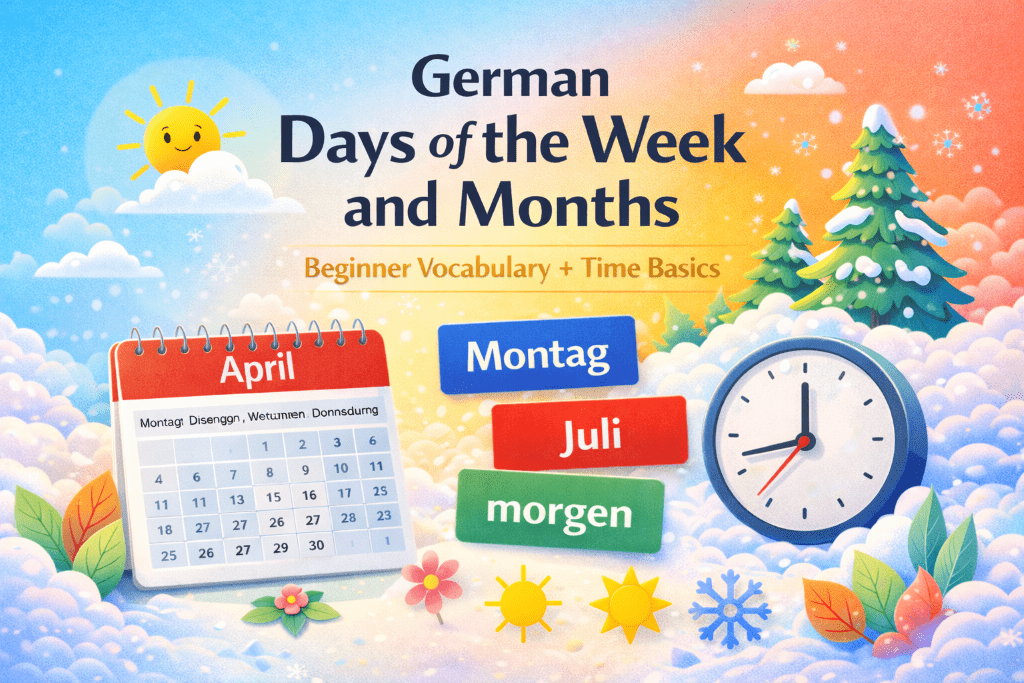
Learning German days, months, and time vocabulary gives you a fast way to talk about real life. You need these words to make plans, talk about your schedule, say when something happens, and understand basic conversations.
This guide covers the most important beginner vocabulary for days of the week, months, seasons, and telling time. You’ll also find example sentences so you can start using these words naturally.
If you are still building your basics, start with our German vocabulary for beginners guide for more essential everyday words.
Days of the Week
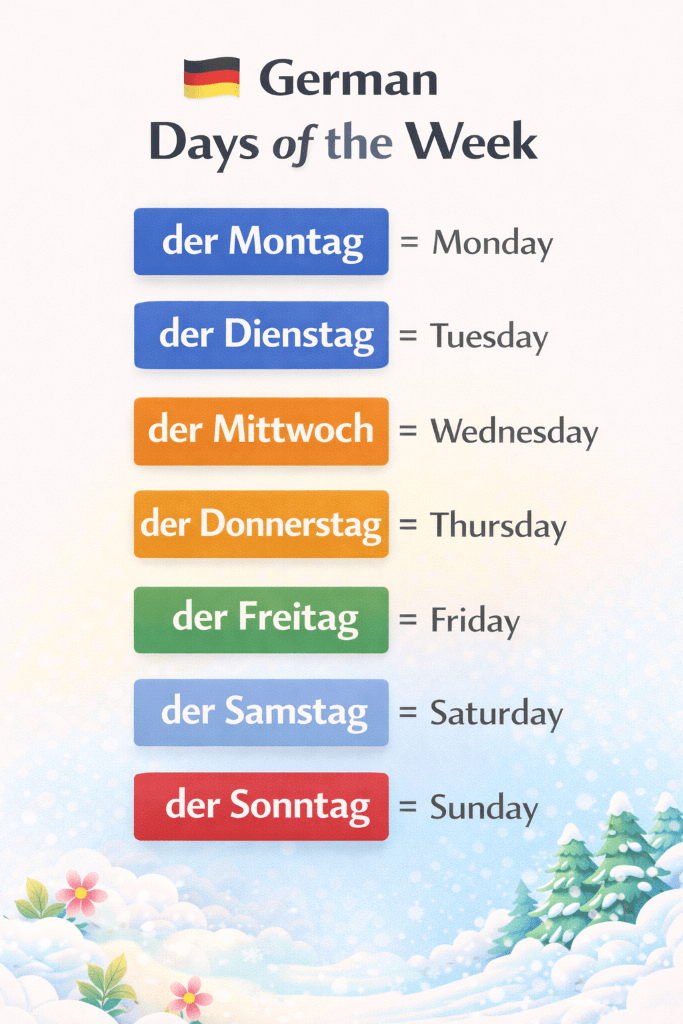
Here are the seven days of the week.
- der Montag = Monday
- der Dienstag = Tuesday
- der Mittwoch = Wednesday
- der Donnerstag = Thursday
- der Freitag = Friday
- der Samstag = Saturday
- der Sonntag = Sunday
In everyday German, you may also hear Sonnabend instead of Samstag in some regions.
Example Sentences
Heute ist Montag.
Today is Monday.
Ich arbeite am Freitag.
I work on Friday.
Wir fahren am Sonntag nach Berlin.
We are going to Berlin on Sunday.
Am Mittwoch habe ich Deutschunterricht.
I have German class on Wednesday.
Useful Day Words
These time words are very common and go well with the days of the week.
- heute = today
- morgen = tomorrow
- gestern = yesterday
- übermorgen = the day after tomorrow
- vorgestern = the day before yesterday
- jeden Tag = every day
- am Wochenende = on the weekend
Example Sentences
Heute lerne ich Deutsch.
Today I am learning German.
Morgen habe ich keine Zeit.
Tomorrow I do not have time.
Gestern war ich müde.
Yesterday I was tired.
Am Wochenende schlafe ich länger.
I sleep longer on the weekend.
Months
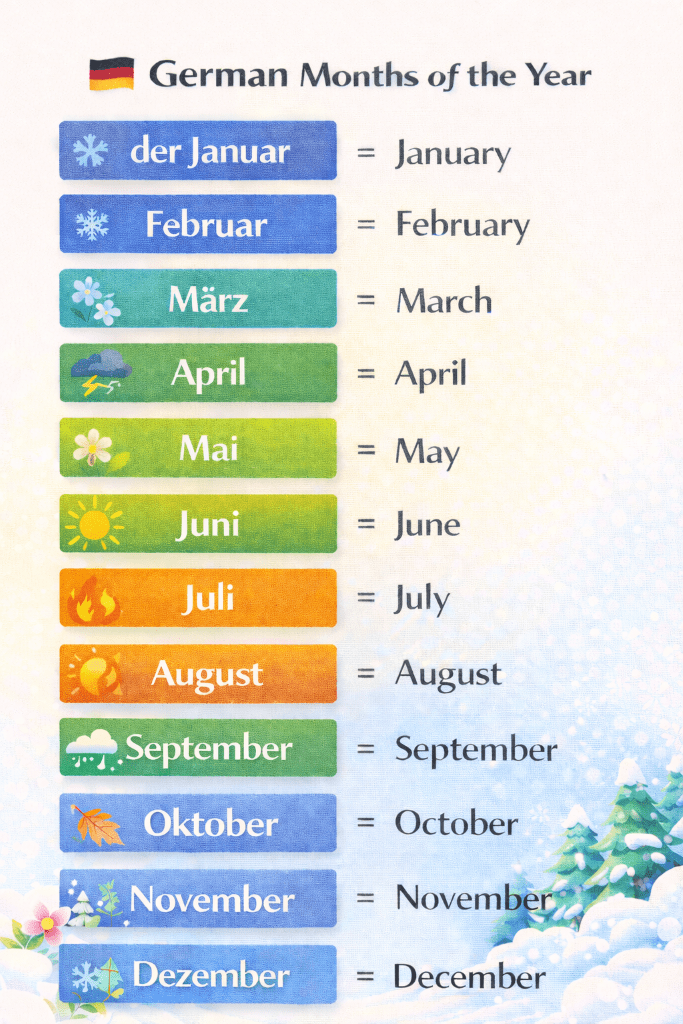
These are the twelve months. All of the months are masculine and take the definite article der.
- Januar = January
- Februar = February
- März = March
- April = April
- Mai = May
- Juni = June
- Juli = July
- August = August
- September = September
- Oktober = October
- November = November
- Dezember = December
Many of these look similar to English, which makes them easier to learn.
Example Sentences
Mein Geburtstag ist im Mai.
My birthday is in May.
Im Dezember ist es kalt.
It is cold in December.
Wir haben im August Urlaub.
We have vacation in August.
Der Kurs beginnt im Januar.
The course begins in January.
Seasons
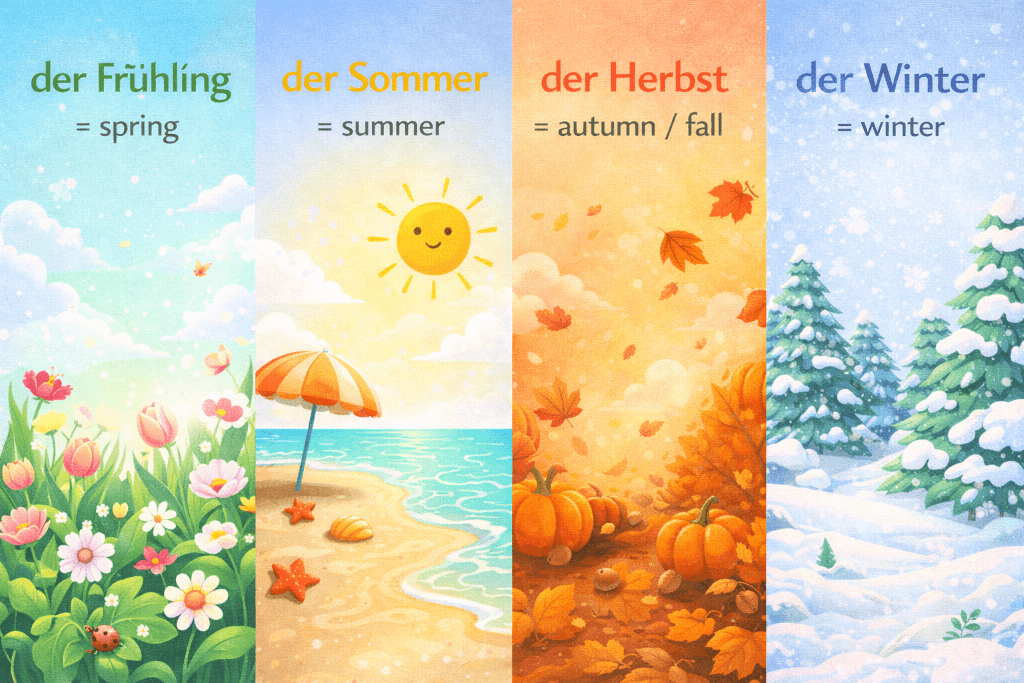
The four seasons are also important beginner vocabulary.
- der Frühling = spring
- der Sommer = summer
- der Herbst = autumn / fall
- der Winter = winter
Example Sentences
Im Frühling sind die Blumen schön.
The flowers are beautiful in spring.
Im Sommer ist es heiß.
It is hot in summer.
Ich mag den Herbst.
I like autumn.
Im Winter schneit es oft.
It often snows in winter.
If you want to expand this topic, see our German weather phrases guide for more everyday weather language.
Basic Time Vocabulary
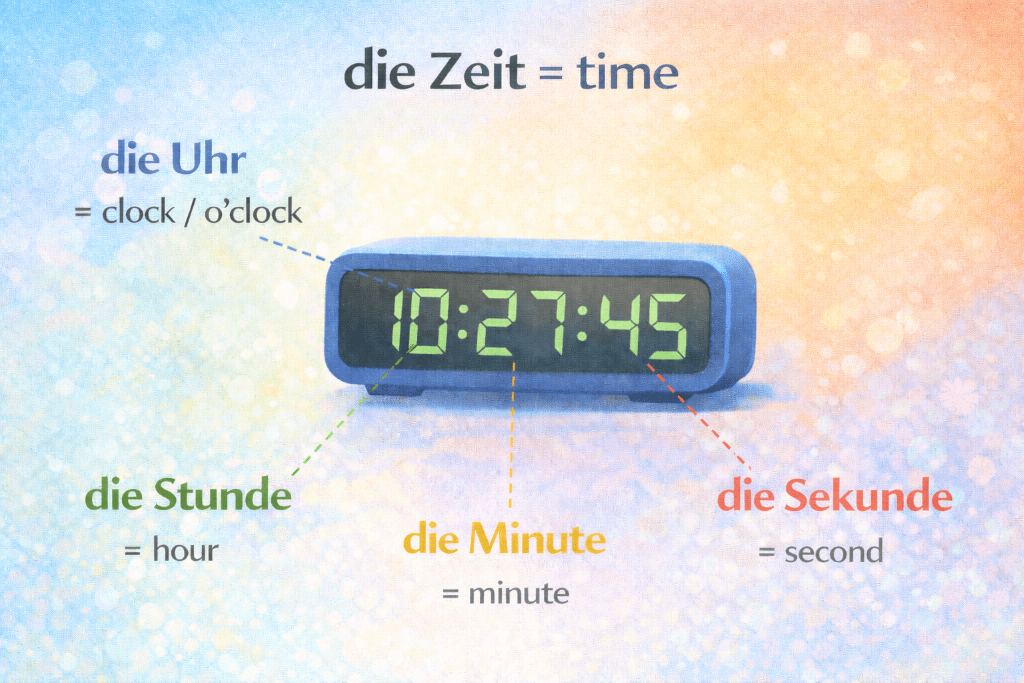
Before you learn full clock expressions, it helps to know these essential words.
- die Zeit = time
- die Uhr = clock/o’clock
- die Stunde = hour
- die Minute = minute
- die Sekunde = second
- früh = early
- spät = late
- jetzt = now
- gleich = soon / in a moment
Example Sentences
Ich habe keine Zeit.
I do not have time.
Es ist spät.
It is late.
Ich komme gleich.
I’ll be there soon.
Der Film dauert eine Stunde.
The movie lasts one hour.
How to Ask the Time
This is the most common question:
Wie spät ist es?
What time is it?
You can also ask:
Wie viel Uhr ist es?
What time is it?
Both are common and correct.
Example Answers
Es ist drei Uhr.
It is three o’clock.
Es ist sieben Uhr.
It is seven o’clock.
Es ist elf Uhr.
It is eleven o’clock.
Telling Time
The easiest beginner pattern is:
Es ist + number + Uhr
Examples:
- Es ist ein Uhr. = It is one o’clock.
- Es ist zwei Uhr. = It is two o’clock.
- Es ist fünf Uhr. = It is five o’clock.
- Es ist neun Uhr. = It is nine o’clock.
Once you know the numbers, telling time in German becomes much easier. If you need a refresher, visit our Numbers in German guide.
Common German Time Expressions
These are useful when talking about your day.
- am Morgen = in the morning
- am Vormittag = in the late morning
- am Mittag = at noon / around midday
- am Nachmittag = in the afternoon
- am Abend = in the evening
- in der Nacht = at night
Example Sentences
Am Morgen trinke ich Kaffee.
I drink coffee in the morning.
Am Nachmittag lerne ich Deutsch.
I study German in the afternoon.
Am Abend sehe ich fern.
I watch TV in the evening.
In der Nacht schlafe ich.
I sleep at night.
Talking About Your Schedule in German
Days, months, and time words are most useful when you combine them to talk about your routine.
Example Sentences
Am Montag arbeite ich von neun Uhr bis fünf Uhr.
On Monday I work from nine o’clock to five o’clock.
Im Juli fahre ich in den Urlaub.
In July I go on vacation.
Am Samstag treffe ich meine Freunde.
On Saturday I meet my friends.
Morgen habe ich um acht Uhr einen Termin.
Tomorrow I have an appointment at eight o’clock.
Mein Deutschkurs ist am Dienstagabend.
My German course is on Tuesday evening.
Days, Months, and Time in Real Life
This vocabulary comes up everywhere:
- making plans
- booking appointments
- talking about school or work
- asking when something starts
- describing your routine
That is why this is one of the most practical beginner topics you can learn early.
If you want to keep building useful everyday language, explore our basic German phrases for beginners and German travel vocabulary guides.
Tips for Learning German Time Vocabulary Faster
Learn the days in order
Start with Monday through Sunday and repeat them until they feel automatic.
Connect months to real events
Think of your birthday, holidays, or travel plans.
Practice with your own schedule
Make simple sentences about your actual life:
- Am Freitag arbeite ich.
- Im Oktober habe ich Geburtstag.
- Es ist jetzt acht Uhr.
FAQ: German Days, Months, and Time
What is Monday in German?
Monday in German is der Montag.
What is Sunday in German?
Sunday in German is der Sonntag.
What is January in German?
January in German is der Januar.
How do you ask the time in German?
You can ask:
Wie spät ist es?
or
Wie viel Uhr ist es?
How do you say “It is three o’clock” in German?
You say:
Es ist drei Uhr. (in the night) Es ist fünfzehn Uhr. (in the afternoon)
Final Thoughts
German days, months, and time vocabulary are essential for beginner conversations. These words help you talk about your schedule, understand plans, and describe everyday life more naturally.
Start with the days of the week and the basic clock phrases first. Then add months, seasons, and time expressions as you go. Once these words become familiar, many basic German conversations feel much easier.
To keep building your beginner vocabulary, visit our learn German vocabulary hub.