German Drinks Vocabulary and How to Order Them
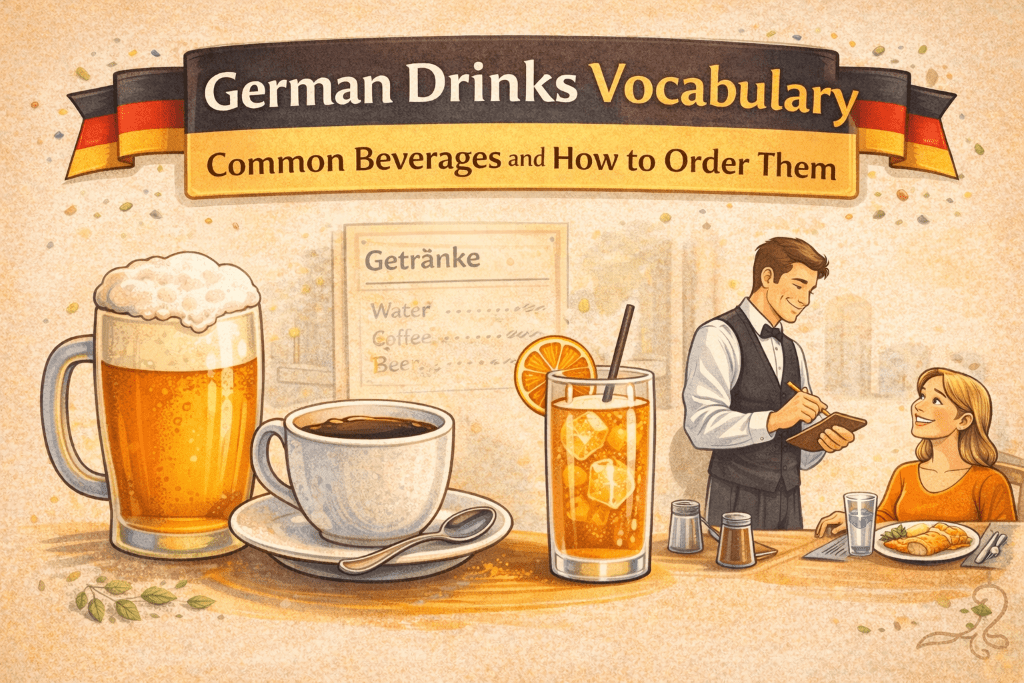
German Drinks Vocabulary: Common Beverages and How to Order Them
German drinks vocabulary is essential when you are at a restaurant, café, or bar. Whether you want coffee, water, or a beer, these are the words you will see and use most often in everyday situations.
If you are learning food-related terms, start with our German food vocabulary guide to build a strong foundation.
The Basic Word for Drinks in German
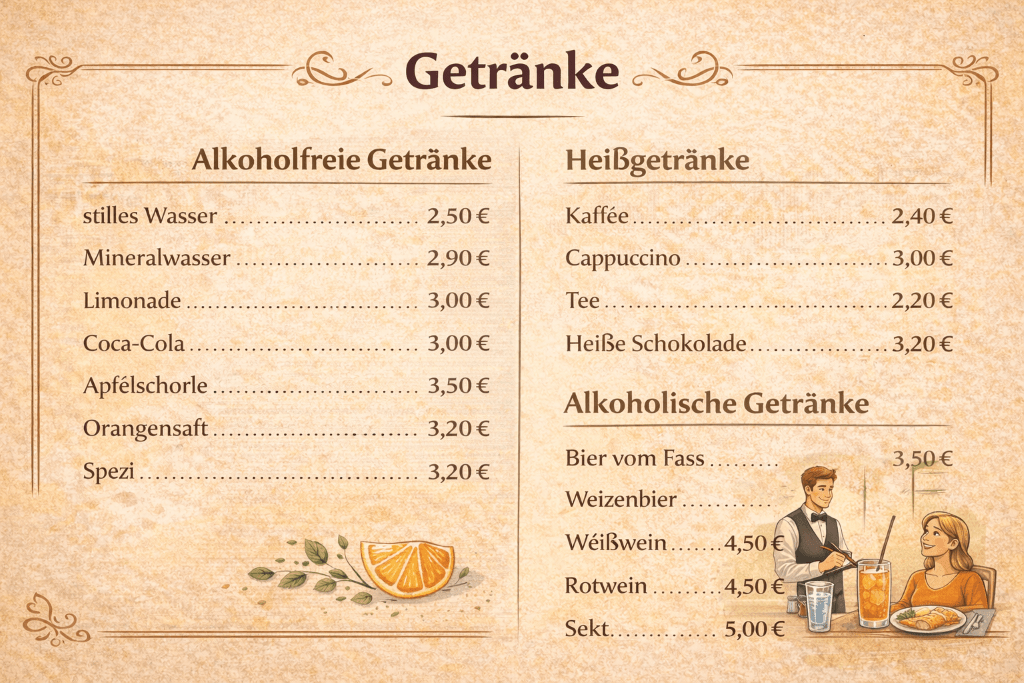
The main word for drinks or beverages in German is die Getränke.
You will often see this on menus as a section heading.
Example sentence:
Die Getränke stehen auf der letzten Seite der Speisekarte.
The drinks are on the last page of the menu.
Another useful word is das Getränk, which means a single drink or beverage.
Example sentence:
Welches Getränk möchtest du?
Which drink would you like?
Common German Drinks Vocabulary
The easiest way to learn drink vocabulary is by category.
If you also want to learn more about how to order from a German menu, see the German menu vocabulary guide.
Water and Soft Drinks
These are some of the most common drinks you will see in German-speaking countries:
- das Wasser = water
- das Mineralwasser = sparkling mineral water
- das stille Wasser = still water
- das Leitungswasser = tap water
- die Limonade = lemonade or soft drink
- die Cola = cola
- der Saft = juice
- der Orangensaft = orange juice
- der Apfelsaft = apple juice
- die Schorle = juice mixed with sparkling water
Example sentences:
Ich trinke morgens nur Wasser.
I only drink water in the morning.
Möchtest du stilles Wasser oder Mineralwasser?
Would you like still water or sparkling water?
Zum Frühstück trinke ich oft Orangensaft.
I often drink orange juice with breakfast.
In Deutschland bestellen viele Leute eine Apfelschorle.
In Germany, many people order an apple spritzer.
One important note for learners: if you ask for Wasser in Germany, you may be asked whether you want stilles Wasser or Mineralwasser. That distinction matters a lot in real life.
Coffee and Hot Drinks
German-speaking countries have a strong café culture, so these words come up often:
- der Kaffee = coffee
- der Espresso = espresso
- der Cappuccino = cappuccino
- der Latte Macchiato = latte macchiato
- der Tee = tea
- der Kräutertee = herbal tea
- der Schwarztee = black tea
- der Früchtetee = fruit tea
- die heiße Schokolade = hot chocolate
Example sentences:
Ich hätte gern einen Kaffee, bitte.
I would like a coffee, please.
Meine Freundin bestellt immer einen Cappuccino.
My friend always orders a cappuccino.
Am Abend trinke ich lieber Tee als Kaffee.
In the evening, I prefer tea to coffee.
Milk and Other Everyday Drinks
These are also useful, especially in daily conversation:
- die Milch = milk
- die Hafermilch = oat milk
- die Mandelmilch = almond milk
- der Kakao = cocoa
- der Smoothie = smoothie
Example sentences:
Trinkst du deinen Kaffee mit Milch?
Do you drink your coffee with milk?
Ich nehme einen Smoothie ohne Zucker.
I’ll have a smoothie without sugar.
Alcoholic Drinks
Even if you do not drink alcohol, these words are still useful to understand menus and conversations:
- das Bier = beer
- das Weizenbier = wheat beer
- das Pils = pilsner
- der Wein = wine
- der Rotwein = red wine
- der Weißwein = white wine
- der Rosé = rosé
- der Sekt = sparkling wine
- der Cocktail = cocktail
Example sentences:
Er bestellt ein Bier zum Abendessen.
He orders a beer with dinner.
Ich trinke lieber Weißwein als Rotwein.
I prefer white wine to red wine.
Möchten Sie etwas Alkoholfreies?
Would you like something non-alcoholic?
Learn about drinks unique to Germany.
Useful Words for Ordering Drinks in German
Learning drink names is helpful, but real progress comes when you can actually order them.
Here are some words and phrases you will see often:
- mit Eis = with ice
- ohne Eis = without ice
- kalt = cold
- warm = warm
- heiß = hot
- groß = large
- klein = small
- ein Glas = a glass
- eine Flasche = a bottle
- eine Tasse = a cup
- alkoholfrei = non-alcoholic
Example sentences:
Ich hätte gern eine Cola ohne Eis.
I would like a cola without ice.
Kann ich ein großes Wasser bekommen?
Can I get a large water?
Sie nimmt eine Tasse Tee.
She is having a cup of tea.
How to Order Drinks in German
These are the most useful sentence patterns to memorize.
Ich hätte gern …
I would like …
Ich nehme …
I’ll take …
Für mich bitte …
For me, please …
Kann ich … bekommen?
Can I get …?
Haben Sie …?
Do you have …?
Example sentences:
Ich hätte gern ein Mineralwasser, bitte.
I would like a sparkling water, please.
Ich nehme einen Cappuccino.
I’ll have a cappuccino.
Kann ich einen Apfelsaft bekommen?
Can I get an apple juice?
Haben Sie auch Hafermilch?
Do you also have oat milk?
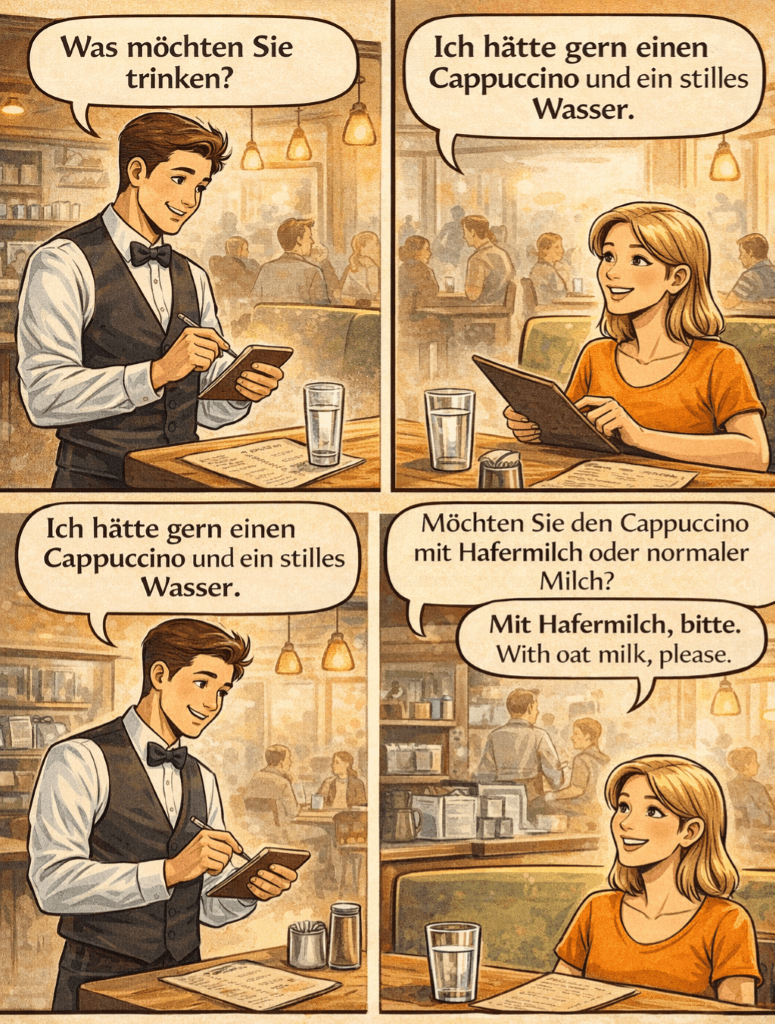
Sample Dialogue: Ordering Drinks in a Café
Here is a short dialogue that shows the vocabulary in action.
Kellner: Was möchten Sie trinken?
Waiter: What would you like to drink?
Gast: Ich hätte gern einen Cappuccino und ein stilles Wasser.
Guest: I would like a cappuccino and a still water.
Kellner: Möchten Sie den Cappuccino mit Hafermilch oder normaler Milch?
Waiter: Would you like the cappuccino with oat milk or regular milk?
Gast: Mit Hafermilch, bitte.
Guest: With oat milk, please.
That is exactly the kind of exchange where this vocabulary becomes useful. For full restaurant conversations, visit our German restaurant phrases guide.
FAQ: German Drinks Vocabulary
What does Getränke mean in German?
Getränke means drinks or beverages. You will often see it as a heading on restaurant menus.
How do you order a drink in German?
A simple way is to say Ich hätte gern … or Ich nehme …
Example:
Ich hätte gern einen Kaffee.
I would like a coffee.
What is the difference between stilles Wasser and Mineralwasser?
Stilles Wasser is still water. Mineralwasser is sparkling mineral water.
What is Schorle in German?
Schorle is a drink made by mixing juice with sparkling water. Apfelschorle is one of the most common examples.
Final Thoughts
German drinks vocabulary is one of the most practical parts of beginner German. You can use it immediately in cafés, restaurants, and everyday conversations. Start with the drinks you are most likely to order yourself, then learn a few key phrases like Ich hätte gern … and still oder mit Kohlensäure.
Once you can recognize common drink names and order them naturally, you will feel much more confident in real situations.