German Shapes: Basic Vocabulary for Beginners
Learning shapes in German is a simple way to build useful beginner vocabulary. These words come up in school, daily conversation, children’s books, descriptions, and even directions. Once you know the basic shape words, it becomes much easier to describe objects around you in German.
In this guide, you’ll learn the most important German shape words, how to use them in simple sentences, and a few helpful patterns that make them easier to remember.
If you are still building your basics, start with our German vocabulary for beginners guide for more essential everyday words.
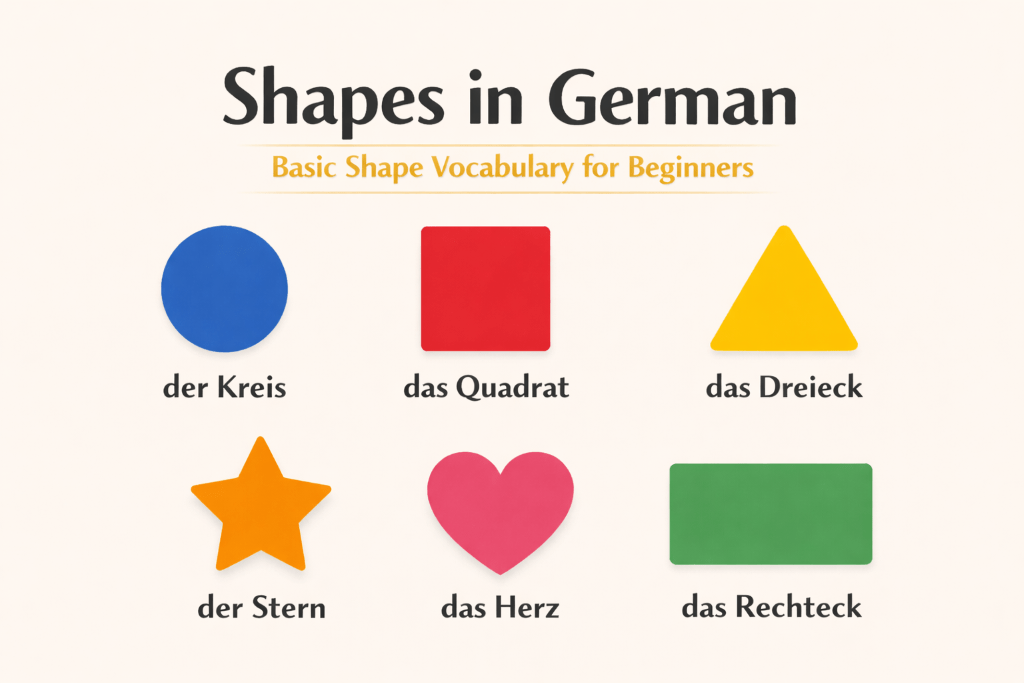
Basic Shapes in German
First, let’s explore the most fundamental shapes in German.
- der Kreis = circle
- das Quadrat = square
- das Rechteck = rectangle
- das Dreieck = triangle
- das Oval = oval
- der Stern = star
- das Herz = heart
Because every shape word has a gender, it helps to understand German noun gender early.
circle – der Kreis
oval – das Oval
rectangle – das Rechteck
square – das Quadrat
triangle – das Dreieck
These are the shapes you are most likely to see in beginner lessons and everyday descriptions.
Example Sentences
Der Kreis ist blau.
The circle is blue.
Das Quadrat ist groß.
The square is big.
Ich sehe ein Dreieck.
I see a triangle.
Das Herz ist rot.
The heart is red.
Der Stern ist gelb.
The star is yellow.
For most shapes with corners, count the number of corners, use the neuter article, das, and add –eck to the end.
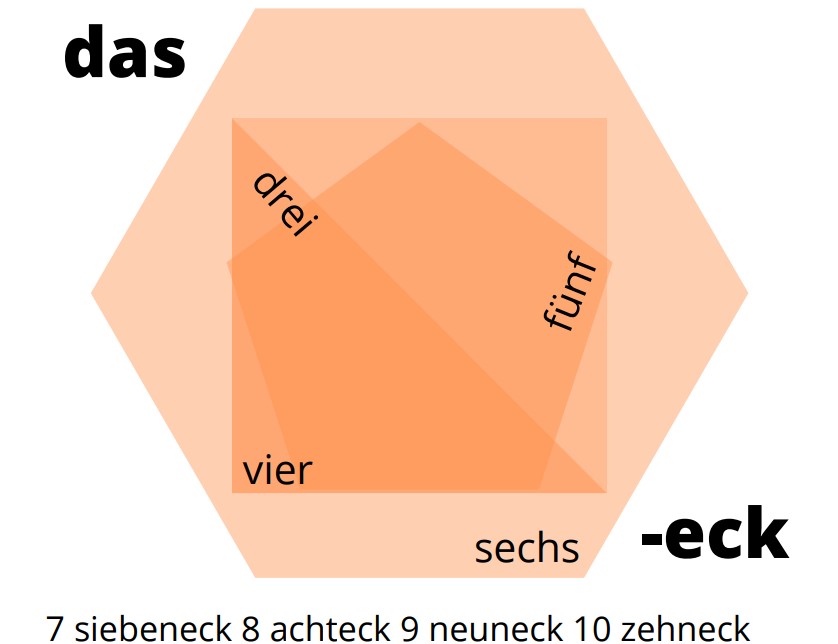
- das Dreieck – Triangle
- Viereck – Square
- Fünfeck – Pentagon
- Sechseck – Hexagon
- Siebeneck – Heptagon
- Achteck – Octagon
- Neuneck – Nonagon
- Zehneck – decagon
das Dreieck – Triangle
Viereck – Square
Fünfeck – Pentagon
Sechseck – Hexagon
Siebeneck – Heptagon
Achteck – Octagon
Neuneck – Nonagon
Zehneck – Decagon
This pattern makes the shapes above easier to remember than many of the others.
How to Ask About Shapes in German
Here are a few simple questions you can use when practicing.
Welche Form ist das?
What shape is that?
Ist das ein Kreis oder ein Oval?
Is that a circle or an oval?
Wie viele Ecken hat das?
How many corners does that have?
Example Answers
Das ist ein Rechteck.
That is a rectangle.
Nein, das ist kein Kreis. Das ist ein Oval.
No, that is not a circle. That is an oval.
Das Dreieck hat drei Ecken.
The triangle has three corners.
Shapes in German Sentences
The best way to remember vocabulary is to see it in context. Here are some beginner-friendly example sentences.
Das Fenster ist ein Rechteck.
The window is a rectangle.
Die Pizza ist ein Kreis.
The pizza is a circle.
Das Verkehrsschild ist ein Dreieck.
The traffic sign is a triangle.
Das Bild hat die Form eines Ovals.
The picture has the shape of an oval.
Ich male einen Stern.
I am drawing a star.
Das Kissen ist herzförmig.
The pillow is heart-shaped.
That last word, herzförmig, means heart-shaped. You do not need it at the beginner level, but it is a nice example of how German can build descriptive words.
Shapes and Everyday Objects
It helps to connect shapes with real objects around you.
In the classroom
- the clock = ein Kreis
- the book = ein Rechteck
- the paper = ein Rechteck
At home
- the table = ein Quadrat or ein Rechteck
- the plate = ein Kreis
- the mirror = ein Oval
In signs and symbols
- warning sign = ein Dreieck
- star symbol = ein Stern
- heart symbol = ein Herz
This is a simple way to practice shapes without memorizing random lists.
Shapes and Colors Together
Shapes and colors work well together because they help you describe things more clearly.
Examples:
Der Kreis ist rot.
The circle is red.
Das Quadrat ist grün.
The square is green.
Das Dreieck ist gelb.
The triangle is yellow.
If you want to keep building this topic, see our German colors guide for the most important beginner color words and example sentences.
Tips for Learning German Shapes Faster
Start with the most common shapes
Focus on:
- Kreis
- Quadrat
- Rechteck
- Dreieck
- Oval
These are the shapes you will use most often.
Practice with objects around you
Describe things you can actually see:
- Die Uhr ist rund.
- Das Handy ist rechteckig.
Learn shapes with colors
This makes the words easier to remember:
- ein roter Kreis
- ein blaues Rechteck
- ein gelbes Dreieck
If you want to understand why these words change in phrases like ein blaues Rechteck, see our German adjective endings guide.
Do not worry about every advanced geometry word yet
At beginner level, it is more useful to know common shapes well than to memorize long lists of specialized terms.
FAQ About Shapes in German
What is circle in German?
Circle in German is der Kreis.
What is square in German?
Square in German is das Quadrat.
What is triangle in German?
Triangle in German is das Dreieck.
What is rectangle in German?
Rectangle in German is das Rechteck.
How do you ask “What shape is that?” in German?
You can say Welche Form ist das?
Final Thoughts
Shapes in German are easy to learn and very useful for beginners. Start with the basic shape words first, then practice them with everyday objects and simple example sentences. Once you can describe both shapes and colors, your German becomes much more practical and visual.
To keep building your beginner vocabulary, visit our learn German vocabulary hub.