German Coordinating and Subordinating Conjunctions Made Easy
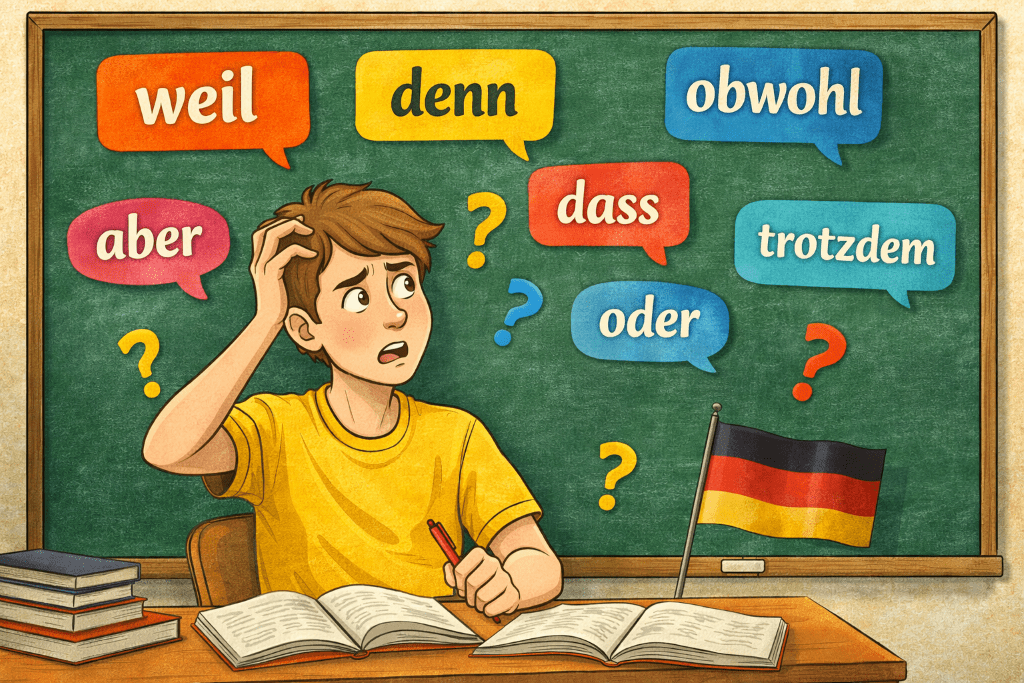
German coordinating and subordinating conjunctions look harmless at first. Then you write a sentence with weil, wenn, obwohl, or denn, and suddenly the verb is in the wrong place, and the whole sentence challenges everything you knew about German grammar.
That is why this topic frustrates so many learners. The hard part is knowing which conjunction to choose and how to adjust the word order. German grammar references consistently separate conjunctions into patterns because they do not all behave the same way in a sentence.
This guide will explain:
- What coordinating and subordinating conjunctions are
- Which conjunctions change word order
- How to use the most important conjunctions in real sentences
- Which lookalike pairs learners mix up most often
What are German Conjunctions?
Conjunctions are words that connect clauses, phrases, or ideas. In German, they do not change form for case, noun gender, or number, which is one small mercy in a language that usually loves endings.
A simple example:
Ich bleibe zu Hause, weil ich müde bin.
I’m staying home because I’m tired.
Without the conjunction weil, you would have two separate ideas. With it, you can show the relationship between them more clearly.
Why Some German Conjunctions Change Word Order and Others Do Not
Two German Conjunctions can mean the same thing, but each calls for a different sentence structure.
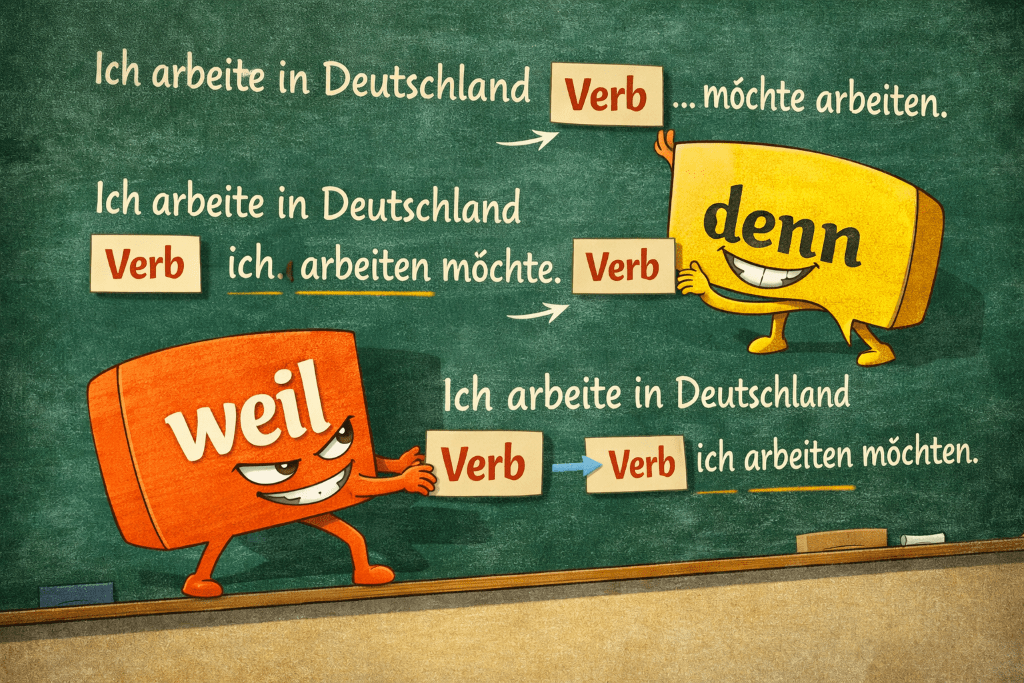
Take denn and weil for example. Both can mean because. The difference is not in the meaning but in the sentence structure.
Coordinating Conjunctions Keep Normal Word Order
Coordinating conjunctions connect two main clauses. After them, the sentence keeps its normal word order.
Example:
Ich bleibe zu Hause, denn ich bin müde.
I’m staying home because I’m tired.
With denn the second clause stays in normal order:
ich + bin + müde
Subordinating Conjunctions Send the Verb to the End
Subordinating conjunctions introduce a subordinate clause. In that clause, the conjugated verb moves to the end.
Example:
Ich bleibe zu Hause, weil ich müde bin.
I’m staying home because I’m tired.
This time, weil changes the word order:
ich + müde + bin
That is why you might feel confused. The meaning is the same, but the grammar is different.
Conjunctive Adverbs Create a Different Pattern
Words like deshalb are often grouped with conjunctions in everyday learning, but they behave differently. Instead of introducing a subordinate clause, they begin a new clause and trigger inversion.
Example:
Ich bin müde. Deshalb bleibe ich zu Hause.
I’m tired. That is why I’m staying home.
After deshalb, the verb comes before the subject:
Deshalb + bleibe + ich
The Pattern to Remember
If you want one simple takeaway, make it this:
- denn keeps the normal word order
- weil sends the verb to the end
- deshalb puts the verb before the subject
That one contrast helps explain why some connectors change German word order, and others don’t.
How to Use German Coordinating Conjunctions
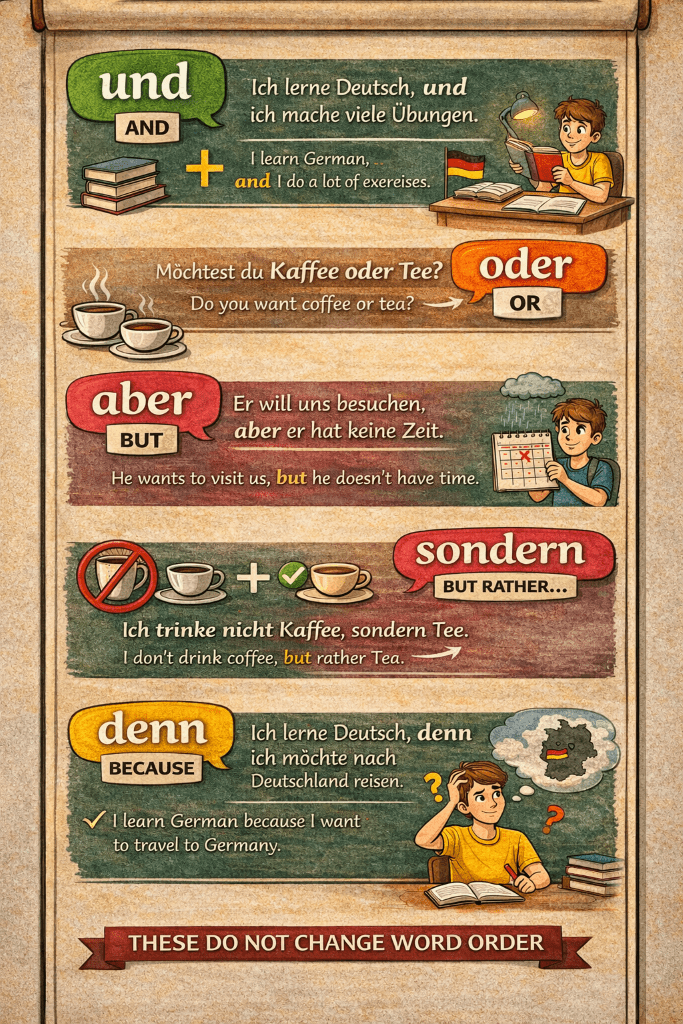
German coordinating conjunctions connect one main clause to another, and the sentence structure does not change.
The five most important coordinating conjunctions are:
- und – and
- oder – or
- aber – but
- denn – because
- sondern – but rather
und
Use und to add information.
Ich trinke Kaffee, und ich lese die Nachrichten.
I drink coffee, and I read the news.
oder
Use oder to show options.
Willst du Tee, oder möchtest du Kaffee?
Do you want tea, or would you like coffee?
aber
Use aber to show contrast.
Ich lerne gern Grammatik, aber ich vergesse oft die Endungen.
I like learning grammar, but I often forget the endings.
denn
Denn gives a reason, like because, but it keeps the normal word order. It also cannot start a sentence the way a well clause can.
Ich bleibe heute zu Hause, denn ich bin krank.
I’m staying home today because I’m sick.
Not possible:
Denn ich bin krank, bleibe ich heute zu Hause.
sondern
Sondern is not just another word for aber. Use sondern after a negation when English would mean “but rather” or “but instead.”
Ich trinke nicht Kaffee, sondern Tee.
I’m not drinking coffee, but rather tea.
Compare:
Ich trinke keinen Kaffee, aber ich trinke Tee.
I don’t drink coffee, but I do drink tea.
Ich trinke keinen Kaffee, sondern Tee.
I don’t drink coffee, but rather tea.
That second sentence is tighter and more precise.
How to Use German Subordinating Conjunctions
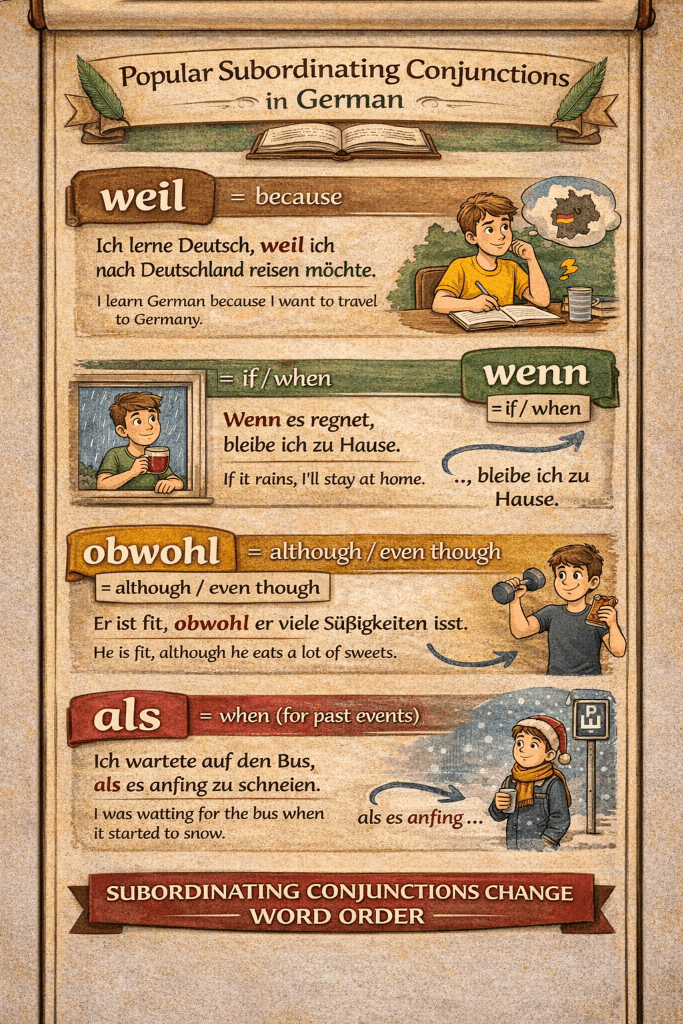
German subordinating conjunctions introduce a subordinate clause. In this case, the conjugated verb goes to the end. If the subordinate clause comes first, the main clause still follows the normal German rule that the verb must be in the second position of the clause. The subordinate clause is also separated from the main clause by a comma.
Ich bleibe zu Hause, weil ich krank bin.
I’m staying home because I’m sick.
Weil ich krank bin, bleibe ich zu Hause.
Because I’m sick, I’m staying home.
The most important subordinating conjunctions are:
- weil – because
- da – since
- dass – that
- wenn – when, if
- als – when
- obwohl – although
- ob – whether, if
- falls – in case
- nachdem – after
- damit – so that
weil
Weil is one of the most common German subordinating conjunctions. It gives a reason and sends the verb to the end.
Ich lerne Deutsch, weil ich in Europa gelebt habe.
I’m learning German because I have lived in Europe.
da
Da also gives a reason and usually sounds a little more formal than weil.
Da ich morgen früh aufstehen muss, gehe ich jetzt schlafen.
Since I have to get up early tomorrow, I’m going to sleep now.
dass
Dass introduces a content clause.
Ich finde, dass Deutsch logisch ist.
I find that German is logical.
wenn
Wenn can mean if or when. It is used for present and future time, and for repeated events in the past.
Ich lese auf Deutsch, wenn ich Zeit habe.
I read in German when I have time.
als
Als is used for a completed event or time in the past, especially a one-time event.
Ich habe jeden Tag neue Wörter gelernt, als ich in Deutschland war.
I learned new words every day when I was in Germany.
obwohl
Obwohl introduces contrast and still sends the verb to the end.
Ich mache noch meine Hausaufgaben, obwohl ich müde bin.
Although I’m tired, I’m still doing my homework.
ob
Ob is used when English could also say whether. That is the clearest rule.
Ich weiß nicht, ob er heute kommt.
I don’t know whether he is coming today.
falls
Falls is close to wenn, but it often feels more like “in case.”
Falls es regnet, bleiben wir drinnen.
If it rains, we’ll stay inside.
bevor
Ich dusche, bevor ich zur Arbeit gehe.
I shower before I go to work.
nachdem
Nachdem ich gegessen habe, mache ich einen Spaziergang.
After I have eaten, I take a walk.
damit
Damit introduces purpose with a subordinate clause.
Ich spreche langsam, damit du alles verstehst.
I speak slowly so that you understand everything.
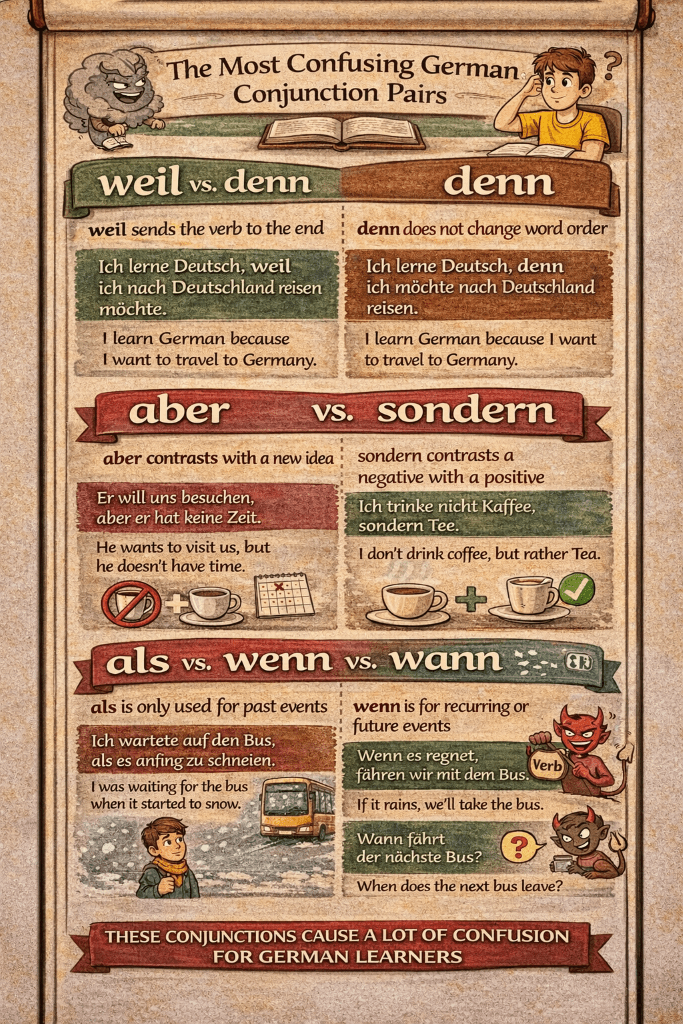
German conjunction comparison infographic showing weil vs denn, aber vs sondern, and als vs wenn vs wann with example sentences
The Most Confusing German Conjunction Pairs
Some German conjunction pairs are a little more confusing than others. Learn how to use them correctly below.
weil vs. denn
Both words mean “because.” The difference is in the word order. Weil is subordinating, so the verb goes to the end. Denn is coordinating, so the normal clause order stays in place. A denn clause also cannot come first.
Ich bleibe zu Hause, weil ich krank bin.
I’m staying home because I’m sick.
Ich bleibe zu Hause, denn ich bin krank.
I’m staying home because I’m sick.
Wrong:
Denn ich bin krank, bleibe ich zu Hause.
Practical tip:
Use weil more often in everyday speech. Use denn when you want a cleaner written rhythm and normal word order.
aber vs. sondern
Use aber for general contrast. Use sondern after a negation when you are correcting or replacing the first idea.
Ich bin müde, aber ich arbeite noch.
I’m tired, but I’m still working.
Ich bin nicht müde, sondern gestresst.
I’m not tired, but stressed.
A fast test: if “but rather” works in English, sondern is probably the better choice.
als vs. wenn vs. wann
This is one of the biggest pain points in German.
Use:
- Als – one-time completed events in the past
- Wenn – present or future time, and repeated past events
- Wann – direct and indirect questions about when something happens
Als ich klein war, hatte ich Angst vor Hunden.
When I was little, I was afraid of dogs.
Wenn ich nach München fahre, besuche ich meine Freunde.
When I go to Munich, I visit my friends.
Ich weiß nicht, wann der Zug kommt.
I don’t know when the train is coming.
ob vs. wenn vs. falls
Use ob when you mean whether. Use wenn and falls for conditions. Falls often sounds more like “in case.”
Ich weiß nicht, ob sie Zeit hat.
I don’t know whether she has time.
Wenn sie Zeit hat, kommt sie mit.
If she has time, she’s coming along.
Falls sie krank ist, bleibt sie zu Hause.
If she is sick, she’ll stay home.
dass vs. das
Learners constantly confuse these because they sound the same.
Dass is a subordinating conjunction.
Das can be an article, a pronoun, or part of a relative clause.
Ich denke, dass er recht hat.
I think that he is right.
Das Buch, das ich lese, ist spannend.
The book that I am reading is exciting.
Memory trick:
If you can replace it with “this” or “that” as a thing, it is probably das.
If it introduces a whole clause after a verb like sagen, glauben, denken, wissen, it is often dass.
damit vs. um … zu
Use damit when the clause has its own subject.
Ich erkläre es langsam, damit du es verstehst.
I explain it slowly so that you understand it.
Use um … zu when the subject is the same.
Ich lerne viel, um die Prüfung zu bestehen.
I study a lot in order to pass the exam.
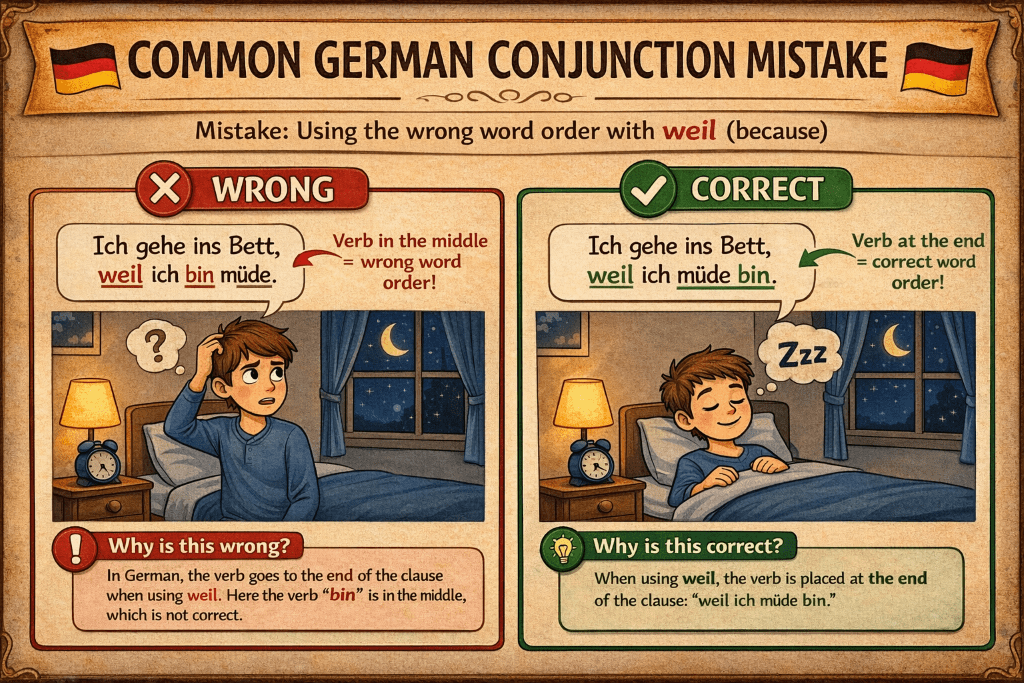
Common German Coordinating and Subordinating Conjunction Mistakes
Watch out for these common German conjunction mistakes. It’s easy to accidentally place German verbs in the wrong order.
1: Keeping the verb in the second position after a subordinating conjunction
Wrong: Ich bleibe zu Hause, weil ich bin krank.
Correct: Ich bleibe zu Hause, weil ich krank bin.
2: Using denn like weil
Wrong: Denn ich bin müde, gehe ich ins Bett.
Correct: Weil ich müde bin, gehe ich ins Bett.
Correct: Ich gehe ins Bett, denn ich bin müde.
3: Using wann instead of wenn or als
Wrong: Wann ich in Wien war, habe ich viel Kaffee getrunken.
Correct: Als ich in Wien war, habe ich viel Kaffee getrunken.
4: Using aber instead of sondern after a negation
Wrong: Ich esse nicht Fleisch, aber Fisch.
Correct: Ich esse nicht Fleisch, sondern Fisch.
5: Forgetting the comma before the subordinate clause
Wrong: Ich bleibe hier weil ich warten muss.
Correct: Ich bleibe hier, weil ich warten muss.

Basic Word Order Formulas for German Coordinating and Subordinating Conjunctions
These basic German word order formulas can help you learn how to build sentences with coordinating and subordinating conjunctions.
Coordinating conjunction
main clause + conjunction + main clause
Ich lerne Deutsch und mein Bruder lernt Englisch.
Subordinating conjunction
main clause + comma + conjunction + subject + … unconjugated verb + conjugated verb
Ich lerne Deutsch, weil ich in Berlin arbeiten möchte.
Subordinating Conjunction at the Beginning
conjunction + subject + unconjugated verb + conjugated verb + comma + verb + subject + rest
Weil ich in Berlin arbeiten möchte, lerne ich Deutsch.
If you can build those three patterns comfortably, your German will become much more accurate.

Practice exercises
Fill in the blank with the best conjunction.
- Ich bleibe zu Hause, _____ ich bin krank.
- Ich trinke keinen Kaffee, _____ Tee.
- _____ ich klein war, wohnte ich in einem Dorf.
- Ich weiß nicht, _____ er heute kommt.
- _____ du Zeit hast, können wir telefonieren.
- Ich gehe früh schlafen, _____ ich morgen arbeiten muss.
- Ich lerne viel, _____ die Prüfung zu bestehen.
- Es regnet. _____ bleiben wir heute drinnen.
- Ich mag den Film, _____ das Ende ist zu lang.
- Er spricht langsam, _____ alle ihn verstehen.
Answer key
- denn
- sondern
- als
- ob
- wenn
- weil
- um
- Deshalb
- aber
- damit
Final Thoughts on German Coordinating and Subordinating Conjunctions
If German conjunctions have ever felt random, they are not. They follow patterns. The problem is that learners are usually taught the vocabulary before they are taught the sentence logic.
Start with the big split:
- Coordinating conjunctions keep the normal word order
- Subordinating conjunctions send the verb to the end
Then learn the confusion pairs one by one:
- weil vs denn
- aber vs sondern
- als vs wenn vs wann
- ob vs wenn vs falls
Once those are clear, German sentences stop feeling backwards and start feeling structured.