German Verbs for Beginners: Vocabulary to Learn First
German Verbs for Beginners: Vocabulary to Learn First
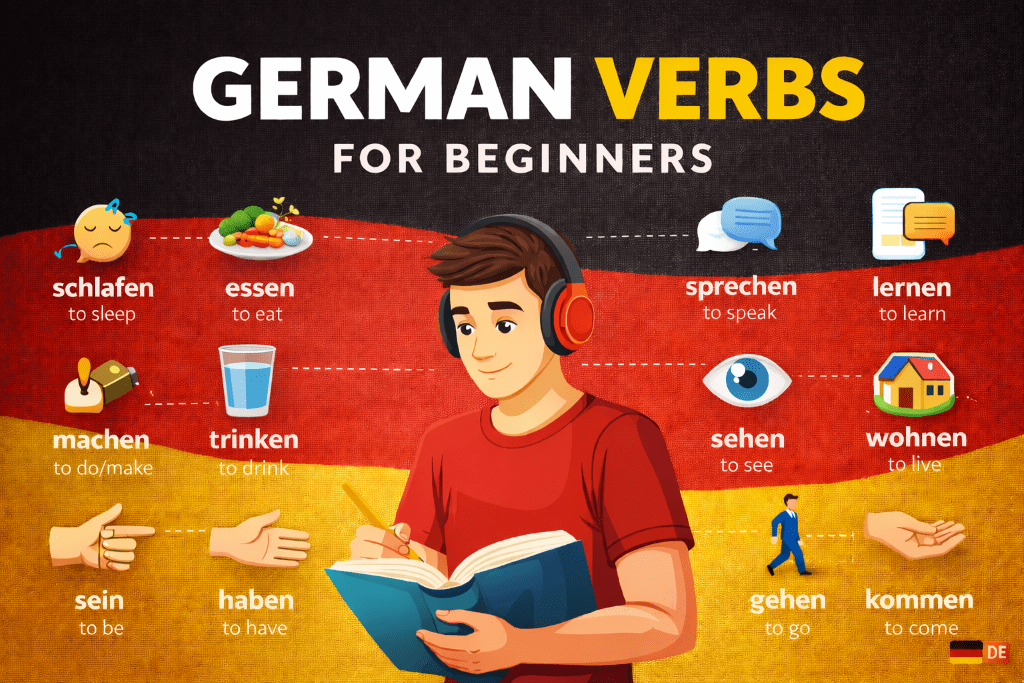
German verbs can feel intimidating at first, but as a beginner, you do not need hundreds of them to start building real sentences. You need a small group of high-frequency verbs that show up in daily conversations.
In this guide, you will learn the most useful German verbs for beginners, how to use them in simple sentences, and what patterns to notice early. Once you know these verbs, German starts to feel much more manageable.
If you are brand new to German, this post pairs well with my guides to German vocabulary for beginners, German present tense, and German verbs.
Why German Verbs Matter So Much
Verbs do most of the heavy lifting in a sentence. Once you know a few common ones, you can talk about who you are, what you want, where you go, what you have, and what you do every day.
For beginners, the smartest approach is not to memorize long random lists. Start with the verbs you will actually use in normal conversation.
A German Verbs List for Beginners
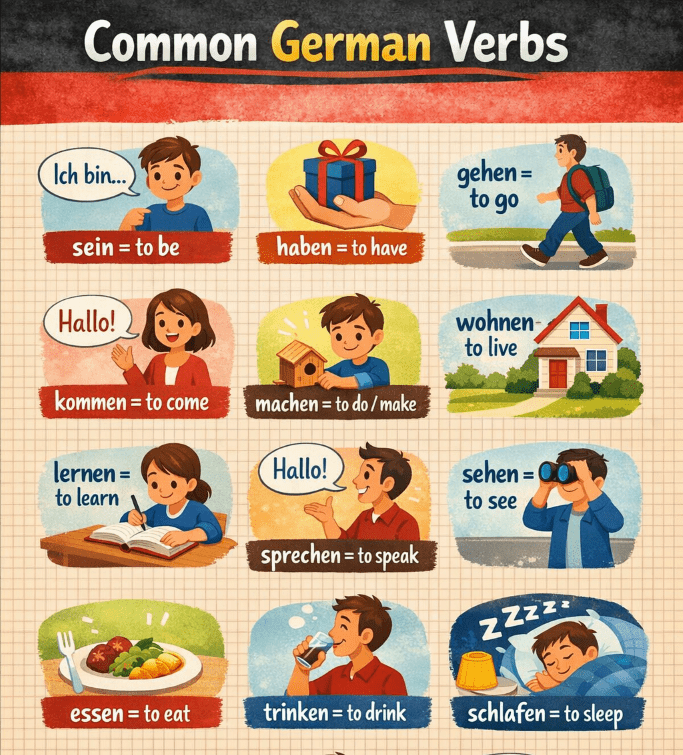
Here is a simple reference list:
- sein = to be
- haben = to have
- gehen = to go
- kommen = to come
- machen = to do/make
- wohnen = to live
- lernen = to learn
- sprechen = to speak
- sehen = to see
- essen = to eat
- trinken = to drink
- schlafen = to sleep
- arbeiten = to work
- spielen = to play
- brauchen = to need
The Most Useful German Verbs for Beginners
Here are some of the best first verbs to learn.
1. sein = to be
This is one of the most important verbs in German. You need it for introductions, descriptions, and basic facts.
| Pronoun | Conjugation |
| ich | bin |
| du | bist |
| er / sie / es | ist |
| wir | sind |
| ihr | seid |
| sie / Sie | sind |
Examples:
Ich bin müde.
I am tired.
Du bist nett.
You are nice.
Er ist mein Bruder.
He is my brother.
2. haben = to have
You will use haben constantly for age, possession, and common expressions.
| Pronoun | Conjugation |
| ich | habe |
| du | hast |
| er / sie / es | hat |
| wir | haben |
| ihr | habt |
| sie / Sie | haben |
Examples:
Ich habe ein Buch.
I have a book.
Wir haben Hunger.
We are hungry.
Sie hat zwei Kinder.
She has two children.
3. gehen = to go
This is a basic movement verb and one of the first verbs beginners should know.
| Pronoun | Conjugation |
| ich | gehe |
| du | gehst |
| er / sie / es | geht |
| wir | gehen |
| ihr | geht |
| sie / Sie | gehen |
Examples:
Ich gehe nach Hause.
I am going home.
Gehst du zur Schule?
Are you going to school?
Wir gehen heute ins Restaurant.
We are going to the restaurant today.
4. kommen = to come
Use kommen when talking about arrival or where someone is from.
| Pronoun | Conjugation |
| ich | komme |
| du | kommst |
| er / sie / es | kommt |
| wir | kommen |
| ihr | kommt |
| sie / Sie | kommen |
Examples:
Ich komme aus den USA.
I come from the USA.
Kommst du morgen?
Are you coming tomorrow?
Er kommt spät.
He is coming late.
5. machen = to do / to make
This is one of the most flexible German verbs for beginners.
| Pronoun | Conjugation |
| ich | mache |
| du | machst |
| er / sie / es | macht |
| wir | machen |
| ihr | macht |
| sie / Sie | machen |
Examples:
Was machst du?
What are you doing?
Ich mache meine Hausaufgaben.
I am doing my homework.
Wir machen Pizza.
We are making pizza.
6. wohnen = to live
This verb is very useful when talking about where you live.
| Pronoun | Conjugation |
| ich | wohne |
| du | wohnst |
| er / sie / es | wohnt |
| wir | wohnen |
| ihr | wohnt |
| sie / Sie | wohnen |
Examples:
Ich wohne in Berlin.
I live in Berlin.
Wo wohnst du?
Where do you live?
Sie wohnen in einer kleinen Stadt.
They live in a small town.
7. lernen = to learn
A perfect beginner verb because you will probably use it a lot.
| Pronoun | Conjugation |
| ich | lerne |
| du | lernst |
| er / sie / es | lernt |
| wir | lernen |
| ihr | lernt |
| sie / Sie | lernen |
Examples:
Ich lerne Deutsch.
I am learning German.
Lernst du jeden Tag?
Do you study every day?
Wir lernen zusammen.
We are learning together.
8. sprechen = to speak
This is one of the most practical verbs in any language course.
| Pronoun | Conjugation |
| ich | spreche |
| du | sprichst |
| er / sie / es | spricht |
| wir | sprechen |
| ihr | sprecht |
| sie / Sie | sprechen |
Examples:
Ich spreche ein bisschen Deutsch.
I speak a little German.
Sprichst du Englisch?
Do you speak English?
Er spricht sehr schnell.
He speaks very fast.
9. sehen = to see
Use sehen for people, places, movies, and everyday situations.
| Pronoun | Conjugation |
| ich | sehe |
| du | siehst |
| er / sie / es | sieht |
| wir | sehen |
| ihr | seht |
| sie / Sie | sehen |
Examples:
Ich sehe den Hund.
I see the dog.
Siehst du das Haus?
Do you see the house?
Wir sehen einen Film.
We are watching a movie.
10. essen = to eat
Food vocabulary becomes much easier once you know essen.
| Pronoun | Conjugation |
| ich | esse |
| du | isst |
| er / sie / es | isst |
| wir | essen |
| ihr | esst |
| sie / Sie | essen |
Examples:
Ich esse Brot.
I eat bread.
Was isst du gern?
What do you like to eat?
Wir essen heute Pasta.
We are eating pasta today.
11. trinken = to drink
Another essential daily-life verb.
| Pronoun | Conjugation |
| ich | trinke |
| du | trinkst |
| er / sie / es | trinkt |
| wir | trinken |
| ihr | trinkt |
| sie / Sie | trinken |
Examples:
Ich trinke Wasser.
I am drinking water.
Trinkst du Kaffee?
Do you drink coffee?
Sie trinkt Tee.
She drinks tea.
12. schlafen = to sleep
This is common, simple, and easy to use in many beginner sentences.
| Pronoun | Conjugation |
| ich | schlafe |
| du | schläfst |
| er / sie / es | schläft |
| wir | schlafen |
| ihr | schlaft |
| sie / Sie | schlafen |
Examples:
Ich schlafe viel.
I sleep a lot.
Das Baby schläft.
The baby is sleeping.
Schläfst du gut?
Do you sleep well?
13. arbeiten = to work
A practical verb for daily routine conversations.
| Pronoun | Conjugation |
| ich | arbeite |
| du | arbeitest |
| er / sie / es | arbeitet |
| wir | arbeiten |
| ihr | arbeitet |
| sie / Sie | arbeiten |
Examples:
Ich arbeite heute.
I am working today.
Wo arbeitest du?
Where do you work?
Mein Vater arbeitet im Büro.
My father works in the office.
14. spielen = to play
This is useful for hobbies, games, sports, and music.
| Pronoun | Conjugation |
| ich | spiele |
| du | spielst |
| er / sie / es | spielt |
| wir | spielen |
| ihr | spielt |
| sie / Sie | spielen |
Examples:
Ich spiele Fußball.
I play soccer.
Spielst du Klavier?
Do you play piano?
Die Kinder spielen draußen.
The children are playing outside.
15. brauchen = to need
This verb is very useful in real conversations.
| Pronoun | Conjugation |
| ich | brauche |
| du | brauchst |
| er / sie / es | braucht |
| wir | brauchen |
| ihr | braucht |
| sie / Sie | brauchen |
Examples:
Ich brauche Hilfe.
I need help.
Brauchst du Geld?
Do you need money?
Wir brauchen mehr Zeit.
We need more time.
How to Use German Verbs in Simple Sentences
German sentence building gets much easier once you remember one beginner rule:
In a basic main clause, the conjugated verb usually comes in the second position.
Examples:
Ich lerne Deutsch.
Du kommst aus Kanada.
Wir trinken Kaffee.
That is why learning common verbs early helps so much. Once you have the verb, you can plug in new nouns and phrases around it.
Do Beginners Need to Learn Full Conjugation Tables?
Not at first.
You should start by learning these three things for each verb:
- the infinitive
- the ich form
- the du form
- the er/sie/es form
That already gives you enough to start speaking.
For example:
lernen
ich lerne
du lernst
er/sie/es lernt
machen
ich mache
du machst
er/sie/es macht
Which German Verbs Should Beginners Learn First?
Start with verbs that help you talk about:
- identity: sein
- possession: haben
- movement: gehen, kommen
- daily actions: machen, essen, trinken, schlafen, arbeiten
- communication: sprechen
- learning: lernen
- need and routine: brauchen, wohnen
This gives you a solid base for everyday German.
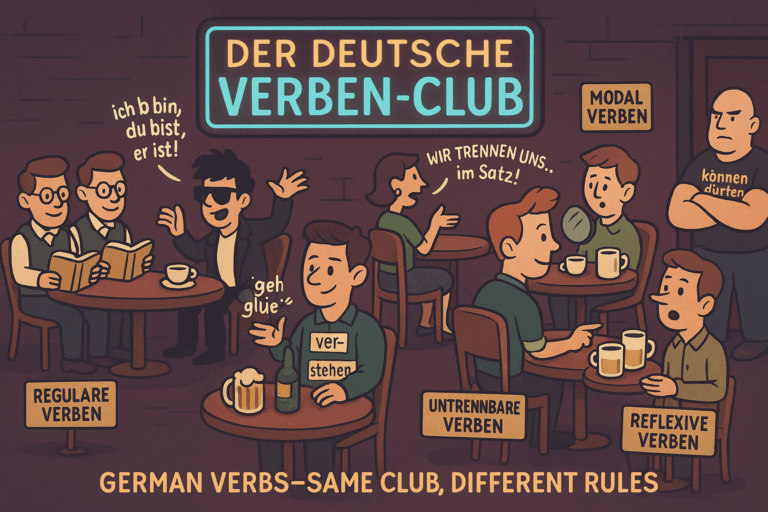
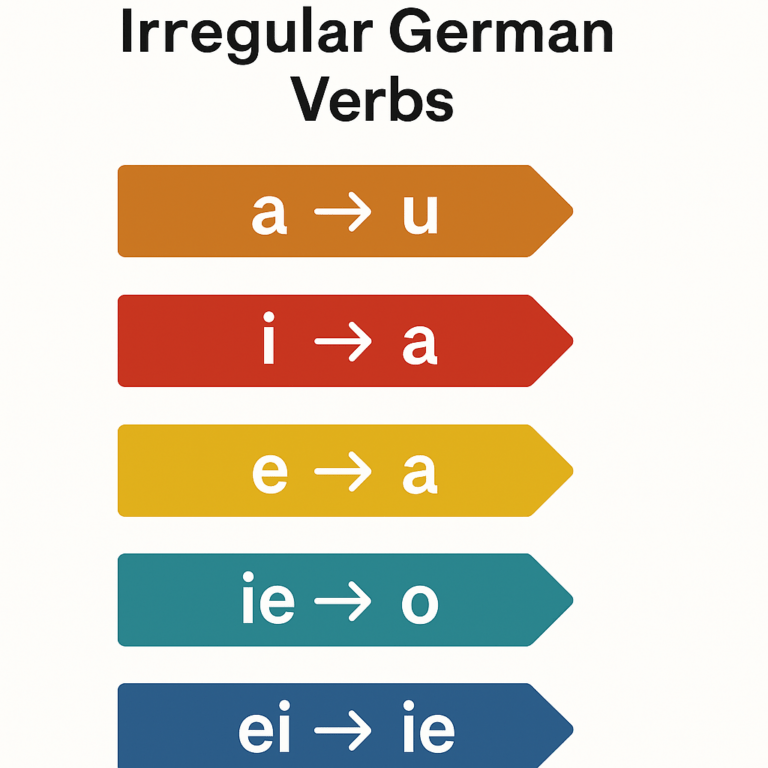
Regular vs Irregular German Verbs
Beginners do not need to master every verb type on day one, but it helps to know there are two big groups, regular and irregular verbs.
Regular verbs
Regular German verbs follow standard patterns, which makes them easier to learn first.
Examples:
lernen, machen, wohnen, arbeiten, spielen
Irregular verbs
Irregular German verbs change more and need memorization.
Examples:
sein, haben, sprechen, sehen, essen
Common Mistakes Beginners Make with German Verbs
Learning too many verbs at once
You do not need 100 verbs in your first week. A smaller high-frequency list is more useful.
Ignoring conjugation
Memorizing only the infinitive is not enough. Learn at least one or two real sentence forms.
Translating word-for-word from English
German and English overlap, but they do not always build meaning the same way.
Avoiding irregular verbs
You cannot skip sein and haben. They are too common.
Practice Tips for Beginners Learning German Verbs
Build tiny sentences
Do not wait until you can say something complicated.
Start with:
- Ich bin…
- Ich habe…
- Ich gehe…
- Ich mache…
Practice verbs with topics you already know
Combine verbs with vocabulary you have learned before. That makes retention much easier.
For example:
- Ich esse Brot.
- Ich trinke Wasser.
- Ich spiele Fußball.
- Ich lerne Deutsch.
Reuse the same verbs every day
Repetition matters more than variety in the beginning.
Group verbs by function
This helps your brain organize them better.
- Daily life: essen, trinken, schlafen, arbeiten
- Movement: gehen, kommen
- Communication: sprechen
- Identity and possession: sein, haben
Practice Section
Translate these into German:
- I am tired.
- I have a dog.
- We are learning German.
- She drinks tea.
- Where do you live?
Answers:
- Ich bin müde.
- Ich habe einen Hund.
- Wir lernen Deutsch.
- Sie trinkt Tee.
- Wo wohnst du?
Final Thoughts on German Verbs
If you feel overwhelmed by German verbs, start smaller.
You do not need every tense, every exception, or every irregular pattern right away. You need the verbs that appear in everyday life and enough confidence to use them in short sentences.
Learn a few useful verbs first. Repeat them often. Use them with beginner vocabulary you already know. That is how German starts to stick.