German word order doesn’t just feel different—it feels unpredictable.
In English, word order is mostly fixed:
Subject → Verb → Object
But in German, you’ll quickly notice something strange:
- Ich gehe heute ins Kino.
- Heute gehe ich ins Kino.
Same meaning. Different structure.
And then it gets worse:
…, weil ich heute ins Kino gehe.
Now the verb is at the end?
This is the moment most learners think:
👉 “This is random.”
It’s not.
German word order follows a small number of consistent patterns. Once you understand them, everything becomes much more logical.
The Real Problem Isn’t German—It’s How It’s Taught
Most explanations of German word order focus on rules:
- “The verb is in position 2”
- “Sometimes the verb goes to the end”
- “Time–manner–place”
Individually, those rules are correct.
But without context, they feel disconnected—like a list of things you’re supposed to memorize without really understanding why they exist.
That’s why it feels random.
German Word Order Isn’t Random—It’s Structured Differently
English relies heavily on fixed word order:
Subject → Verb → Object
If you change that order, the sentence usually stops making sense.
German works differently.
Instead of relying on strict order, German relies on:
- verb position
- case (accusative, dative, etc.)
- and sentence structure signals
👉 This gives German more flexibility, but it also means you have to pay attention to different things.
A Quick Example
Compare these:
Ich gehe heute ins Kino.
Heute gehe ich ins Kino.
Both are correct.
Both mean the same thing.
The difference is not grammar—it’s focus.
German allows you to move elements around for emphasis, while keeping the structure intact.
Why This Guide Will Feel Different
Instead of giving you isolated rules, this guide will show you:
- how German sentences are built
- how the verb creates a structure you can rely on
- and how patterns repeat across everything from simple sentences to complex ones
We’ll start with the absolute basics and gradually build up to more advanced structures, so nothing feels like it’s coming out of nowhere.
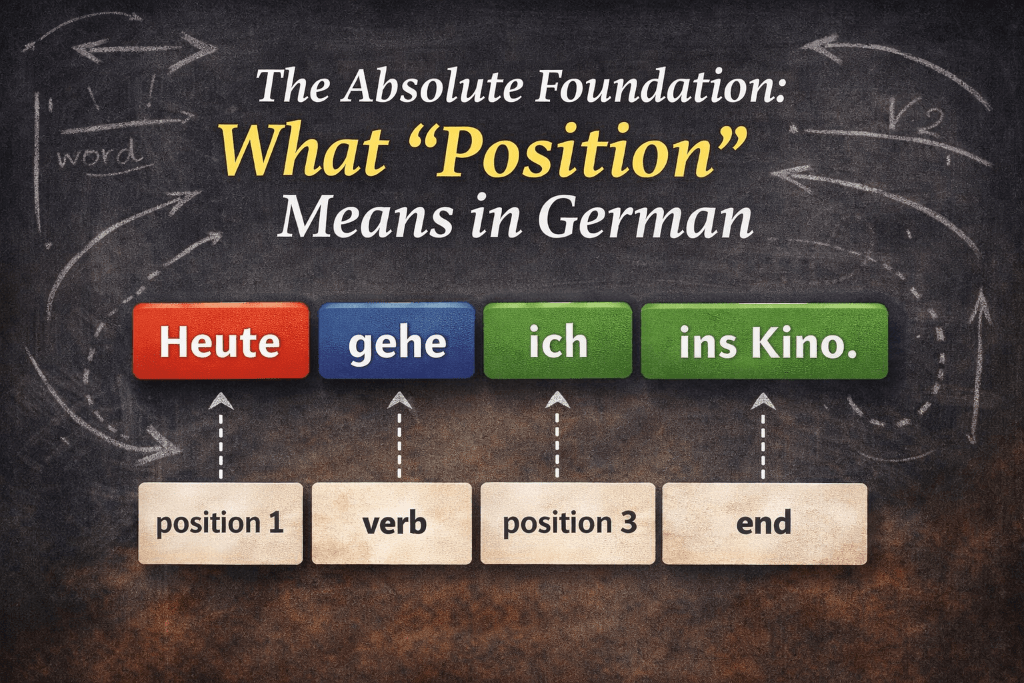
The Absolute Foundation: What “Position” Means for German Word Order
Before we talk about rules like “the verb is in position 2,” we need to clear up a very common misunderstanding.
Because most learners hear that rule and immediately think:
“Okay, the verb is the second word.”
And that’s where things start to fall apart.
Word vs Element: The Most Important Distinction
In German, “position” does not mean word.
It means:
👉 element (also called a “chunk” or “unit of meaning”)
What Is an Element?
An element can be:
- a single word
- a phrase
- or even a group of words that belong together
Example 1: Simple Sentence
Ich gehe heute ins Kino.
Let’s break it into elements:
- Ich (subject)
- gehe (verb)
- heute (time)
- ins Kino (place)
👉 The verb (gehe) is in position 2
Example 2: Looks Different, Same Structure
Heute gehe ich ins Kino.
Now the sentence starts differently but watch what happens:
- Heute (time)
- gehe (verb)
- ich (subject)
- ins Kino (place)
👉 The verb is STILL in position 2
The Key Insight
Even though Heute is only one word, it counts as one full element.
And even though ins Kino is two words, it also counts as one element.
Example 3: A Longer Element
Mit dem Bus gehe ich ins Kino.
Break it down:
- Mit dem Bus (manner)
- gehe (verb)
- ich (subject)
- ins Kino (place)
👉 The entire phrase mit dem Bus counts as one element
Common Mistake (Now You’ll Avoid It)
Many learners try to force the verb into the “second word” position:
Mit gehe dem Bus ich ins Kino ❌
That sounds completely wrong because you broke the element.
The Rule (Now That You Understand It)
👉 The verb must be in position 2 (the second element)
Not the second word.
Sentence Slots: How German Sentences Are Built
Now that you understand elements, we can introduce a simple framework.
Think of every German sentence as having slots.
The Four Main Positions
- Position 1 → the first element (focus)
- Position 2 → the conjugated verb
- Middle Field → everything else
- End Position → verbs or key elements
Example
Heute gehe ich mit dem Bus ins Kino.
Let’s map it:
- Position 1 → Heute
- Position 2 → gehe
- Middle field → ich mit dem Bus
- End position → ins Kino
Quick Tip
If phrases like mit dem Bus or ins Kino still feel unclear, that’s tied to how prepositions determine case and meaning, which we break down in your German prepositions guide.
The Big Takeaway
If you remember one thing from this section, make it this:
👉 German sentences are built from elements, not words
And once you see those elements, the word order starts to feel more structured.
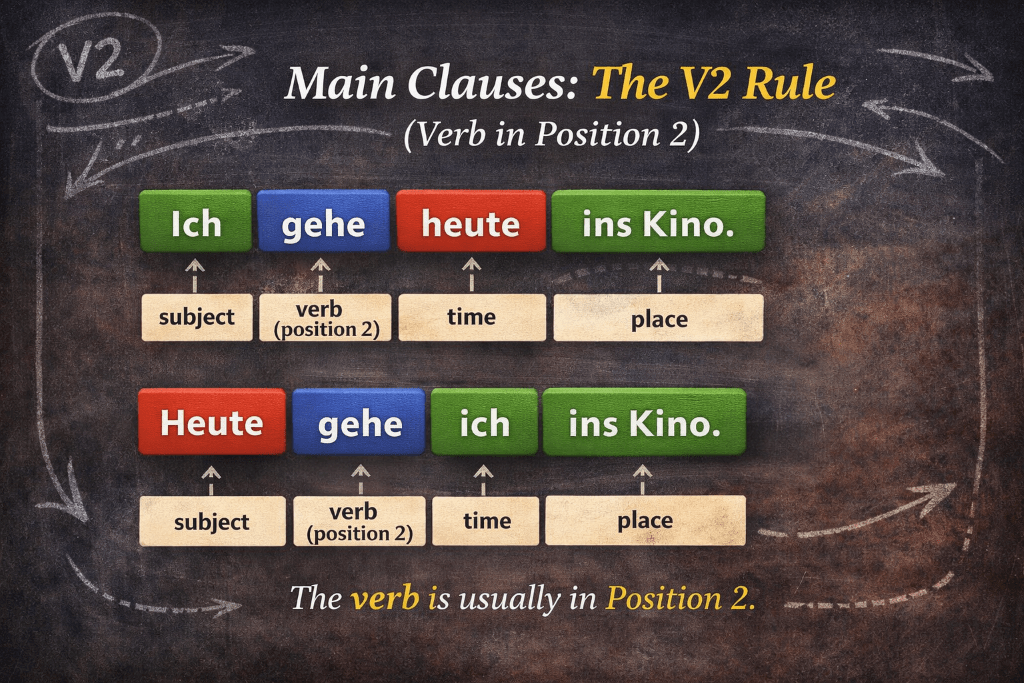
Main Clauses: The V2 Rule (Verb in Position 2)
Now that you understand what “position” really means in German, we can introduce the most important rule in the entire language:
👉 In German main clauses, the conjugated verb is always in position 2.
This is called the V2 rule (Verbzweitstellung).
What Is a Main Clause?
A main clause is a complete sentence that can stand on its own.
Examples
Ich gehe ins Kino.
Heute gehe ich ins Kino.
Im Sommer reisen wir nach Deutschland.
Each of these is a full, independent sentence.
And in every case:
👉 the verb is in position 2
What Does “Conjugated Verb” Mean?
The conjugated verb is the verb that changes based on the subject.
The Rule in Action (Step-by-Step)
Let’s start with a basic sentence:
Ich gehe heute ins Kino.
Break it into elements:
- Ich
- gehe
- heute
- ins Kino
👉 The verb is in position 2 → correct
Now move something to the front:
Heute gehe ich ins Kino.
New structure:
- Heute
- gehe
- ich
- ins Kino
👉 The verb stays in position 2
The verb does not move randomly.
👉 It stays fixed in position 2
👉 Everything else moves around it
Compare These:
Neutral (Subject First)
Ich gehe heute ins Kino.
(neutral)
Time First (Emphasis on When)
Heute gehe ich ins Kino.
(emphasis on time)
Place First
Ins Kino gehe ich heute.
(emphasis on destination)
Why German Uses This Structure
German word order is designed for flexibility + emphasis.
The first position is like a spotlight.
Whatever you put there becomes the focus.
The “Only One Element First” Rule
There’s an important limitation:
👉 Only one element can occupy position 1
Correct
Heute gehe ich ins Kino.
Incorrect
Heute ich gehe ins Kino ❌
Why?
Because now:
- Heute = element 1
- ich = trying to also be in position 1
👉 That breaks the structure
Subject–Verb Inversion (What’s Really Happening)
When something other than the subject comes first, the subject moves after the verb.
Example
Heute gehe ich ins Kino.
This might look strange at first, but it’s actually very consistent:
- Position 1 → Heute
- Position 2 → gehe
- Subject → ich
👉 This is not a special rule—it’s just the result of the V2 structure.
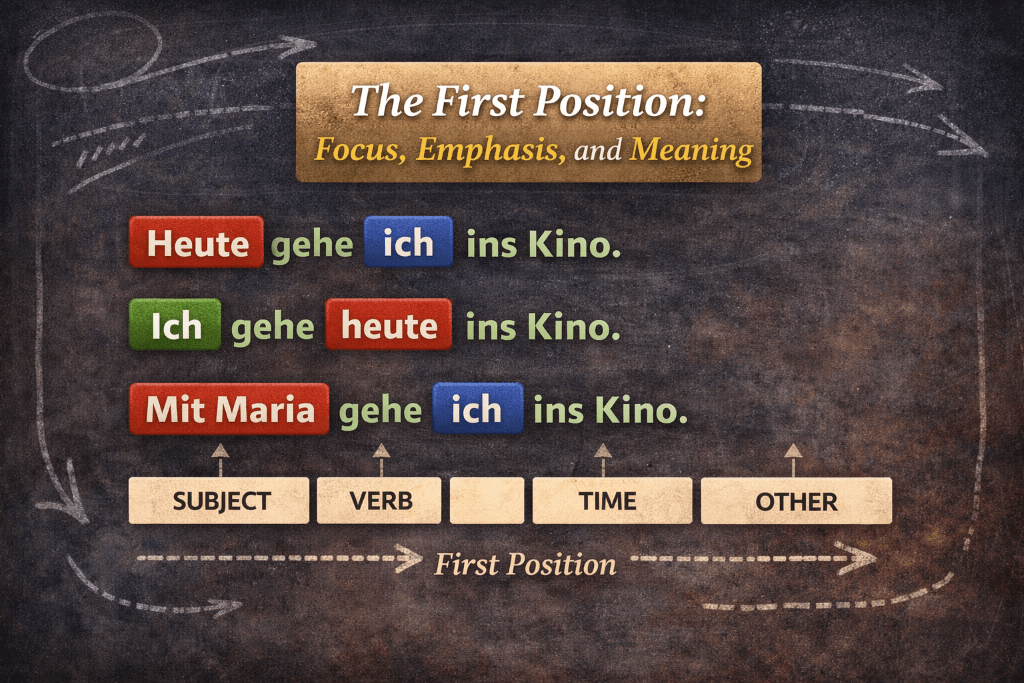
The First Position: Focus, Emphasis, and Meaning
Now that you understand the verb always sits in position 2, let’s take a closer look at what comes before it.
Because in German, the first position isn’t just the beginning of the sentence.
👉 It’s the most important spot in the sentence.
Why the First Position Matters
In English, the subject almost always comes first:
I am going to the store.
She is reading a book.
Changing that order often sounds unnatural or requires extra structure.
German doesn’t have that limitation.
Instead, German uses the first position to control:
- emphasis
- context
- what the listener should focus on
Common Options for first position:
- the subject
- a time expression
- a place expression
- an object
- an entire phrase
Examples (Same Idea, Different Focus)
Let’s take one simple sentence and shift the focus.
Let’s look at a slightly richer sentence:
Am Abend essen wir zusammen im Restaurant.
Break it into elements:
- Am Abend (time)
- essen (verb)
- wir (subject)
- zusammen (manner)
- im Restaurant (place)
Now compare that to English.
If you tried to follow the same structure, you’d get something like:
In the evening, eat we together in the restaurant.
Which sounds completely unnatural.
Or even worse:
In the evening, eating we together.
Why This Works in German (But Not in English)
English depends heavily on:
👉 fixed word order
If you move things around too much, the sentence breaks.
German, on the other hand, depends on:
👉 structure + verb position
As long as the verb stays in position 2 and the elements remain intact, the sentence works.
Subject First (Neutral)
Wir essen am Abend zusammen im Restaurant.
This is the most neutral version. It answers the basic question: what are we doing? The subject comes first, so the sentence feels straightforward and unmarked.
Manner First (Focus on “together”)
Zusammen essen wir am Abend im Restaurant.
Now the emphasis falls on zusammen. This version makes sense if you want to highlight that you’re eating together, perhaps in contrast to eating separately.
Place First (Focus on location)
Im Restaurant essen wir am Abend zusammen.
Here the spotlight is on im Restaurant. This works when the location matters most, for example, if you’re contrasting it with eating at home.
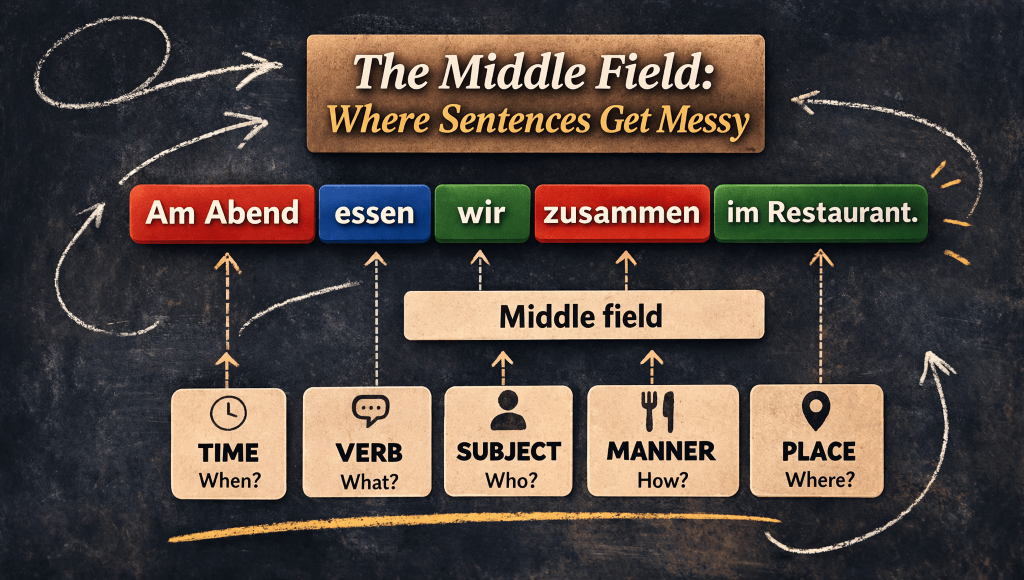
The Middle Field: Where Sentences Get Messy
The “middle” part of the sentence is where German starts placing the rest of the information. A good way to think about it is this:
👉 The beginning of the sentence sets the focus
👉 The verb anchors the structure
👉 The middle field carries the details
Let’s take a simple sentence:
Am Abend essen wir zusammen im Restaurant.
You already know that Am Abend is in position 1 and essen is the verb in position 2.
That means the middle field is this part:
wir zusammen im Restaurant
How do you know whether zusammen or im Restaurant comes first?
The Time–Manner–Place Rule
One of the most helpful patterns in the middle field is the German time, manner, place rule:
👉 time – manner – place
This means German often likes to answer these questions in this order:
- When?
- How?
- Where?
For example:
Wir essen heute zusammen im Restaurant.
- heute = when
- zusammen = how
- im Restaurant = where
English does this less clearly, while German tends to organize these details more deliberately.
German Pronoun Placement
German Pronouns are small words like:
- ich (I)
- mich (me)
- ihm (him/to him)
- es (it)
- dir (you/to you)
Pronouns are closely tied to German cases. That means their form changes depending on their role in the sentence:
- accusative (direct object): mich, dich, ihn, es
- dative (indirect object): mir, dir, ihm, ihr
Compare These Two Sentences
Ich gebe dem Mann das Buch.
Ich gebe es ihm.
In the first sentence, both objects are full nouns:
- dem Mann (dative)
- das Buch (accusative)
In the second sentence, both are replaced with pronouns:
- es (accusative)
- ihm (dative)
And now they move earlier in the sentence.
When you have two pronouns in the same sentence, the order changes compared to nouns.
👉 With pronouns, German usually follows this order:
accusative pronoun → dative pronoun
Negation Placement (nicht)
Where Does nicht Go?
This is one of the most common questions in German and also one of the most misunderstood.
Most learners try to memorize a fixed position for nicht. That doesn’t work.
👉 The real rule is simple:
*nicht* goes before what it negates.
Before you place nicht, ask yourself:
👉 What exactly am I saying “not” to?
That answer determines where nicht goes.
Negating the Whole Sentence
If you’re negating the entire idea, nicht usually comes toward the end of the sentence:
Ich gehe heute nicht.
(I’m not going today.)
Here, you’re negating the action as a whole.
Negating a place
Ich gehe nicht ins Kino.
(I’m not going to the cinema.)
You’re saying: not to the cinema
Negating a time
Ich gehe heute nicht ins Kino.
(I’m not going to the cinema today.)
Now you’re negating heute (today).
Negating manner
Ich gehe nicht gern ins Kino.
(I don’t like going to the cinema.)
Here, nicht is negating gern (the feeling/attitude).
Negation with Two Verbs
When there’s a second verb at the end of the sentence, nicht usually comes before that final verb.
Example
Ich habe den Film nicht gesehen.
(I did not see the film.)
Not:
Ich habe nicht gesehen den Film . ❌
Example
Ich will heute nicht arbeiten.
(I don’t want to work today.)
Here, nicht is negating arbeiten.
Adverbs and Frequency Words: oft, immer, nie
Words like oft (often), immer (always), and nie (never) are some of the most common adverbs in German, and luckily, they’re not as complicated as they might seem.
The key is to understand where they naturally fit into the sentence and why.
Where Do These Words Go?
Frequency adverbs usually appear in the middle field, after the verb, and often after the subject:
Ich gehe oft ins Kino.
Wir essen immer zusammen.
Er kommt nie pünktlich.
They don’t go at the beginning by default, and they don’t get pushed all the way to the end. Instead, they sit comfortably in the middle, as part of the sentence flow.
Can They Go First?
Yes, but only if you want to emphasize them.
Example
Oft gehe ich ins Kino.
This puts strong focus on oft (often), maybe to contrast with something else.
But this is not the default structure; it’s a stylistic choice.
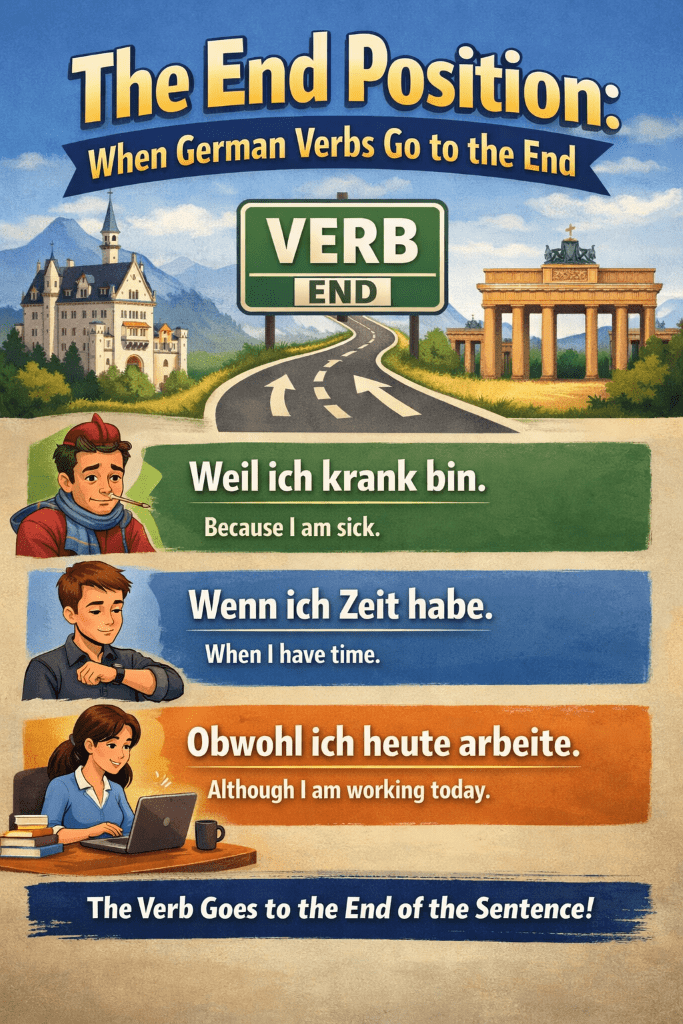
The End Position: When German Verbs Go to the End
Up to now, you’ve seen one main rule:
👉 the verb sits in position 2
But then you start seeing sentences like this:
Ich bleibe zu Hause, weil ich krank bin.
And suddenly, the verb is at the end.
This is where many learners feel like German is breaking its own rules.
It’s not.
It’s just using a different sentence structure.
Subordinate Clauses: The Trigger
The verb moves to the end in something called a subordinate clause.
These are parts of a sentence that cannot stand alone and are introduced by words like:
- weil (because)
- dass (that)
- obwohl (although)
- wenn (if/when)
Example
Ich gehe ins Kino, weil ich Zeit habe.
Focus on the second part:
weil ich Zeit habe
Here, the verb (habe) is at the end.
Why Does the Verb Move?
This is the part most explanations skip.
A subordinate clause is dependent on the main clause. It doesn’t stand on its own. It adds extra information. Up until now, we’ve been working with independent main clauses.
In subordinate clauses, German word order changes:
👉 instead of putting the verb early, it moves it to the end
The sentence is building up information and holding the verb until the end.
weil ich heute keine Zeit habe
As you hear this, you’re waiting for the final verb to complete the idea.
This is why German sentences can feel like they’re unfinished until the very end.
Everything leads up to the verb.
And once you hear it, the meaning becomes complete.
Multiple Verbs at the End
Now let’s make it a little more advanced.
When there’s more than one verb, they stack at the end.
Example
Ich bleibe zu Hause, weil ich arbeiten muss.
At the end:
- arbeiten
- muss
Both verbs appear together.
Example
weil ich den Film sehen will.
Again, both verbs go to the end:
- sehen
- will
The conjugated verb (muss, will) is still controlling the sentence, but it’s no longer in position 2.
Instead, it moves to the end along with the other verb.
Main clause:
Ich arbeite heute.
(verb in position 2)
Subordinate clause:
…, weil ich heute arbeite.
(verb at the end)
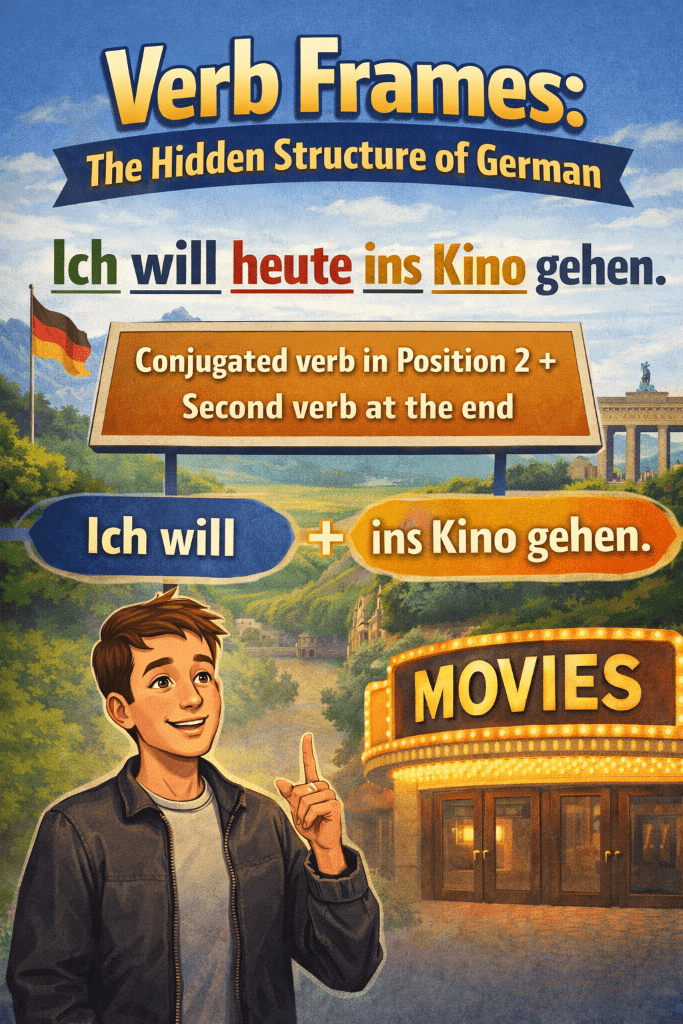
Verb Frames: The Hidden Structure of German Word Order
By now, you’ve seen two key patterns:
- The verb sits in position 2
- Sometimes the verb goes to the end
But there’s a deeper structure behind both of these ideas, and once you see it, a lot of German suddenly makes more sense.
That structure is called a verb frame.
What Is a Verb Frame?
A verb frame happens when a sentence has more than one verb.
Instead of keeping all verbs together, German splits them:
👉 One verb appears early in the sentence
👉 The other verb goes to the end
Everything else sits in between.
Example
Ich will heute ins Kino gehen.
Break it down:
- will → conjugated verb (position 2)
- gehen → second verb (at the end)
So the sentence forms a “frame”:
👉 will … gehen
And everything else—ich heute ins Kino—fits inside that frame.
Modal Verbs
German modal verbs are verbs like:
- wollen (to want)
- müssen (to have to)
- können (to be able to)
The model verb is conjugated and comes in second position in a main clause while the main verb comes at the end in its infinitive form.
Example
Ich will gehen.
(I want to go.)
Structure:
- will → position 2
- gehen → at the end
Perfect Tense
The same structure appears in the perfect tense:
Ich habe gegessen.
(I have eaten.)
- habe → conjugated verb (position 2)
- gegessen → past participle (end of sentence)
Ich habe gestern Abend im Restaurant gegessen.
Again, you get a frame:
👉 habe … gegessen
And everything else sits inside.
Future Tense
Future tense follows the same pattern:
Ich werde gehen.
(I will go.)
The conjugated form of werden is second and the infinitive form of the main verb comes at the end.
- werde → position 2
- gehen → at the end
Ich werde morgen mit dir ins Kino gehen.
The Pattern Behind All of This
Instead of memorizing each tense separately, you can recognize the pattern:
👉 conjugated verb in position 2 + second verb at the end
This is the verb frame.
Now everything starts to fit together:
- main clauses → verb in position 2
- subordinate clauses → verb at the end
- verb frames → verbs at both ends
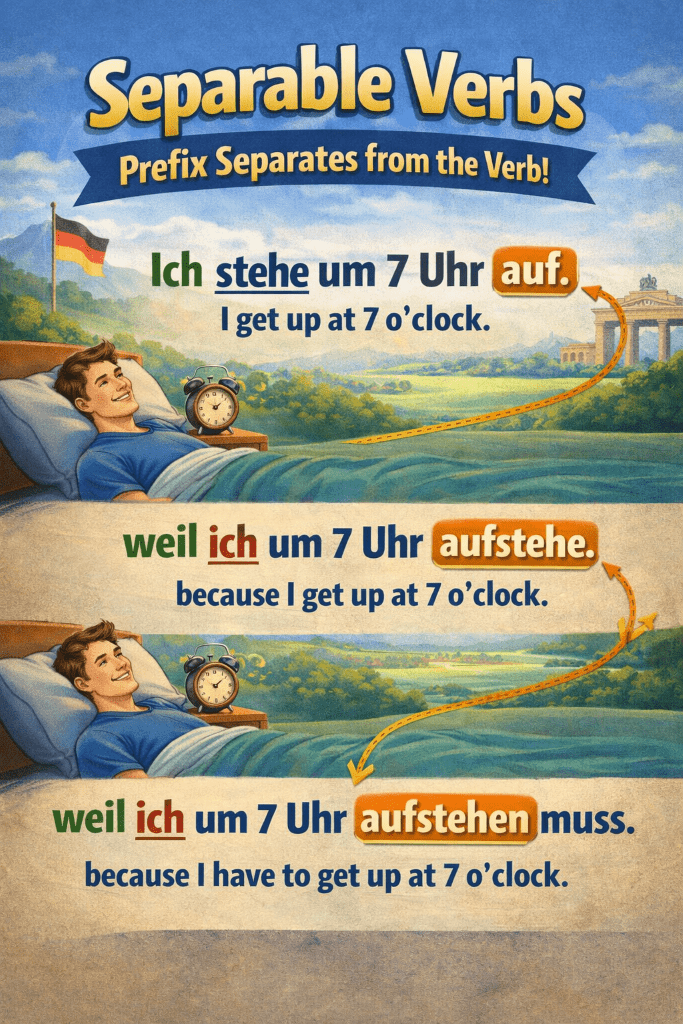
Separable Verbs (Split Structure)
At some point, you’ll come across verbs that seem to break apart in the middle of a sentence.
For example:
Ich stehe um 7 Uhr auf.
If you’ve learned the verb aufstehen (to get up), this can feel confusing at first. Why is part of the verb at the beginning (stehe) and part of it at the end (auf)?
This is what German calls a separable verb.
What Is a Separable Verb?
A separable verb is made up of two parts:
- a prefix (like auf, an, mit, ein)
- a base verb (like stehen, kommen, machen)
Together, they form one meaning:
- aufstehen → to get up
- ankommen → to arrive
- mitkommen → to come along
How They Work in Main Clauses
In a normal main clause, the verb follows the rule you already know:
👉 The conjugated verb goes in position 2
But with separable verbs, only the base verb is conjugated and the prefix moves to the end.
Example
Ich stehe um 7 Uhr auf.
- stehe → conjugated verb (position 2)
- auf → prefix (moves to the end)
So even though it looks split, it still follows the same structure:
👉 verb in position 2
👉 final element at the end
Example
Wir kommen heute Abend an.
- kommen → position 2 (as kommen → kommen / kommen → kommen depending on subject)
- an → at the end
How They Work in Subordinate Clauses
Now let’s look at what happens when the same verb appears in a subordinate clause.
…, weil ich um 7 Uhr aufstehe.
Here, the verb is no longer split.
- aufstehe → both parts are together
In subordinate clauses:
👉 The entire verb moves to the end
So instead of splitting, the verb rejoins and stays intact.
Example
Main clause:
Ich komme heute Abend an.
Subordinate clause:
…, weil ich heute Abend ankomme.
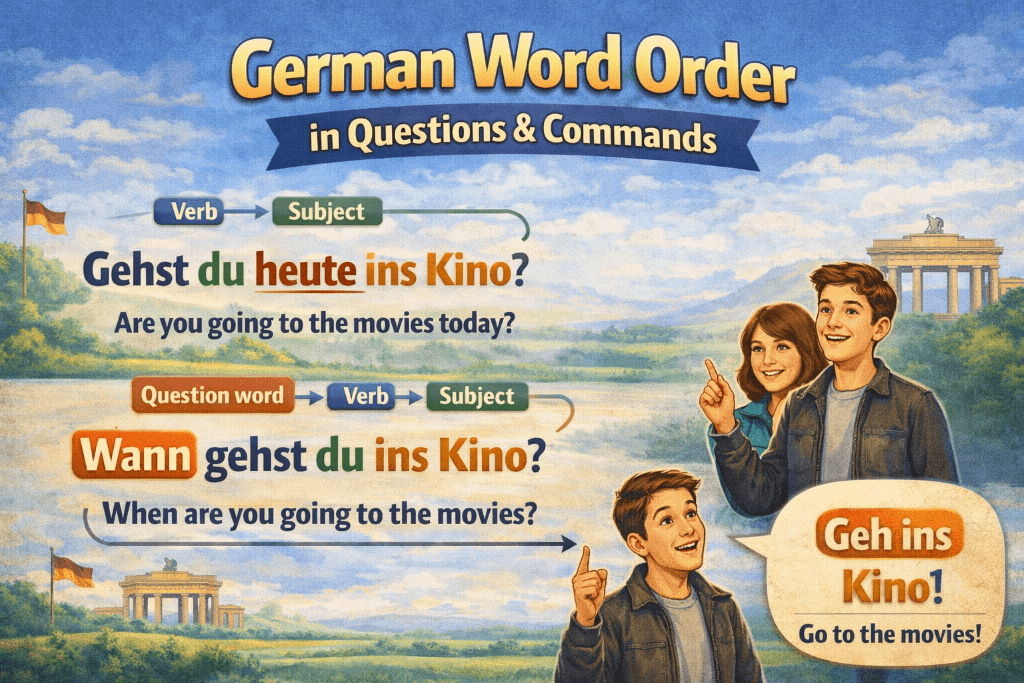
German Word Order in Questions & Commands
So far, you’ve seen the main pattern in German:
- one element first
- the verb in position 2
But questions and commands follow a slightly different structure.
The good news is that they’re actually very consistent, and once you see the pattern, they’re easy to recognize.
Yes/No Questions
When you ask a question that can be answered with yes or no, the verb moves to position 1.
Du gehst heute ins Kino.
(You are going to the cinema.)
Turn it into a question:
Gehst du heute ins Kino?
(Are you going to the cinema?)
The Pattern
👉 verb + subject + rest of the sentence
W-Questions
Now let’s look at questions that start with words like:
- was (what)
- wann (when)
- wo (where)
- warum (why)
Wann gehst du ins Kino?
(When are you going to the cinema?)
- wann → position 1
- gehst → position 2
- The rest of the sentence follows
The Key Idea
Even in questions:
👉 The verb still stays in position 2
The only difference is that a question word takes position 1.
Commands (Imperative)
Commands (telling someone to do something) follow a structure similar to yes/no questions.
👉 The verb goes in position 1
Komm bitte mit!
(Come with me!)
Geh nach Hause!
(Go home!)
The subject is usually not stated, because it’s understood.
Sometimes you’ll see:
Gehen Sie bitte nach Hause.
Here, the subject (Sie) is included for politeness.
The Pattern
👉 verb first → rest of the sentence follows
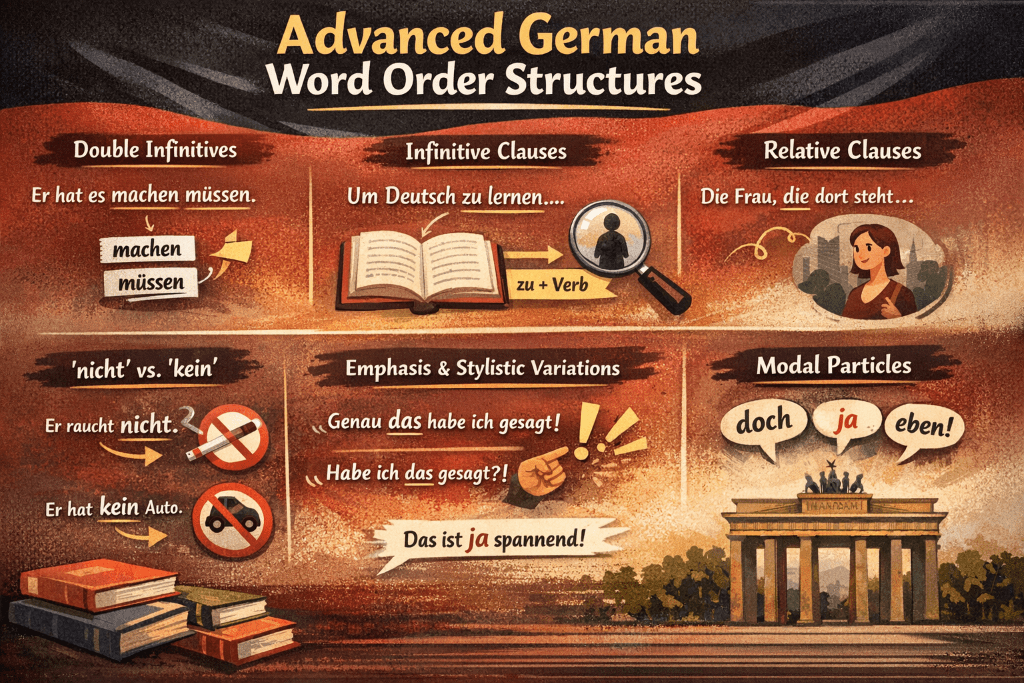
Advanced German Word Order Structures
By now, you’ve seen the core system behind German word order:
- The verb anchors the sentence
- The middle field carries the details
- Subordinate clauses push a verb to the end
This section builds on that foundation and shows you how German handles more complex structures. These are the patterns that often confuse learners, but once you see how they fit into the system, they become much more manageable.
Double Infinitives
Sometimes, German places two verbs at the end, both in their base (infinitive) form.
Example
Ich habe ihn kommen sehen.
(I saw him come.)
At the end of the sentence, you get:
👉 kommen sehen
This structure is used in the present perfect (spoken past tense) when there are two verbs.
👉 The sentence builds toward the action, and both verbs stay at the end as a unit
This follows the same logic you’ve already seen: important verb information is often pushed to the end.
Infinitive Clauses (zu + infinitive)
Another common structure uses zu + infinitive.
Example
Ich versuche zu gehen.
(I’m trying to go.)
- versuche → conjugated verb (position 2)
- zu gehen → at the end
Ich versuche heute früher zu gehen.
Again, everything leads to:
👉 zu gehen
This is another version of the verb frame:
👉 conjugated verb early + action at the end
Relative Clauses
Relative clauses give you more information about a noun.
Example
Der Mann, der dort steht, ist mein Lehrer.
(The man who is standing there is my teacher.)
Focus on the clause:
der dort steht
- der → relative pronoun
- steht → verb at the end
Even though this is part of a larger sentence, it behaves like a subordinate clause:
👉 the verb goes to the end
Because you’re inserting a full clause inside another sentence.
But the rule is the same:
👉 verb moves to the end
Word Order with “nicht” vs “kein”
Both nicht and kein express negation, but they work differently.
nicht
Used to negate:
- verbs
- adjectives
- specific parts of a sentence
Ich gehe nicht ins Kino.
kein
Used to negate:
- nouns without an article
Ich habe kein Geld.
nicht moves depending on meaning:
Ich gehe nicht ins Kino.
Ich gehe heute nicht.
But kein stays directly with the noun:
Ich habe kein Geld.
Emphasis & Stylistic Variations
Once you understand the rules, you’ll start to notice that German sometimes bends them slightly.
Ins Kino gehe ich heute.
This is correct—but more expressive.
The speaker is emphasizing ins Kino (the place).
German word order is not just about correctness, it’s also about:
- emphasis
- tone
- flow
Native speakers adjust word order to highlight what matters most.
Heute habe ich das wirklich nicht erwartet.
The placement of wirklich adds emphasis to the sentence.
Modal Particles: The Small Words That Change the Tone
Once you start understanding German word order, you’ll notice small words that don’t seem to translate directly,but still affect the meaning of a sentence.
These are called German modal particles.
Common ones include:
- doch
- ja
- mal
- eben
- halt
Modal particles don’t change what you’re saying.
They change how it feels.
Komm!
(Come!)
Komm doch!
(Come on!)
The action is the same but the tone is softer, more emotional, or more persuasive.
Modal particles usually appear in the middle field, often:
👉 after the verb
👉 and after the subject
Ich gehe ja heute ins Kino.
- Ich → subject
- gehe → verb
- ja → modal particle
- rest of the sentence follows
Komm doch mit!
Here, doch sits naturally in the middle of the sentence, even in a command.
The Big Takeaway
Even in advanced structures, German follows the same core ideas:
- verbs often move to the end in complex structures
- multiple verbs group together
- meaning influences placement
- word order can shift for emphasis
Once you recognize these patterns, even the most complex sentences start to feel like variations of the same system not completely new rules.
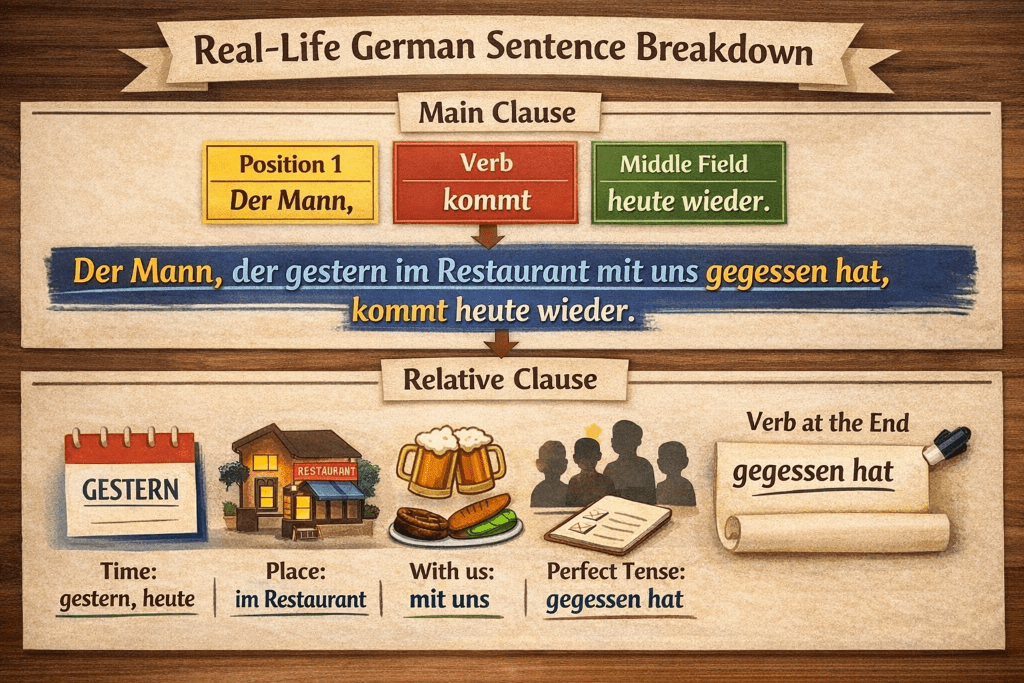
Real-Life German Sentence Breakdowns
Let’s take everything you’ve learned and apply it to real sentences.
Example 1 (Main Clause + Verb Frame + Time–Manner–Place)
Heute werde ich mit meiner Freundin nach der Arbeit ins Restaurant gehen.
Breakdown:
- Position 1 → Heute
- Verb (position 2) → werde
- Middle field → ich mit meiner Freundin nach der Arbeit ins Restaurant
- End position → gehen
What’s happening here:
- future tense → werde … gehen (verb frame)
- time → Heute, nach der Arbeit
- manner → mit meiner Freundin
- place → ins Restaurant
👉 Everything sits inside the verb frame
Example 2 (Subordinate Clause + Negation + Modal Verb)
Ich bleibe heute zu Hause, weil ich morgen früh nicht arbeiten muss.
Breakdown (subordinate clause only):
- Connector → weil
- Subject → ich
- Middle field → morgen früh nicht arbeiten
- End position → muss
What’s happening here:
- subordinate clause → verb goes to the end
- negation → nicht comes before arbeiten
- modal verb → arbeiten muss at the end
Example 3 (Pronouns + Object Order + Frequency Word)
Ich gebe es ihm oft am Abend im Büro.
Breakdown:
- Position 1 → Ich
- Verb → gebe
- Middle field → es ihm oft am Abend im Büro
- End → (no second verb)
What’s happening here:
- pronouns → es (accusative) before ihm (dative)
- frequency → oft
- time → am Abend
- place → im Büro
👉 This is a perfect middle-field example
Example 4 (Separable Verb + Modal Particle + Emphasis)
Am Wochenende stehe ich ja immer sehr früh auf.
Breakdown:
- Position 1 → Am Wochenende
- Verb → stehe
- Middle field → ich ja immer sehr früh
- End → auf
What’s happening here:
- separable verb → stehe … auf
- modal particle → ja
- frequency → immer
- emphasis → sehr früh
Example 5 (Relative Clause + Complex Structure)
Der Mann, der gestern im Restaurant mit uns gegessen hat, kommt heute wieder.
Breakdown (relative clause):
- Connector → der
- Middle field → gestern im Restaurant mit uns gegessen
- End → hat
Main clause:
- Position 1 → Der Mann
- Verb → kommt
- Middle field → heute wieder
Relative clause:
- verb → at the end (hat)
- perfect tense → gegessen hat
- time → gestern, heute
- place → im Restaurant
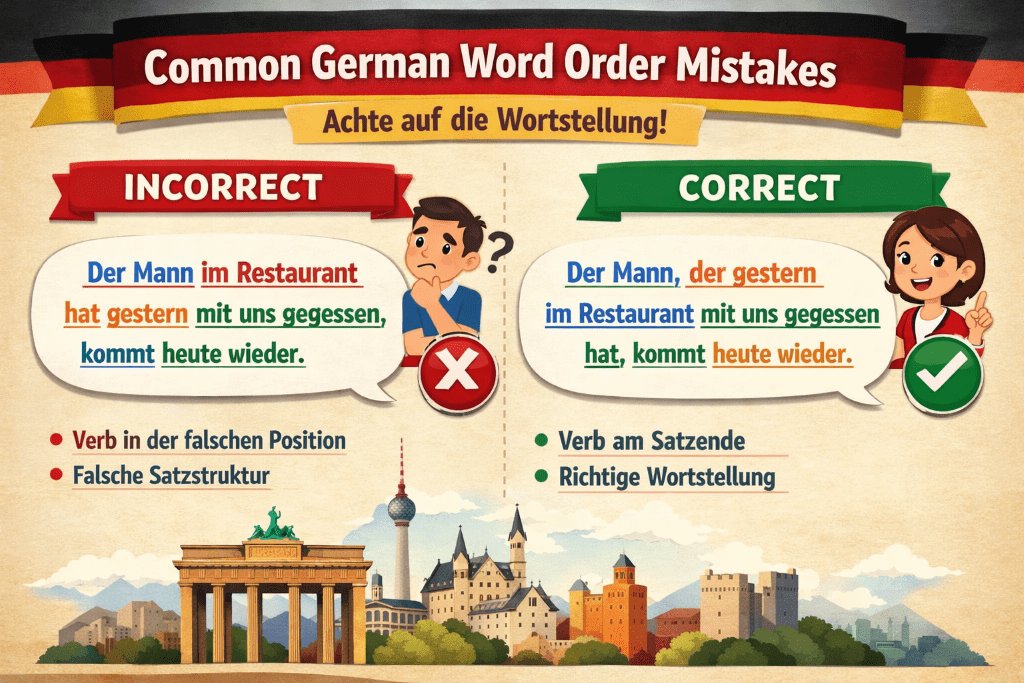
Common German Word Order Mistakes (Grouped by Level)
German word order isn’t hard because it’s random. It’s hard because many rules show up everywhere. When something goes wrong, it’s usually the same patterns repeating.
Let’s look at the most common mistakes, grouped by level, so you know exactly what to watch for.
Beginner Mistakes
At the beginner level, most errors come from applying English word order to German.
Forgetting the Verb in Position 2
Ich heute gehe ins Kino. ❌
Ich gehe heute ins Kino. ✅
This is the most important rule in German word order. If the verb is not in position 2, the sentence will sound wrong immediately.
Putting the Subject First Every Time
Ich gehe heute ins Kino.
(correct—but overused)
German allows flexibility:
Heute gehe ich ins Kino. ✅
Many learners avoid moving elements because it feels unnatural, but this is a key part of sounding more natural in German.
Breaking Up Elements
Mit gehe dem Bus ich… ❌
Phrases like mit dem Bus must stay together as one unit.
Mixing Up nicht Placement
Ich gehe ins Kino nicht. ❌
German doesn’t place nicht at the very end by default. It goes before what you’re negating.
Intermediate mistakes
At this level, learners understand the basics—but struggle with more complex sentence structures.
Forgetting Verb Position in Subordinate Clauses
…, weil ich bin müde. ❌
…, weil ich müde bin. ✅
The verb must move to the end in subordinate clauses.
Incorrect Object Order
Ich gebe ihm es. ❌
Ich gebe es ihm. ✅
When using pronouns:
👉 accusative comes before dative
Ignoring Time–Manner–Place
Ich gehe ins Kino heute mit Freunden. ❌
Ich gehe heute mit Freunden ins Kino. ✅
This isn’t completely wrong, but it sounds unnatural.
Misplacing Frequency Words
Ich oft gehe ins Kino. ❌
Ich gehe oft ins Kino. ✅
Frequency words usually sit in the middle of the sentence, not before the verb.
Advanced mistakes
At the advanced level, mistakes are more subtle. The sentence may be grammatically correct—but not quite natural.
Overloading Position 1
Heute im Restaurant esse ich… ❌
Only one element should come before the verb.
Better:
Heute esse ich im Restaurant. ✅
Misplacing nicht in Complex Sentences
Ich habe nicht das Buch gelesen. ❌
Ich habe das Buch nicht gelesen. ✅
With multiple verbs, nicht usually comes before the final verb.
Misunderstanding Emphasis
Ins Kino ich gehe heute. ❌
This breaks the verb position rule.
Correct:
Ins Kino gehe ich heute. ✅
Advanced word order changes are about emphasis, but the core structure still applies.
Separating Separable Verbs Incorrectly
…, weil ich stehe um 7 Uhr auf. ❌
…, weil ich um 7 Uhr aufstehe. ✅
In subordinate clauses, separable verbs come back together.
German Word Order FAQ
This section answers the most common questions learners have about German word order.
What is the V2 rule in German?
The V2 rule (Verb second) means that in a German main clause, the conjugated verb must always be in position 2. This does not mean the second word. It means the second element in the sentence.
Why is the verb at the end of German sentences?
In German sentences, the verb moves to the end in subordinate clauses, which are introduced by words like:
- weil (because)
- dass (that)
- wenn (if/when)
- obwohl (although)
Example: Ich bleibe zu Hause, weil ich krank bin.
The verb (bin) is at the end because the clause depends on the main sentence.
What is time, manner, and place in German?
Time–manner–place is a common pattern for ordering information in the middle of a German sentence.
👉 time → manner → place
Example: Ich gehe heute mit dem Bus ins Kino.
- heute → when
- mit dem Bus → how
- ins Kino → where
This order helps your sentences sound natural and clear.
Where does nicht go in German sentences?
Nicht goes before what you are negating. That means its position depends on meaning, not a fixed rule.
Examples:
Ich gehe nicht ins Kino.
(not to the cinema)
Ich habe den Film nicht gesehen.
(not seen)
How can I remember German word order?
Instead of memorizing rules separately, focus on the system:
- main clause → verb in position 2
- subordinate clause → verb at the end
- middle field → time, manner, place
- pronouns → come early
- nicht → goes before what it negates
👉 Think in patterns, not individual rules.
The more sentences you see, the more natural it becomes.
Is German word order the same as English?
Not exactly, but it’s not completely different either.In simple sentences, German and English often look similar:
Ich sehe den Film.
I watch the movie.
Both follow a basic subject–verb–object structure.
But German becomes more flexible once you add more information. It uses verb position and grammatical cases to show meaning, allowing elements like time, place, or objects to move around without changing the core meaning.
That’s why you can say:
Ich gehe heute ins Kino.
Heute gehe ich ins Kino.
In English, changing the order like this is much more limited. In German, it’s normal and often used to shift emphasis.
Can you start a German sentence with anything?
You can start with almost any single element (time, place, object, etc.), but only one element can come before the verb.
Do Germans always follow time, manner, and place?
Not always. It’s a strong guideline, not a strict rule. Native speakers change the order for emphasis, but time–manner–place is the safest default.
Why does German sound “backwards”?
It often feels that way because German puts important verbs at the end in some structures. Instead of translating directly, it helps to focus on the structure and wait for the verb.
How do you know where to put words in German?
Look at three things:
- where the verb goes
- what type of clause it is
- what information is most important
Once you understand those, the rest of the sentence falls into place.
Is German word order hard to learn?
At first, yes. But it becomes much easier once you recognize the patterns. Most sentences follow the same core structure; you’re just rearranging elements within it.
What is the biggest mistake learners make?
Trying to translate directly from English instead of following the German structure.
German Word Order: From Chaos to Structure
At the beginning, German word order can feel like chaos. Verbs move. Sentences flip. Words show up in places you don’t expect.
But by now, you’ve seen the truth:
👉 it’s not random—it’s a system
What looks confusing at first is actually built on a few consistent ideas:
- The verb anchors the sentence
- Main clauses and subordinate clauses follow different patterns
- The middle field organizes information in a natural way
- Meaning determines placement more than rigid rules
Once you understand those patterns, you stop trying to memorize every possible sentence.
Instead, you start recognizing structure.
You see:
- why the verb is where it is
- why an adverb comes first
- why a prefix moves to the end
And that’s when things shift.
The more you read, hear, and build sentences, the more those patterns start to feel automatic.
One day, you won’t be thinking “Is this position 2 or the end of the sentence?” You’ll just know.
And what once felt confusing will start to feel surprisingly logical.
That’s the goal, not perfection, but understanding.