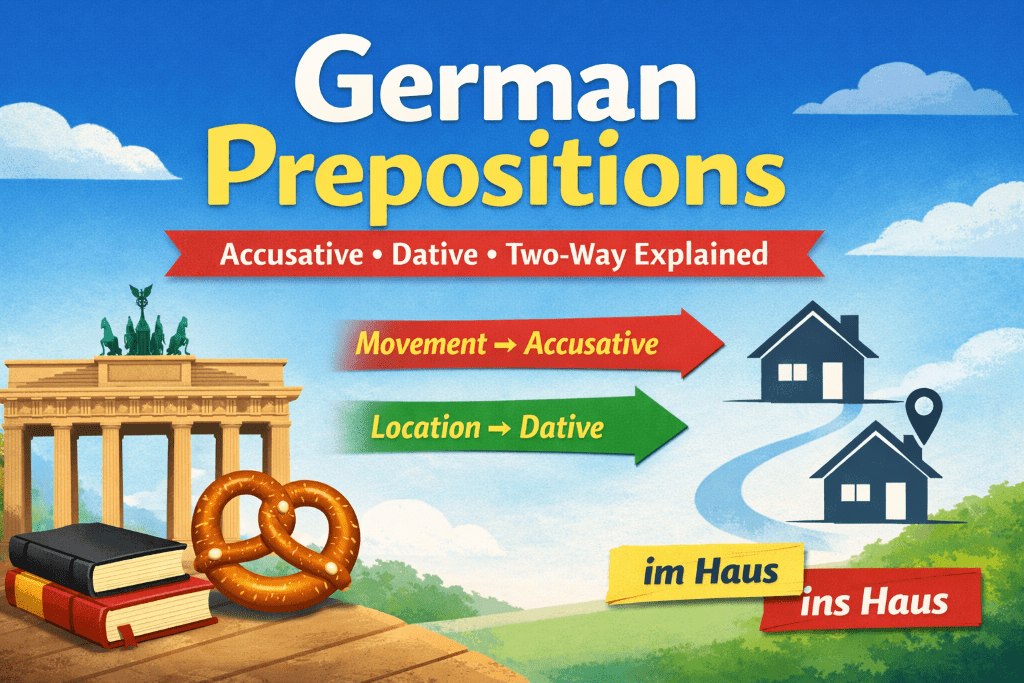
German prepositions (Präpositionen) are small words—in, auf, mit, für—that connect a noun or pronoun to the rest of a sentence. On the surface, they don’t look very intimidating. If you’ve learned prepositions in English, you might expect them to behave the same way.
That assumption is exactly where things start to go wrong.
In German, prepositions don’t just tell you where or when something happens. They also determine the grammatical case of the noun that follows—usually accusative (Akkusativ) or dative (Dativ). And that choice changes everything, from the article (der → den → dem) to the meaning of the sentence itself.
This is why learners often hit a wall.
You memorize that in means “in,” but suddenly you see:
- im Haus
- ins Haus
Same word. Different forms. Different meanings.
Or you try to translate directly from English:
“on the bus”
…and end up with something that sounds completely unnatural in German.
The real problem isn’t the vocabulary—it’s that German prepositions force you to think differently. Instead of translating word-for-word, you have to pay attention to:
- whether something is moving or staying still
- how German views space and relationships
- which case the preposition requires
That’s a lot to juggle at once.
But here’s the good news: German prepositions are not random. Once you understand the underlying patterns—especially the difference between movement and location—they become much more predictable.
In this guide, you’ll learn:
- what German prepositions are and how they work
- the difference between accusative and dative prepositions
- how two-way prepositions function (without confusion)
- practical ways to remember them so they stick
By the end, you won’t just recognize German prepositions—you’ll understand how to use them naturally.
The 3 Types of German Prepositions (Your Mental Framework)
Before you try to memorize anything, you need a clear structure in your head. Without one, German prepositions feel random. With it, they start to make sense.
Each of these groups is tied directly to the German case system. If you’re unsure how accusative and dative work, it’s worth reviewing the basics before going deeper.
| Type | What It Means |
| Accusative prepositions | Always take the accusative |
| Dative prepositions | Always take dative |
| Two-way prepositions | Switch depending on meaning |
That looks simple, but each category works differently, and understanding how they work is what actually helps you use them correctly.
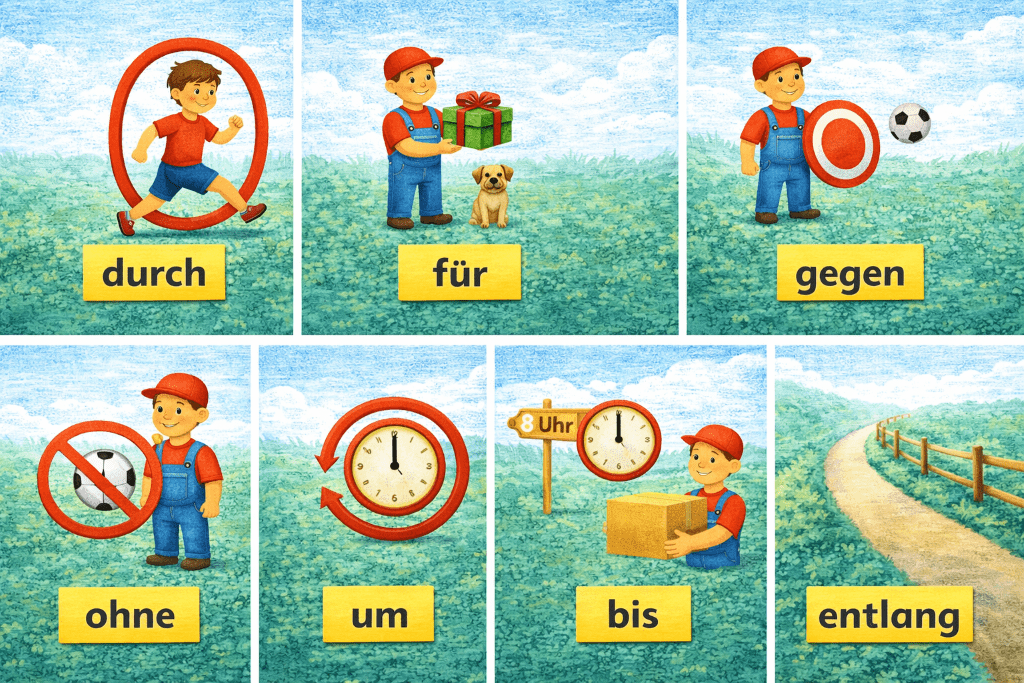
1. Accusative Prepositions (Always Akkusativ)
When you use one of these prepositions, the definite and indefinite articles of the noun that follows must be in the accusative case.
- durch (through)
- für (for)
- gegen (against)
- ohne (without)
- um (around/at time)
- bis (until/to)
- entlang (along)
Accusative Case Change
| Gender | Nominative | Accusative |
| Masculine | der Mann | den Mann |
| Feminine | die Frau | die Frau |
| Neuter | das Kind | das Kind |
- für den Mann
- durch den Park
Ask yourself:
- What’s the preposition? → durch
- What case does it require? → accusative
- What happens to der Park? → becomes den Park
That’s the process you want to internalize.
Examples
- Ich gehe durch den Park.
→ I walk through the park. - Das Geschenk ist für deine Mutter.
→ The gift is for your mother. - Wir laufen um die Ecke.
→ We walk around the corner.
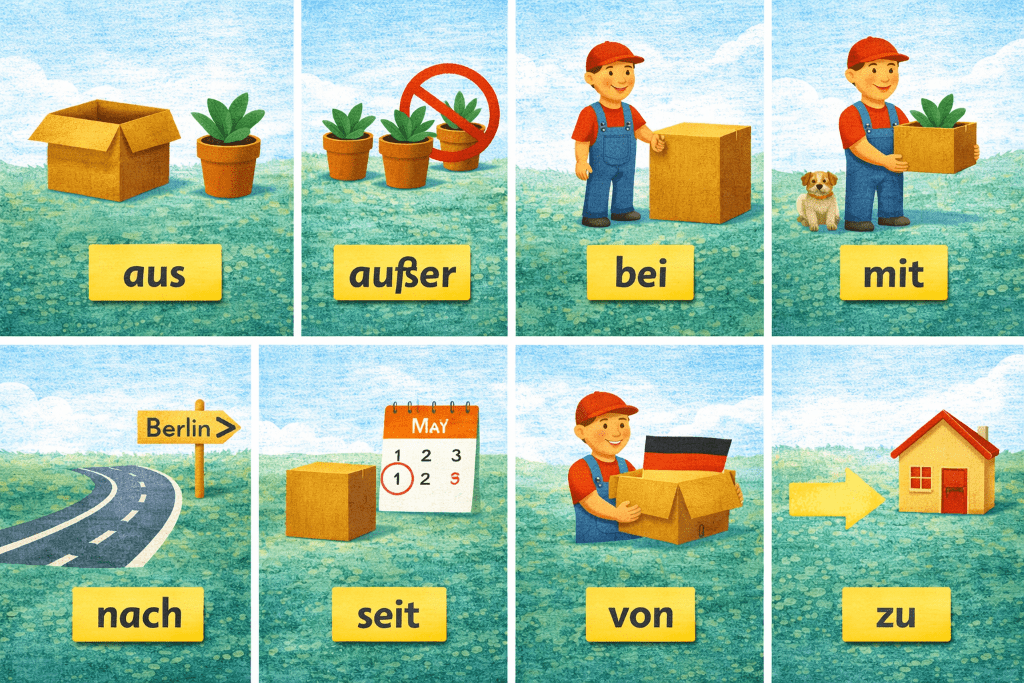
2. Dative Prepositions (Dativ)
Dative is less about direction and more about location, relationships, and ongoing states.
The German dative prepositions are:
- aus (out of)
- außer (except)
- bei (at, with)
- mit (with)
- nach (to, after)
- seit (since)
- von (from, of)
- zu (to)
Dative Case Changes
| Gender | Nominative | Dative |
| Masculine | der Mann | dem Mann |
| Feminine | die Frau | der Frau |
| Neuter | das Kind | dem Kind |
Ich fahre mit dem Auto.
Break it down:
- mit → always dative
- das Auto → becomes dem Auto
That’s why dative fits.
Examples
- Ich komme aus dem Haus.
→ I come out of the house. - Ich bin bei meiner Freundin.
→ I’m at my girlfriend’s place. - Wir fahren mit einem Auto.
→ We drive with a car.
3. Two-Way Prepositions
This is where most learners get stuck—and where things finally start to click.
Two-way prepositions don’t come with a fixed case. Instead, you choose the case based on meaning.
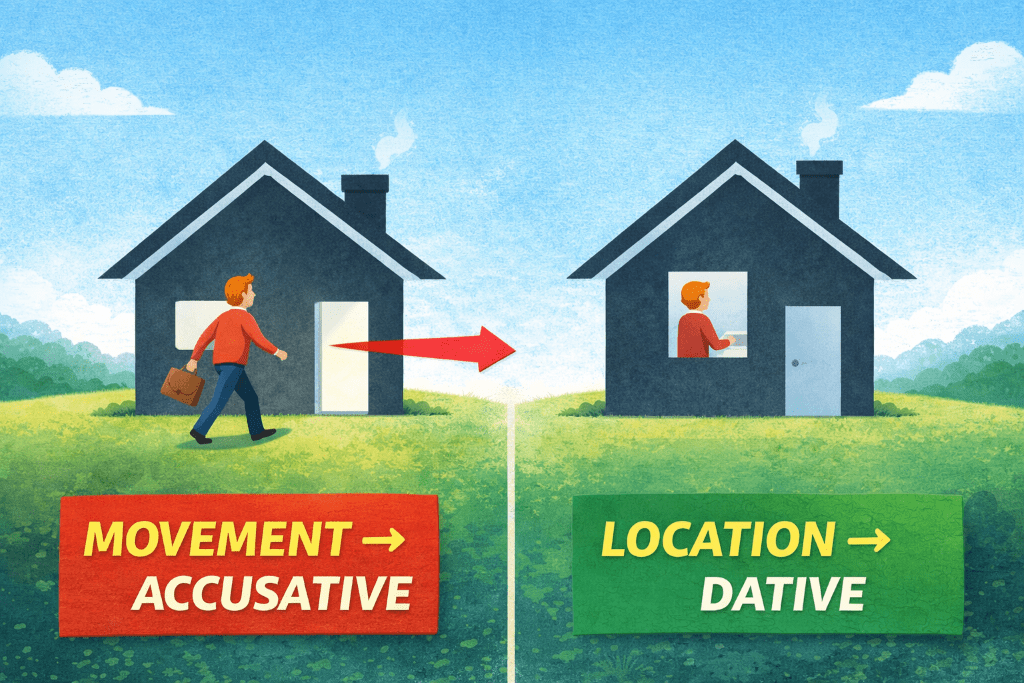
Accusative = Movement (Change of Position)
Used when something moves from A to B.
| Example | Explanation |
| Ich gehe in das Haus. | entering the house |
| Er legt das Buch auf den Tisch. | placing onto surface |
Dative = Location (No Movement)
Used when something is already there.
| Example | Explanation |
| Ich bin in dem Haus. | already inside |
| Das Buch liegt auf dem Tisch. | resting on surface |
That means every time you use one, you have to ask:
👉 What is actually happening in the sentence?
- Is something changing position? → use accusative
- Is something already in a position? → use dative
This is why they’re called “two-way.” They can go in either direction depending on context.
What are the German Two-Way Prepositions?
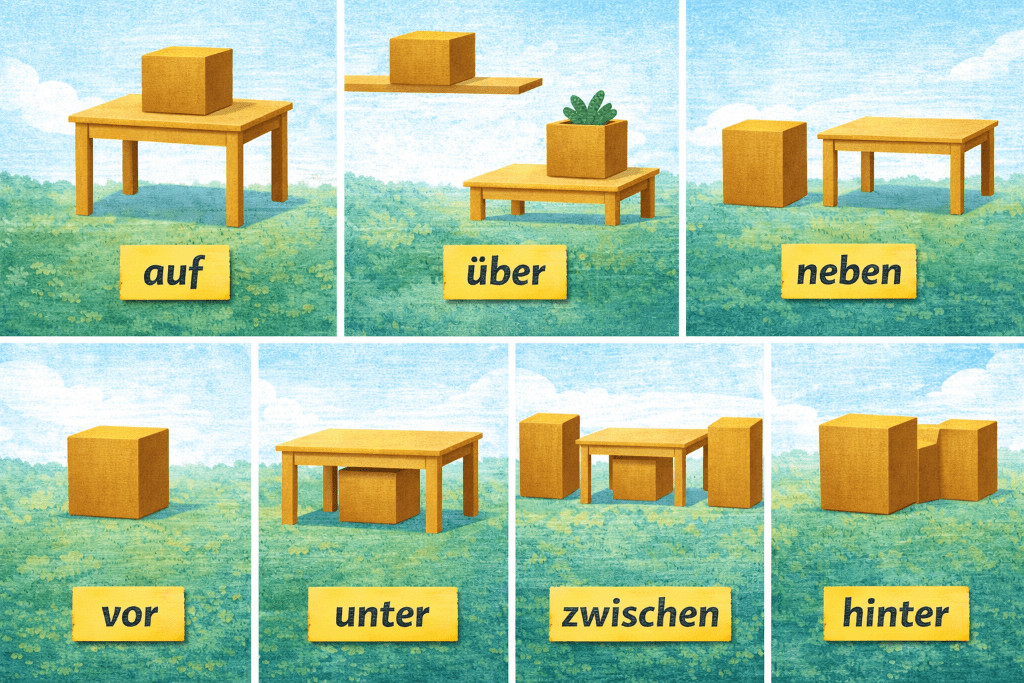
The German two-way prepositions are:
- an (on/at)
- auf (on/upon)
- in (in)
- unter (under)
- über (over)
- vor (before/in front of)
- zwischen (between)
- neben (next to)
- hinter (behind)
👉 Accusative = movement
👉 Dative = location
Example
Ich gehe in das Haus.
You are outside → now you are inside
That change triggers accusative
Movement (Akkusativ)
- Ich gehe in das Haus.
→ I go into the house. - Er legt das Buch auf den Tisch.
→ He puts the book onto the table.
Location (Dativ)
- Ich bin in dem Haus.
→ I am in the house. - Das Buch liegt auf dem Tisch.
→ The book is on the table.
German Changing Prepositions Accusative vs Dative
| Situation | German | Why |
| Going into the house | in das Haus | movement → accusative |
| Being inside the house | in dem Haus | location → dative |
| Putting book on table | auf den Tisch | movement |
| Book already on table | auf dem Tisch | location |
Contractions Between Articles and Prepositions
German article contractions happen when a preposition combines with a definite article (like dem or das) to form a shorter, more natural-sounding word.
Instead of saying two separate words, German speakers almost always merge them in everyday speech.
German Article Contractions
| Full form | Contraction | Example |
| zu + dem | zum | Ich gehe zum Arzt. |
| zu + der | zur | Ich gehe zur Bank. |
| in + dem | im | Ich bin im Kino. |
| in + das | ins | Ich gehe ins Kino. |
| an + dem | am | Ich bin am Bahnhof. |
| an + das | ans | Ich gehe ans Fenster. |
| für + das | fürs | Das ist fürs Wochenende. |
| bei + dem | beim | Ich bin beim Bäcker. |
Article contractions are shortened forms created by combining:
👉 preposition + definite article
For example:
- in dem → im
- zu dem → zum
So instead of:
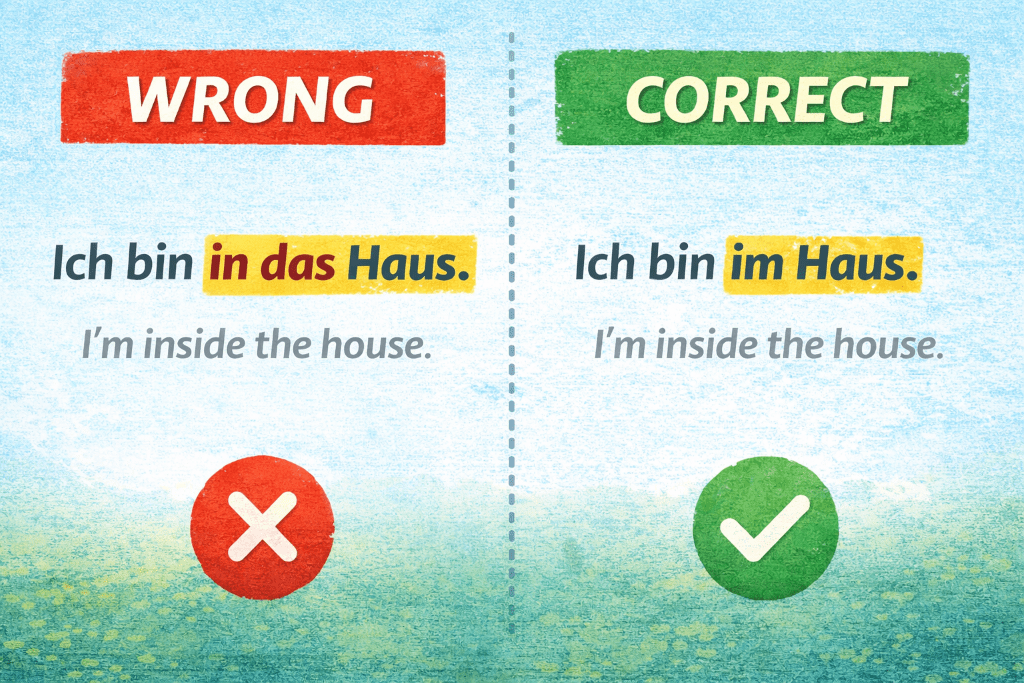
Ich bin in dem Haus.
You’ll hear:
Ich bin im Haus.
Both are correct—but only one sounds natural.
German Verbs with Fixed Prepositions
Some German verbs always appear with a specific preposition. These are called verbs with fixed prepositions (Verben mit festen Präpositionen).
That means:
👉 the preposition is not optional
👉 and it often doesn’t match English
| Verb + preposition | Case | Meaning | Example |
| warten auf | + Akkusativ | to wait for | Ich warte auf den Bus. |
| denken an | + Akkusativ | to think about | Wir denken an dich. |
| teilnehmen an | + Dativ | to participate in | Sie nimmt an dem Wettbewerb teil. |
| sprechen mit | + Dativ | to talk with | Ich spreche mit dem Lehrer. |
| Angst vor | + Two-way | to be afraid of | Ich habe Angst vor der Spinne. |
When a verb has a fixed preposition, the combination works as a unit.
You can’t swap the preposition, and you usually can’t translate it word-for-word.
Think of it like this:
👉 You’re not learning a verb
👉 You’re learning a verb + preposition pair
Your instinct is to translate.
English: wait for someone
German: auf jemanden warten
English: to think about something
German: an etwas denken (not über)
English: to depend on something
German: von etwas abhängen
👉 There is no consistent logic between English and German here.
That’s why memorizing translations doesn’t work.
German Prepositions: From Confusing Rules to Clear Patterns
German prepositions can feel overwhelming at first because they force you to let go of direct translation. You’re not just choosing a word. You’re choosing a structure, a case, and sometimes even a different way of thinking about space and meaning.
That’s a lot to process.
But as you’ve seen, there’s nothing random about it.
Once you understand:
- that some prepositions always take a specific case
- that others depend on movement vs. location
- and that verbs often come with their own fixed prepositions
everything starts to fall into place.
What used to feel like memorization becomes pattern recognition.
What used to feel confusing becomes predictable.
And eventually, you stop asking:
“Is this accusative or dative?”
Because the sentence itself tells you.
So don’t worry about mastering every preposition overnight. Focus on recognizing patterns, practicing real sentences, and building familiarity over time.
The more you see it, the more natural it becomes.
And one day, without even realizing it, you’ll say:
im Haus instead of in dem Haus
ins Haus when there’s movement
—and it will feel completely obvious.
That’s when you know it’s working.
German Prepositions FAQ
What are German prepositions?
German prepositions are words that connect nouns to a sentence and determine whether the noun is in the accusative, dative, or another grammatical case. Some examples include: mit (with), durch (through), and ohne (without).
What is the difference between accusative and dative prepositions?
Accusative prepositions always take the accusative case, while dative prepositions always take the dative case. Two-way prepositions use accusative for movement and dative for location.
What are two-way prepositions in German?
Two-way prepositions (Wechselpräpositionen) can take either accusative or dative depending on whether there is movement (accusative) or a fixed location (dative).
How do you know when to use dative or accusative in German?
Use accusative when there is movement or direction, and dative when describing a static position or location.
What is the easiest way to learn German prepositions?
The most effective way is to learn them in full sentences, use visual associations, and practice regularly rather than memorizing isolated lists.