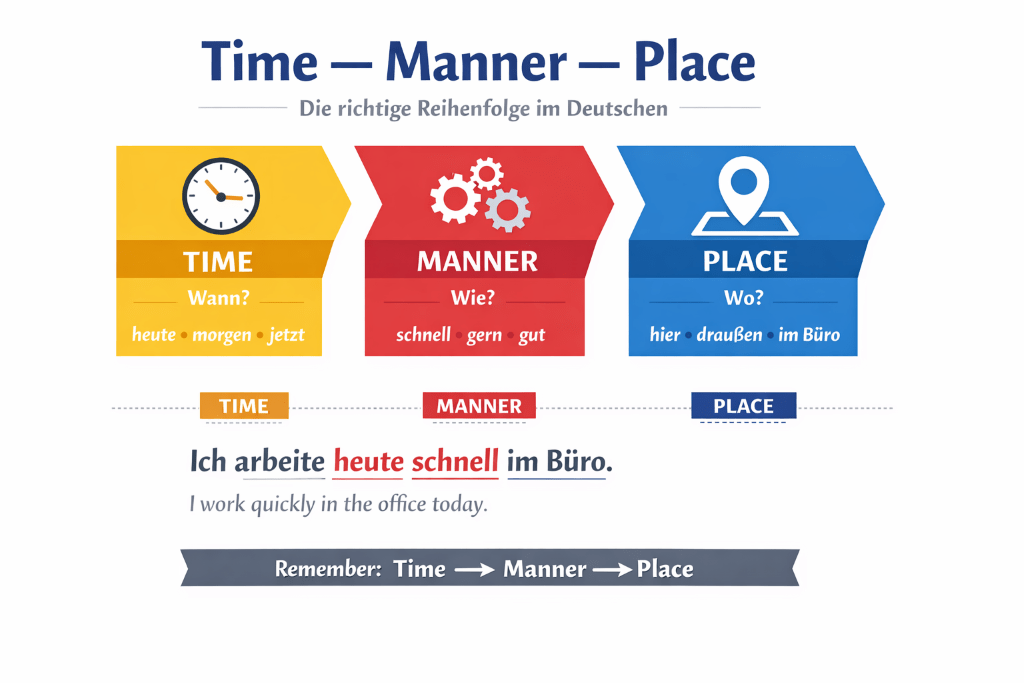
German sentence structure can feel confusing at first, especially when multiple adverbs appear in the same sentence. But there’s a clear and reliable rule that German speakers follow called the German time, manner, place rule:
👉 Time → Manner → Place (TMP)
Once you understand this rule, your German sentences will immediately sound more natural and correct.
What Are Adverbs in German?
Adverbs describe when, how, and where something happens.
In German, these are typically grouped into three categories:
- Time (Wann?) — when something happens
- Manner (Wie?) — how something happens
- Place (Wo?) — where something happens
German Time, Manner, Place Example
Ich gehe heute schnell ins Büro.
I’m going to the office quickly today.
Correct TMP order:
- heute (time)
- schnell (manner)
- ins Büro (place)
The TMP Rule (Time → Manner → Place)
When using multiple adverbs in a sentence, German typically follows this order:
👉 Time → Manner → Place
Example
Ich arbeite morgen effizient im Büro.
I will work efficiently in the office tomorrow.
Breakdown:
- morgen (time)
- effizient (manner)
- im Büro (place)
📌 Tip: If your sentence sounds “off” in German, check the order of your adverbs first.
Real-Life Use Cases: When You’ll Use German Time Manner Place
The Time–Manner–Place (TMP) structure isn’t just a grammar rule; it’s something you’ll use every day when speaking German.
Any time you describe what you’re doing, when, how, and where, you’ll naturally use this pattern.
Talking About Your Daily Routine
Ich arbeite heute konzentriert im Büro.
I work focused in the office today.
Ich lerne abends ruhig zu Hause.
I study quietly at home in the evenings.
Describing Work and Professional Situations
Wir treffen uns morgen früh im Konferenzraum.
We meet early tomorrow morning in the conference room.
Der Techniker arbeitet heute sorgfältig an der Maschine.
The technician is working carefully on the machine today.
Making Plans
Ich fahre morgen schnell nach Berlin.
I’m traveling quickly to Berlin tomorrow.
Wir gehen später entspannt ins Restaurant.
We go to the restaurant later in a relaxed way.
Giving Directions or Instructions
Fahren Sie jetzt langsam durch den Tunnel.
Drive slowly through the tunnel now.
Gehen Sie heute direkt ins Büro.
Go straight to the office today.
1. Time (Wann?)
Time expressions usually come first after the verb.
Common Time Adverbs
- heute — today
- morgen — tomorrow
- gestern — yesterday
- jetzt — now
- später — later
- oft — often
Example Sentences
Ich lerne heute Deutsch.
I am learning German today.
Wir treffen uns morgen.
We meet tomorrow.
2. Manner (Wie?)
Manner describes how something is done.
Common Manner Adverbs
- schnell — quickly
- langsam — slowly
- gern — gladly
- gut — well
- sorgfältig — carefully
Example Sentences
Er arbeitet sehr sorgfältig.
He works very carefully.
Sie fährt schnell.
She drives quickly.
3. Place (Wo?)
Place tells us where something happens.
Common Place Adverbs
- hier — here
- dort — there
- draußen — outside
- im Büro — in the office
- zu Hause — at home
Example Sentences
Ich bin heute zu Hause.
I am at home today.
Er arbeitet im Büro.
He works in the office.
Putting It All Together (TMP in Action)
Let’s combine all three:
Ich arbeite heute effizient im Büro.
I work efficiently in the office today.
Wir fahren morgen schnell nach Berlin.
We will travel quickly to Berlin tomorrow.
Er lernt jetzt intensiv zu Hause.
He is studying intensively at home now.
German word order typically follows Time → Manner → Place, meaning you say when something happens, how it happens, and where it happens—in that order.
When German Time Manner Place Changes (Exceptions & Flexibility)
German is flexible, especially for emphasis.
You can move elements for focus:
Example
Heute arbeite ich im Büro.
Today I work in the office.
Here, time comes first for emphasis, and the verb still stays in position 2.
📌 Important Rule: The verb is always in position 2, even when you move elements around.
Advanced Tip: Dative Before Accusative (Bonus Rule)
When objects are involved, German also follows:
👉 Dative before Accusative
Example:
Ich gebe dem Mann das Buch.
I give the man the book.
Common Mistakes to Avoid
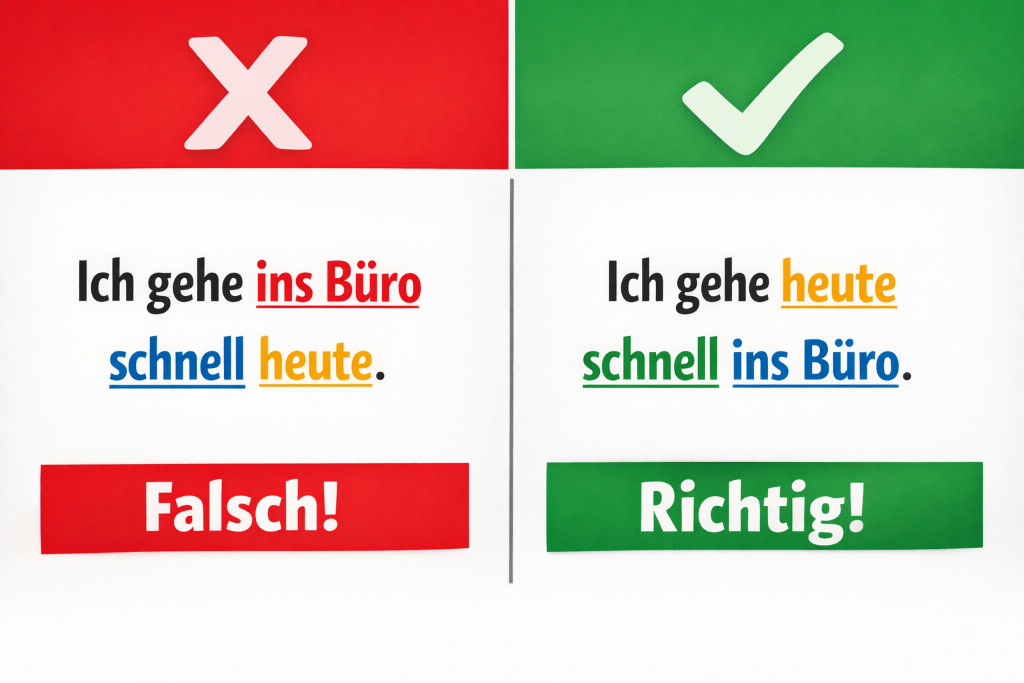
❌ Ich gehe ins Büro schnell heute.
(incorrect order)
✅ Ich gehe heute schnell ins Büro.
👉 Time → Manner → Place
Using German Time, Manner, Place to Speak Fluently
The TMP rule is one of the most useful sentence structure rules in German. Once you understand it, you can:
- Build more natural sentences
- Avoid common beginner mistakes
- Sound more fluent immediately
Like most grammar rules, TMP becomes easier with practice. Start by building simple sentences and gradually add more detail.
German Time, Manner, Place Exercises
Rearrange the words to form a correct German sentence using:
👉 Time → Manner → Place
Exercise 1
(ich / heute / arbeite / ruhig / im Büro)
Exercise 2
(wir / morgen / fahren / schnell / nach Berlin)
Exercise 3
(ich / jetzt / lerne / intensiv / zu Hause)
Exercise 4
(er / gestern / gearbeitet / effizient / im Büro / hat)
Exercise 5
(sie / heute / spricht / langsam / mit dem Kunden)
Exercise 6
(wir / später / treffen / uns / draußen / gemütlich)
Exercise 7
(ich / morgen / gehe / früh / ins Fitnessstudio)
Exercise 8
(er / heute / arbeitet / konzentriert / an dem Projekt)
Exercise 9
(wir / jetzt / fahren / vorsichtig / durch den Tunnel)
Exercise 10
(sie / gestern / hat / leise / im Büro / gearbeitet)
Answer Key
1. Ich arbeite heute ruhig im Büro.
2. Wir fahren morgen schnell nach Berlin.
3. Ich lerne jetzt intensiv zu Hause.
4. Er hat gestern effizient im Büro gearbeitet.
5. Sie spricht heute langsam mit dem Kunden.
6. Wir treffen uns später gemütlich draußen.
7. Ich gehe morgen früh ins Fitnessstudio.
8. Er arbeitet heute konzentriert an dem Projekt.
9. Wir fahren jetzt vorsichtig durch den Tunnel.
10. Sie hat gestern leise im Büro gearbeitet.
FAQ: German Time, Manner, Place (TMP)
Q: Does time or place come first in German?
A: In standard German word order, time comes before place.
German typically follows this structure:
👉 Time → Manner → Place
For example:
Ich arbeite heute im Büro.
I work in the office today.
- heute = time
- im Büro = place
Q: What is time–manner–place in German?
A: Time–Manner–Place (TMP) is a rule that describes the typical order of adverbs in a German sentence.
It answers three questions:
- When? → Time
- How? → Manner
- Where? → Place
Example:
Ich arbeite heute effizient im Büro.
I work efficiently in the office today.
- heute = time
- effizient = manner
- im Büro = place
Q: What is the time manner place rule in German?
A: The time–manner–place rule means that when multiple adverbs appear in a sentence, they usually follow this order:
👉 Time → Manner → Place
Example:
Wir fahren morgen schnell nach Berlin.
We will travel quickly to Berlin tomorrow.
This structure helps German sentences sound natural and logical, and it’s one of the most important word order rules for learners.
Q: How do you remember German word order (TMP)?
A: A simple way to remember the rule is:
👉 Time → Manner → Place
You can also think of it like telling a story:
- When did it happen?
- How did it happen?
- Where did it happen?
Typical sentence pattern: Ich + verb + time + manner + place
Example: Ich arbeite heute ruhig zu Hause.
Q: Can the TMP order change in German?
A: Yes — but only for emphasis.
German allows flexibility, especially at the beginning of a sentence:
Heute arbeite ich im Büro.
Today I work in the office.
However, the verb must stay in position 2, and TMP must stay in the default order inside the sentence.
Continue Learning German
To improve your German even faster, explore more guides on My Germanized Life:
- Learn German grammar to understand sentence structure
- Expand your German vocabulary to build more complex sentences
- Improve your German pronunciation to sound more natural when speaking