
A1 German Course 10 Sections63 Lessons1 QuizLifetime
Lesson 48: Directions and the Imperative
In this lesson, you’ll learn how to ask for simple directions in German. You’ll also learn how to understand basic direction phrases like go straight ahead, go left, and go right.
You do not need to understand every grammar detail yet. The goal is to recognize and use short direction phrases.
What You’ll Learn
- How to ask where a place is
- How to say left, right, and straight ahead
- How to understand simple directions
- How to use polite command phrases with Gehen Sie…
- How to recognize the informal command Geh…
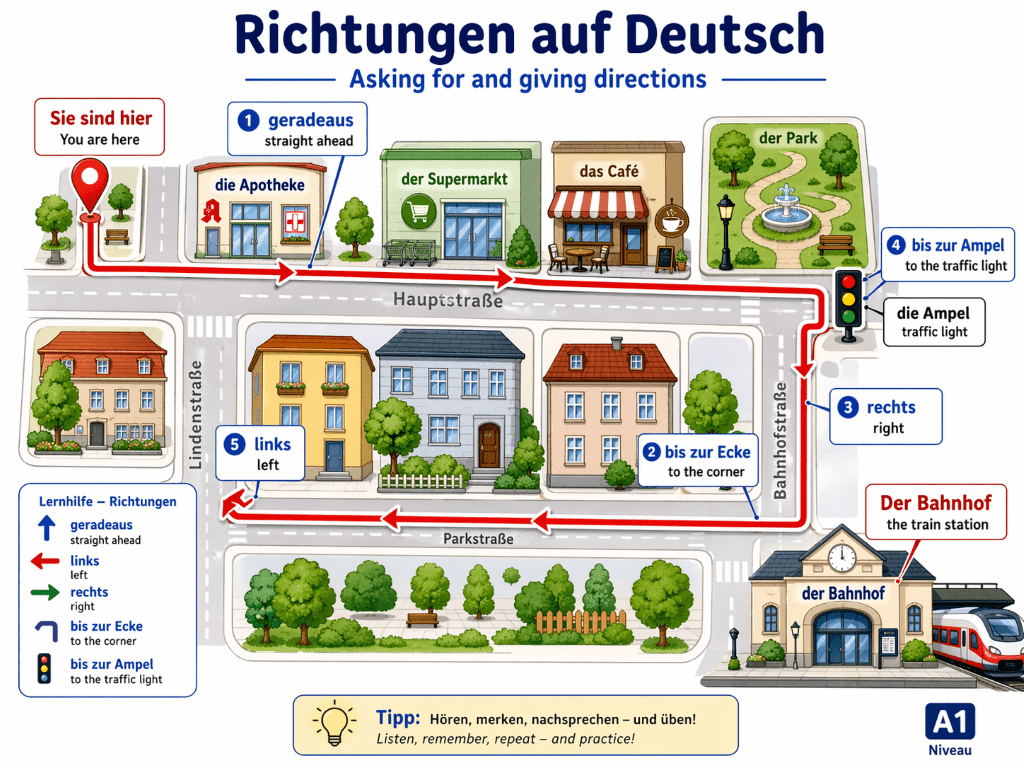
Direction Vocabulary
| German | English |
|---|---|
| links | left |
| rechts | right |
| geradeaus | straight ahead |
| die Straße | the street |
| die Ecke | the corner |
| die Ampel | the traffic light |
| hier | here |
| dort | there |
These words are very useful when asking for directions or understanding where to go.
Asking For Directions
You already know the question:
Wo ist … ?
Where is … ?
You can make it more polite by starting with:
Entschuldigung, …
Excuse me, …
Examples:
Entschuldigung, wo ist der Bahnhof?
Excuse me, where is the train station?
Entschuldigung, wo ist die Apotheke?
Excuse me, where is the pharmacy?
Entschuldigung, wo ist das Hotel?
Excuse me, where is the hotel?
This is simple and useful. You do not need a long question to ask for directions.
A More Natural Direction Question
You may also hear:
Wie komme ich zum Bahnhof?
How do I get to the train station?
This is very useful, but it is a little more advanced than Wo ist … ?
For now, learn it as a chunk:
Wie komme ich zum Bahnhof? = How do I get to the train station?
You can use the same pattern with other places:
Wie komme ich zur Apotheke?
How do I get to the pharmacy?
Wie komme ich zum Supermarkt?
How do I get to the supermarket?
Do not worry about why it is zum or zur yet. Just learn the full phrases for now.
Giving Directions With Gehen Sie…
When someone gives directions politely, they may use:
Gehen Sie …
Go …
This is the polite command form. You use it with Sie.
For directions, learn these phrases as chunks:
| German | English |
|---|---|
| Gehen Sie geradeaus. | Go straight ahead. |
| Gehen Sie links. | Go left. |
| Gehen Sie rechts. | Go right. |
| Gehen Sie bis zur Ecke. | Go to the corner. |
| Gehen Sie bis zur Ampel. | Go to the traffic light. |
How The Imperative Works
An imperative is a command, instruction, or request.
In this lesson, you are using the imperative for directions:
Gehen Sie geradeaus.
Go straight ahead.
German has different imperative forms depending on who you are talking to.
For A1, focus on three forms:
- Du = One person you know well
- Ihr = More than one person you know well
- Sie = One or more people in a formal situation
Imperative Table: Gehen
Gehen means to go.
| Pronoun | Imperative Form | Example | ||
|---|---|---|---|---|
| du | Geh | Geh geradeaus. | ||
| ihr | Geht | Geht geradeaus. | ||
| Sie | Gehen Sie | Gehen Sie geradeaus. |
The most useful form for directions is:
Gehen Sie …
You use this when asking or giving directions to strangers, workers, shop employees, or anyone you want to address politely.
How To Build The Imperative
With Du
For one person you know well, use:
Geh …
Examples:
Geh geradeaus.
Go straight ahead.
Geh links.
Go left.
Geh rechts.
Go right.
You do not need to say du in the command.
Not:
Geh du geradeaus.
Just say:
Geh geradeaus.
With Ihr
For more than one person you know well, use:
Geht …
Examples:
Geht geradeaus.
Go straight ahead.
Geht links.
Go left.
Geht rechts.
Go right.
This form is useful if you are talking to a group of friends, children, or classmates.
With Sie
For polite or formal directions, use:
Gehen Sie …
Examples:
Gehen Sie geradeaus.
Go straight ahead.
Gehen Sie links.
Go left.
Gehen Sie rechts.
Go right.
Here, the pronoun Sie is included, unlike with the du and ihr forms.
Another Useful Imperative: Fragen
Fragen means to ask.
| Pronoun | Imperative Form | Example | ||
|---|---|---|---|---|
| du | Frag | Frag Anna. | ||
| ihr | Fragt | Fragt Anna. | ||
| Sie | Fragen Sie | Fragen Sie Anna. |
Notice the same basic pattern:
| Form | Pattern |
|---|---|
| du | Short command form |
| ihr | Usually the same as the ihr verb form |
| Sie | Verb + Sie |
For this lesson, you do not need to memorize many imperative forms. Just understand how the three command types work.
Which Form Should You Use?
Use Gehen Sie… when asking for or giving directions to someone you do not know.
Use Geh… with one friend, family member, child, or someone you call du.
Use Geht… with more than one person you call du.
| Situation | Use |
|---|---|
| A stranger asks for directions | Gehen Sie geradeaus. |
| You tell one friend where to go | Geh geradeaus. |
| You tell two friends where to go | Geht geradeaus. |
| You talk to a shop employee or official | Gehen Sie… |
Informal Direction Phrases
With someone you know, you may hear:
Geh …
Go …
Examples:
Geh geradeaus.
Go straight ahead.
Geh links.
Go left.
Geh rechts.
Go right.
This is the informal command form. For now, the most important thing is to recognize it.
Use Gehen Sie… with strangers.
Use Geh… only with people you would call du.
Understanding A Simple Route
A direction can be made from a few short steps.
Example:
Gehen Sie geradeaus.
Go straight ahead.
Dann gehen Sie rechts.
Then go right.
Der Bahnhof ist links.
The train station is on the left.
Together:
Gehen Sie geradeaus. Dann gehen Sie rechts. Der Bahnhof ist links.
This means:
Go straight ahead. Then go right. The train station is on the left.
The Word Dann
Dann means then.
It helps connect steps.
Examples:
Gehen Sie geradeaus. Dann gehen Sie links.
Go straight ahead. Then go left.
Gehen Sie bis zur Ecke. Dann gehen Sie rechts.
Go to the corner. Then go right.
This is a simple way to give directions in order.
A Small Grammar Note: Bis Zur Ecke
You may see this phrase:
bis zur Ecke
to the corner / until the corner
Do not worry about the full grammar yet. Learn it as one useful phrase.
| German | English |
|---|---|
| bis zur Ecke | to the corner |
| bis zur Ampel | to the traffic light |
Examples:
Gehen Sie bis zur Ecke.
Go to the corner.
Gehen Sie bis zur Ampel.
Go to the traffic light.