
A1 German Course 10 Sections63 Lessons1 QuizLifetime
Lesson 47: Where Things Are – In, Auf, and Neben
In this lesson, you’ll learn how to say where things are in a room. You already know home and room words, so now you’ll use them with simple place phrases like in, auf, and neben.
What You’ll Learn
- How to say where something is
- How to use in, auf, and neben
- How to ask Where is…?
- How to use simple location chunks
- How to describe a room with short sentences
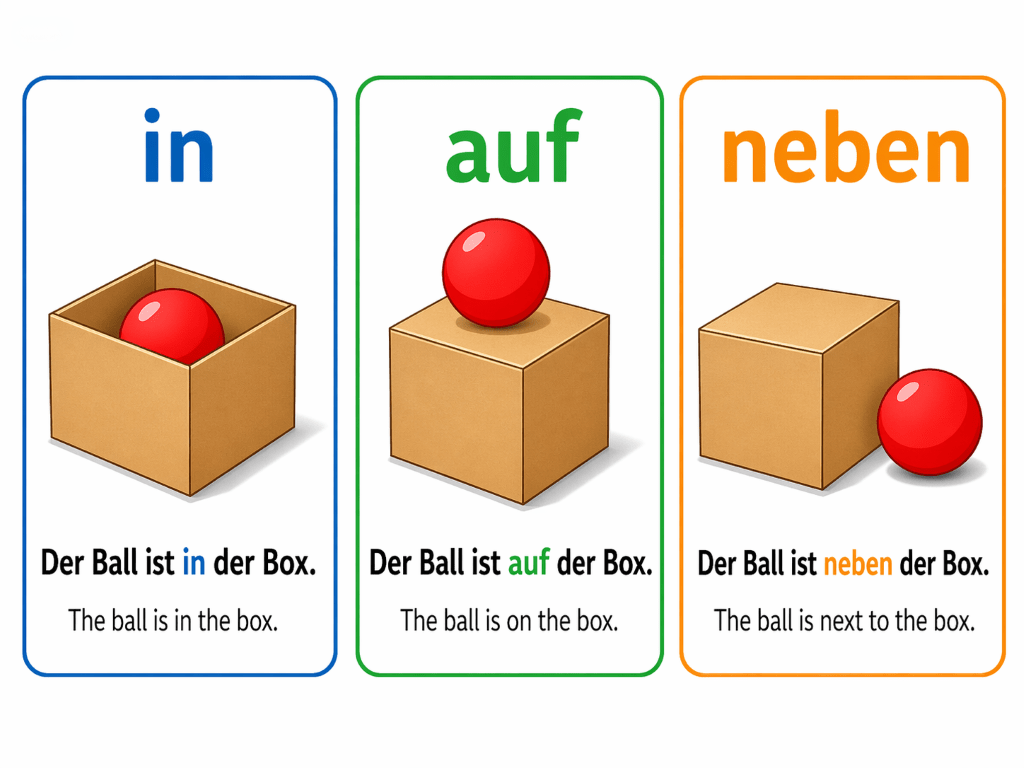
Three Useful Place Words
German has place words that help you say where something is.
| German | English |
|---|---|
| in | In |
| auf | On |
| neben | Next to/beside |
Examples in English:
- The book is in the room.
- The book is on the table.
- The chair is next to the bed.
In German, you can use these same ideas, but the small words after them may change.
For now, learn the full phrase as a chunk.
Saying Something Is In A Room
Use:
… ist im Zimmer.
… is in the room.
Examples:
Das Bett ist im Zimmer.
The bed is in the room.
Die Lampe ist im Zimmer.
The lamp is in the room.
Der Stuhl ist im Zimmer.
The chair is in the room.
What Does Im Mean?
im is a short form of:
in dem
For beginners, you can understand im as in the.
So:
im Zimmer = in the room
im Schlafzimmer = in the bedroom
im Wohnzimmer = in the living room
im Bad = in the bathroom
Learn these as useful chunks for now.
Saying Something Is In The Kitchen
You already learned:
die Küche = the kitchen
With die words, the place phrase often looks different.
Use:
in der Küche = in the kitchen
Examples:
Der Tisch ist in der Küche.
The table is in the kitchen.
Die Lampe ist in der Küche.
The lamp is in the kitchen.
You do not need to memorize the full grammar rule yet. Just learn:
in der Küche = in the kitchen
Saying Something Is On The Table
Use:
auf dem Tisch = on the table
Examples:
Das Buch ist auf dem Tisch.
The book is on the table.
Das Handy ist auf dem Tisch.
The phone is on the table.
Der Schlüssel ist auf dem Tisch.
The key is on the table.
What Does Auf Dem Mean?
auf dem means on the with many masculine and neuter nouns in these place phrases.
For now, learn:
auf dem Tisch = on the table
auf dem Bett = on the bed
auf dem Stuhl = on the chair
Do not worry about mastering all of this yet. These are common A1 phrases.
Saying Something Is Next To Something
Use:
neben dem … = next to the …
Examples:
Der Stuhl ist neben dem Tisch.
The chair is next to the table.
Die Lampe ist neben dem Bett.
The lamp is next to the bed.
Die Tasche ist neben dem Stuhl.
The bag is next to the chair.
For now, learn these as chunks:
neben dem Tisch = next to the table
neben dem Bett = next to the bed
neben dem Stuhl = next to the chair
Asking Where Something Is
A useful question is:
Wo ist … ?
Where is … ?
Examples:
Wo ist das Buch?
Where is the book?
Wo ist die Tasche?
Where is the bag?
Wo ist der Schlüssel?
Where is the key?
You can answer with a place phrase:
Das Buch ist auf dem Tisch.
The book is on the table.
Die Tasche ist neben dem Bett.
The bag is next to the bed.
Der Schlüssel ist in der Küche.
The key is in the kitchen.
A Small Grammar Note: Why The Articles Change
You may notice that the articles change:
| Basic Noun | Place Phrase |
|---|---|
| der Tisch | auf dem Tisch |
| das Bett | neben dem Bett |
| die Küche | in der Küche |
This happens because German changes articles in location phrases.
For now, the goal is to recognize and use common phrases.
Learn these chunks first:
| German | English |
|---|---|
| im Zimmer | In the room |
| in der Küche | In the kitchen |
| auf dem Tisch | On the table |
| neben dem Bett | Next to the bed |
You will understand the full grammar more deeply later.
Useful Room Sentences
Here are a few simple sentences that describe a room:
Das Bett ist im Schlafzimmer.
The bed is in the bedroom.
Das Buch ist auf dem Tisch.
The book is on the table.
Die Lampe ist neben dem Bett.
The lamp is next to the bed.
Die Tasche ist in der Küche.
The bag is in the kitchen.
Mini Text: Mein Zimmer
Mein Zimmer ist klein, aber schön.
My room is small, but nice.
Das Bett ist im Zimmer.
The bed is in the room.
Der Tisch ist neben dem Bett.
The table is next to the bed.
Das Buch ist auf dem Tisch.
The book is on the table.
Die Tasche ist neben dem Stuhl.
The bag is next to the chair.