A1 German Course 10 Sections63 Lessons1 QuizLifetime
Lesson 40: Telling Time
In this lesson, you’ll learn how to tell time in German. You’ll learn how to ask what time it is, how to say simple times, how to understand the 24-hour clock, and how to use everyday spoken time phrases like halb sechs.
What you’ll learn
- how to ask what time it is
- how to say simple times in German
- how to use Uhr
- how to use um with time
- the difference between 2 Uhr nachts and 14 Uhr
- how to understand halb sechs, halb sieben, and similar time phrases
- how to talk about when something happens
Asking what time it is
A useful question is:
Wie spät ist es?
What time is it?
You may also hear:
Wie viel Uhr ist es?
What time is it?
Both questions mean basically the same thing. For beginners, start with:
Wie spät ist es?
Saying the hour
To say the time, use:
Es ist … Uhr.
Examples:
Es ist ein Uhr.
It is one o’clock.
Es ist zwei Uhr.
It is two o’clock.
Es ist drei Uhr.
It is three o’clock.
Es ist zehn Uhr.
It is ten o’clock.
In German, Uhr means o’clock when you are telling time.
A small note about one o’clock
For one o’clock, German uses:
Es ist ein Uhr.
Not:
Es ist eins Uhr.
So remember this useful chunk:
ein Uhr = one o’clock
Telling time with minutes
You can also add minutes after Uhr.
Examples:
Es ist acht Uhr fünf.
It is 8:05.
Es ist neun Uhr zehn.
It is 9:10.
Es ist zwölf Uhr dreißig.
It is 12:30.
This is a simple, clear way to tell time.
Pattern:
Es ist + hour + Uhr + minutes
Examples:
Es ist sieben Uhr fünfzehn.
It is 7:15.
Es ist sechs Uhr vierzig.
It is 6:40.
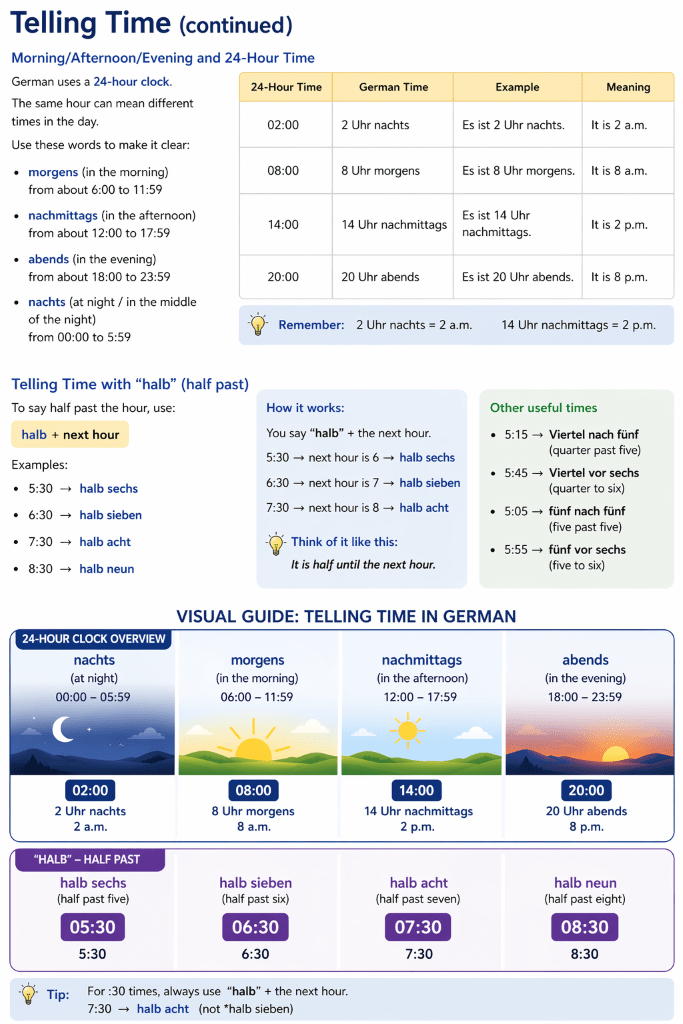
The 24-hour clock
German often uses the 24-hour clock, especially in written schedules, appointments, transportation, school, work, and official situations.
That means:
2 Uhr = 2:00
14 Uhr = 14:00 / 2:00 p.m.
These two times are not the same in a schedule.
2 Uhr nachts = 2:00 at night / 2:00 a.m.
14 Uhr = 2:00 in the afternoon / 2:00 p.m.
You may also hear:
2 Uhr nachmittags = 2:00 in the afternoon
But in official written time, German often uses:
14 Uhr = 2:00 p.m.
Useful 24-hour time examples
| German time | English time |
|---|---|
| 8 Uhr | 8:00 a.m. |
| 12 Uhr | 12:00 p.m. / noon |
| 14 Uhr | 2:00 p.m. |
| 16 Uhr | 4:00 p.m. |
| 18 Uhr | 6:00 p.m. |
| 20 Uhr | 8:00 p.m. |
| 22 Uhr | 10:00 p.m. |
For beginners, remember:
14 Uhr = 2:00 p.m.
18 Uhr = 6:00 p.m.
20 Uhr = 8:00 p.m.
Day and night words
You can add words to make the time clearer.
| German | English |
|---|---|
| morgens | in the morning |
| nachmittags | in the afternoon |
| abends | in the evening |
| nachts | at night |
Examples:
Es ist 8 Uhr morgens.
It is 8:00 in the morning.
Es ist 2 Uhr nachts.
It is 2:00 at night.
Es ist 14 Uhr.
It is 2:00 p.m.
Es ist 20 Uhr.
It is 8:00 p.m.
Saying when something happens
To say at a time, use:
um
Examples:
um acht Uhr = at eight o’clock
um zehn Uhr = at ten o’clock
um sieben Uhr dreißig = at 7:30
um 14 Uhr = at 2:00 p.m.
This is different from Es ist …
Use Es ist … to say what time it is.
Use um … to say when something happens.
Compare: Es ist and um
Es ist acht Uhr.
It is eight o’clock.
Ich lerne um acht Uhr.
I study at eight o’clock.
Es ist 14 Uhr.
It is 2:00 p.m.
Der Termin ist um 14 Uhr.
The appointment is at 2:00 p.m.
Everyday spoken time: halb sechs
German also has everyday spoken time expressions.
One very important phrase is:
halb sechs
This does not mean 6:30.
It means:
halb sechs = 5:30
German counts toward the next hour.
So:
halb sechs = halfway to six = 5:30
halb sieben = halfway to seven = 6:30
halb acht = halfway to eight = 7:30
This feels strange for English speakers at first, but the pattern is simple once you get used to it.
Spoken time examples
| German | English |
|---|---|
| halb zwei | 1:30 |
| halb drei | 2:30 |
| halb vier | 3:30 |
| halb fünf | 4:30 |
| halb sechs | 5:30 |
| halb sieben | 6:30 |
| halb acht | 7:30 |
| halb neun | 8:30 |
Think of halb as halfway to the next hour.
Compare the two ways
You can say 5:30 in a clear digital way:
Es ist fünf Uhr dreißig.
It is 5:30.
Or you can say it in a common spoken way:
Es ist halb sechs.
It is 5:30.
Both are correct.
The first version is clearer and more literal.
The second version is common in everyday spoken German.
When to use each one
Use the simple digital form when you want to be very clear:
Es ist fünf Uhr dreißig.
It is 5:30.
Der Termin ist um 14 Uhr.
The appointment is at 2:00 p.m.
Use halb… when you are practicing everyday spoken German:
Es ist halb sechs.
It is 5:30.
Ich frühstücke um halb acht.
I eat breakfast at 7:30.
Ich lerne Deutsch um halb sieben.
I study German at 6:30.
Time with daily routines
You can use time phrases with daily routine sentences.
Examples:
Ich frühstücke um sieben Uhr.
I eat breakfast at seven o’clock.
Ich arbeite um neun Uhr.
I work at nine o’clock.
Ich lerne Deutsch um sechs Uhr.
I study German at six o’clock.
Ich schlafe um zehn Uhr.
I sleep at ten o’clock.
Ich frühstücke um halb acht.
I eat breakfast at 7:30.
Ich lerne um halb sieben.
I study at 6:30.
A small grammar point: the verb stays early
In a simple German sentence, the verb usually comes early.
Examples:
Ich frühstücke um sieben Uhr.
Ich arbeite um neun Uhr.
Ich lerne um sechs Uhr.
Pattern:
subject + verb + time
Examples:
Ich lerne um acht Uhr.
Du arbeitest um neun Uhr.
Wir essen um sechs Uhr.
You can also start with the time phrase:
Um acht Uhr lerne ich.
At eight o’clock, I study.
For now, the easiest beginner pattern is:
Ich + verb + um + time
Examples:
Ich lerne um acht Uhr.
Ich frühstücke um halb acht.
Ich schlafe um zehn Uhr.
Useful time phrases
| German | English |
|---|---|
| Wie spät ist es? | What time is it? |
| Es ist ein Uhr. | It is one o’clock. |
| Es ist zwei Uhr. | It is two o’clock. |
| Es ist 14 Uhr. | It is 2:00 p.m. |
| 2 Uhr nachts | 2:00 a.m. |
| um acht Uhr | at eight o’clock |
| um 14 Uhr | at 2:00 p.m. |
| halb sechs | 5:30 |
| halb sieben | 6:30 |
| halb acht | 7:30 |