A1 German Course 10 Sections63 Lessons1 QuizLifetime
Lesson 50: Modal Verbs – Signs And Simple Rules
In this lesson, you’ll learn useful German signs and simple rule phrases. You’ll also learn how to use müssen and dürfen in basic A1 sentences.
This lesson is practical. The goal is to help you understand signs, rules, and short instructions in everyday places like stations, shops, schools, offices, parks, and public buildings.
What You’ll Learn
- How To Understand Basic German Signs
- How To Say Something Is Open Or Closed
- How To Use müssen For “Must” Or “Have To”
- How To Use dürfen For “May” Or “Be Allowed To”
- How To Say Something Is Not Allowed
- How To Recognize Simple Rules In Public Places
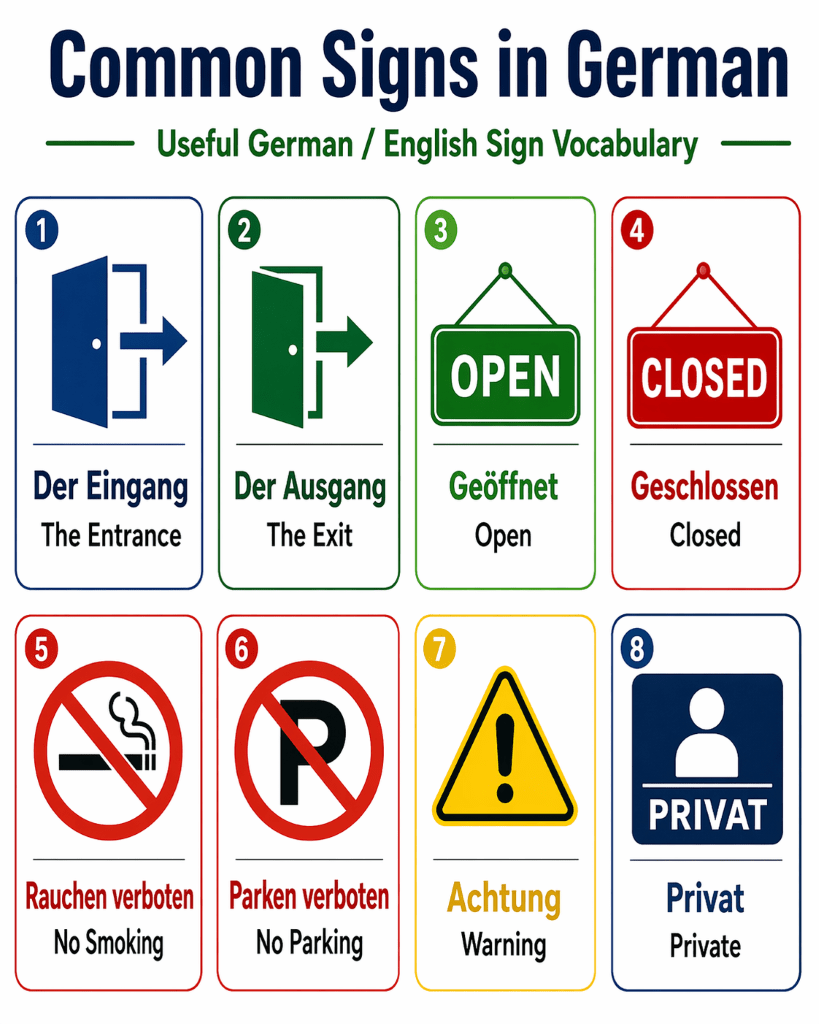
Useful Sign Words
You will see these words often on signs, doors, buildings, and public notices.
| German | English |
|---|---|
| Der Eingang | The Entrance |
| Der Ausgang | The Exit |
| Geöffnet | Open |
| Geschlossen | Closed |
| Verboten | Forbidden / Not Allowed |
| Achtung | Attention / Warning |
| Privat | Private |
| Bitte | Please |
| Danke | Thank You |
These words are useful even if you do not understand the whole sentence yet.
Open And Closed
Two very common sign words are:
Geöffnet = Open
Geschlossen = Closed
Examples:
Das Geschäft ist geöffnet.
The shop is open.
Das Café ist geschlossen.
The café is closed.
You may also see these words alone on signs:
Geöffnet
Open
Geschlossen
Closed
Entrance And Exit
Two important public-place words are:
Der Eingang = The Entrance
Der Ausgang = The Exit
You may see these signs in stores, train stations, museums, offices, and public buildings.
Examples:
Der Eingang ist hier.
The entrance is here.
Der Ausgang ist dort.
The exit is there.
These are simple location sentences you already know:
Place + ist + location
The Word Verboten
Verboten means forbidden or not allowed.
You may see it on signs like:
Rauchen verboten
Smoking forbidden / No smoking
Parken verboten
Parking forbidden / No parking
Fotografieren verboten
Taking photos is forbidden / No photos
For now, learn these as sign phrases. You do not need to understand every grammar detail.
The Modal Verb Müssen
müssen means must or have to.
Use müssen when something is necessary.
Examples in English:
I must go.
I have to wait.
You have to pay.
In German, the müssen form comes early, and the action verb goes at the end.
Pattern:
Subject + müssen form + more information + action verb
Example:
Ich muss zur Schule gehen.
I have to go to school.
Here is the structure:
| Part | German | Meaning |
|---|---|---|
| Subject | Ich | I |
| Modal Verb | muss | must / have to |
| More Information | zur Schule | to school |
| Action Verb | gehen | go |
The action verb gehen stays at the end.
Verb Table: Müssen
| Pronoun | Form | Example |
|---|---|---|
| Ich | Muss | Ich muss gehen. |
| Du | Musst | Du musst warten. |
| Er / Sie / Es | Muss | Sie muss zahlen. |
| Wir | Müssen | Wir müssen gehen. |
| Ihr | Müsst | Ihr müsst warten. |
| Sie / sie | Müssen | Sie müssen zahlen. |
For this lesson, focus on these forms first:
Ich muss …
I must / I have to …
Du musst …
You must / You have to …
Sie müssen …
You must / You have to … formal
Useful Müssen Sentences
Use müssen when a rule or situation requires something.
Ich muss warten.
I have to wait.
Ich muss zahlen.
I have to pay.
Ich muss zur Schule gehen.
I have to go to school.
Sie müssen hier warten.
You must wait here.
These are simple but useful in real life.
The Modal Verb Dürfen
dürfen means may or be allowed to.
Use dürfen when something is allowed.
Examples in English:
I may go.
You may enter.
You are allowed to park here.
In German, dürfen works like müssen:
The modal verb comes early.
The action verb goes at the end.
Pattern:
Subject + dürfen form + more information + action verb
Example:
Ich darf hier parken.
I am allowed to park here.
Structure:
| Part | German | Meaning |
|---|---|---|
| Subject | Ich | I |
| Modal Verb | darf | may / am allowed to |
| More Information | hier | here |
| Action Verb | parken | park |
Verb Table: Dürfen
| Pronoun | Form | Example |
|---|---|---|
| Ich | Darf | Ich darf gehen. |
| Du | Darfst | Du darfst warten. |
| Er / Sie / Es | Darf | Er darf parken. |
| Wir | Dürfen | Wir dürfen gehen. |
| Ihr | Dürft | Ihr dürft warten. |
| Sie / sie | Dürfen | Sie dürfen parken. |
For this lesson, focus on these forms first:
Ich darf …
I may / I am allowed to …
Du darfst …
You may / You are allowed to …
Sie dürfen …
You may / You are allowed to … formal
Saying Something Is Not Allowed
This is one of the most useful patterns in this lesson:
Ich darf hier nicht …
I am not allowed to … here.
Examples:
Ich darf hier nicht parken.
I am not allowed to park here.
Ich darf hier nicht rauchen.
I am not allowed to smoke here.
Ich darf hier nicht fotografieren.
I am not allowed to take photos here.
The word nicht makes the sentence negative.
The action verb still goes at the end:
Ich darf hier nicht parken.
Compare Müssen and Dürfen
| German | Meaning | Use |
|---|---|---|
| Ich muss gehen. | I have to go. | Something is necessary. |
| Ich darf gehen. | I may go. | Something is allowed. |
| Ich darf nicht gehen. | I may not go. | Something is not allowed. |
This is the simple difference:
Müssen = You have to do it.
Dürfen = You are allowed to do it.
Nicht dürfen = You are not allowed to do it.
Useful Rule Phrases
Here are practical rule phrases you may hear or see.
| German | English |
|---|---|
| Sie müssen warten. | You must wait. |
| Sie müssen zahlen. | You must pay. |
| Sie dürfen gehen. | You may go. |
| Sie dürfen hier parken. | You may park here. |
| Sie dürfen hier nicht parken. | You may not park here. |
| Sie dürfen hier nicht rauchen. | You may not smoke here. |
These use Sie, so they are formal or polite. That is common on signs, in offices, or when speaking to strangers.
A Small Word Order Reminder
With modal verbs like müssen and dürfen, German often uses two verbs.
The modal verb comes early:
Ich muss …
Ich darf …
The action verb goes at the end:
Ich muss zahlen.
I have to pay.
Ich darf hier parken.
I am allowed to park here.
Ich darf hier nicht rauchen.
I am not allowed to smoke here.
Think of the sentence like this:
First Verb Early, Action Verb At The End