
A1 German Course 10 Sections63 Lessons1 QuizLifetime
Lesson 49: Gehen Or Fahren?
In this lesson, you’ll learn how to say where you are going and how you get there. You already know many place words, so this lesson focuses on the movement patterns you need for everyday German.
What You’ll Learn
- How to choose gehen or fahren
- How to say home with nach Hause
- How to use movement phrases like zum Bahnhof, zur Schule, and ins Café
- How to say you travel by bus, train, car, bike, or on foot
- How to combine a destination with transportation
- How to ask how someone gets somewhere
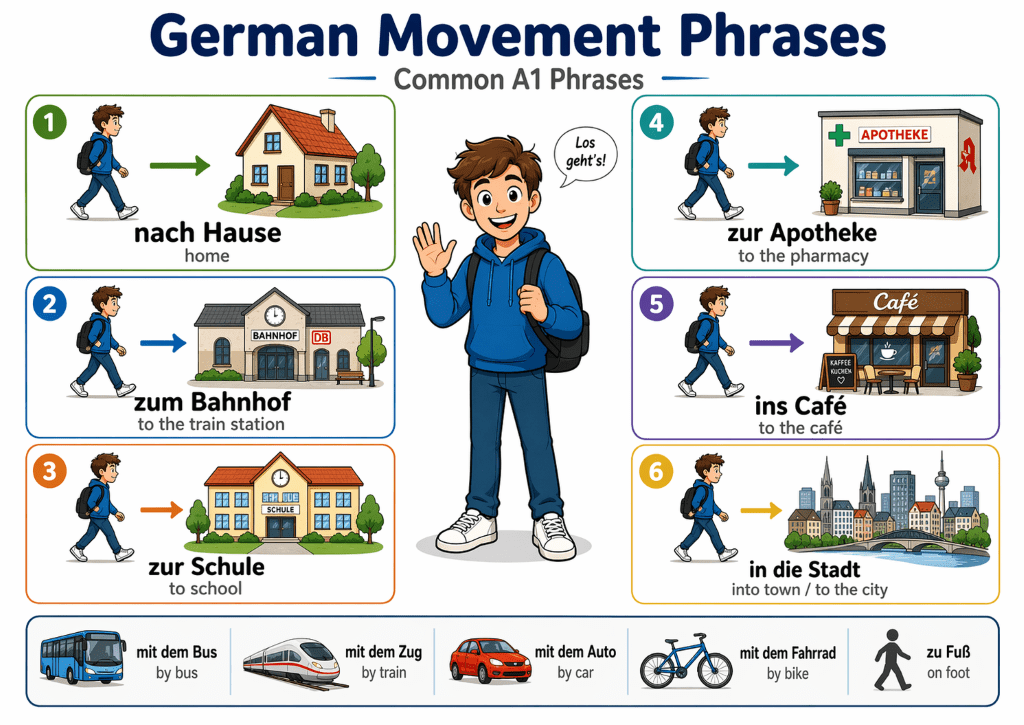
Gehen Or Fahren?
German uses two very common verbs for going places.
| German | English | Use When… |
|---|---|---|
| gehen | To go / to walk | You are walking somewhere |
| fahren | To drive / to go by vehicle | You are going by bus, train, car, bike, or another vehicle |
Use gehen when the focus is on walking to a place.
Ich gehe zur Schule.
I am going to school.
Use fahren when the focus is transportation.
Ich fahre mit dem Bus.
I am going by bus.
For beginners, remember:
Gehen = Go / walk
Fahren = Go by vehicle
Going Home: Nach Hause
German uses a special phrase for going home:
Nach Hause
Home / to home
You can use it with gehen or fahren.
Ich gehe nach Hause.
I am going home.
Ich fahre nach Hause.
I am going home by vehicle.
The difference is small but useful:
| German | Meaning |
|---|---|
| Ich gehe nach Hause. | I am going home / walking home |
| Ich fahre nach Hause. | I am going home by vehicle |
You do not say zum Haus when you mean “going home.” Use nach Hause.
Going To A Place
In English, you often use one word: to.
In German, the phrase changes depending on the place.
For A1, do not try to build every phrase from scratch. Learn these as useful chunks.
| German | English |
|---|---|
| zum Bahnhof | To the train station |
| zum Supermarkt | To the supermarket |
| zur Schule | To school |
| zur Apotheke | To the pharmacy |
| ins Café | To the café |
| ins Restaurant | To the restaurant |
| in die Stadt | Into town / to the city |
These phrases all show movement toward a place.
Why Are There Different Words For “To”?
German does not use one single word for every to phrase.
You will see different forms:
- zum
- zur
- ins
- in die
- nach Hause
For now, the goal is not to master the full grammar. The goal is to recognize and use the most common A1 movement phrases.
Think of them as complete phrases:
Zum Bahnhof = To the train station
Zur Schule = To school
Ins Café = To the café
In die Stadt = Into town
Nach Hause = Home
You will learn the deeper grammar later.
Using Movement Phrases With Gehen
Use gehen when you are going somewhere, especially if you are walking or the transportation is not important.
Ich gehe zum Bahnhof.
I am going to the train station.
Ich gehe zur Schule.
I am going to school.
Ich gehe ins Café.
I am going to the café.
Ich gehe nach Hause.
I am going home.
The pattern is:
Ich gehe + movement phrase
Using Movement Phrases With Fahren
Use fahren when you are going by vehicle.
Ich fahre in die Stadt.
I am going into town.
Ich fahre zum Bahnhof.
I am going to the train station by vehicle.
Ich fahre nach Hause.
I am going home by vehicle.
The pattern is:
Ich fahre + movement phrase
Saying How You Travel: Mit Dem
To say you travel by bus, train, car, or bike, use:
Mit dem …
By …
Learn these as chunks:
| German | English |
|---|---|
| mit dem Bus | By bus |
| mit dem Zug | By train |
| mit dem Auto | By car |
| mit dem Fahrrad | By bike |
Examples:
Ich fahre mit dem Bus.
I go by bus.
Ich fahre mit dem Zug.
I go by train.
Ich fahre mit dem Fahrrad.
I go by bike.
Use fahren with vehicles.
Not:
Ich gehe mit dem Bus.
Say:
Ich fahre mit dem Bus.
Going On Foot: Zu Fuß
If you walk, use:
Zu Fuß
On foot
Examples:
Ich gehe zu Fuß.
I go on foot.
Ich gehe zu Fuß zur Schule.
I walk to school.
Here, gehen makes sense because you are walking.
Combining Destination And Transportation
Now you can combine two ideas:
- Where you are going
- How you get there
Pattern:
Ich fahre + mit dem transport + movement phrase
Examples:
Ich fahre mit dem Bus zur Schule.
I go to school by bus.
Ich fahre mit dem Zug in die Stadt.
I go into town by train.
Ich fahre mit dem Auto zum Supermarkt.
I go to the supermarket by car.
For walking, use:
Ich gehe zu Fuß + movement phrase
Example:
Ich gehe zu Fuß zum Bahnhof.
I walk to the train station.
Asking How Someone Gets Somewhere
A useful question is:
Wie kommst du … ?
How do you get … ?
Examples:
Wie kommst du zur Schule?
How do you get to school?
Wie kommst du zum Bahnhof?
How do you get to the train station?
Wie kommst du in die Stadt?
How do you get into town?
Simple answers:
Ich fahre mit dem Bus.
I go by bus.
Ich gehe zu Fuß.
I go on foot.
Ich fahre mit dem Fahrrad.
I go by bike.